
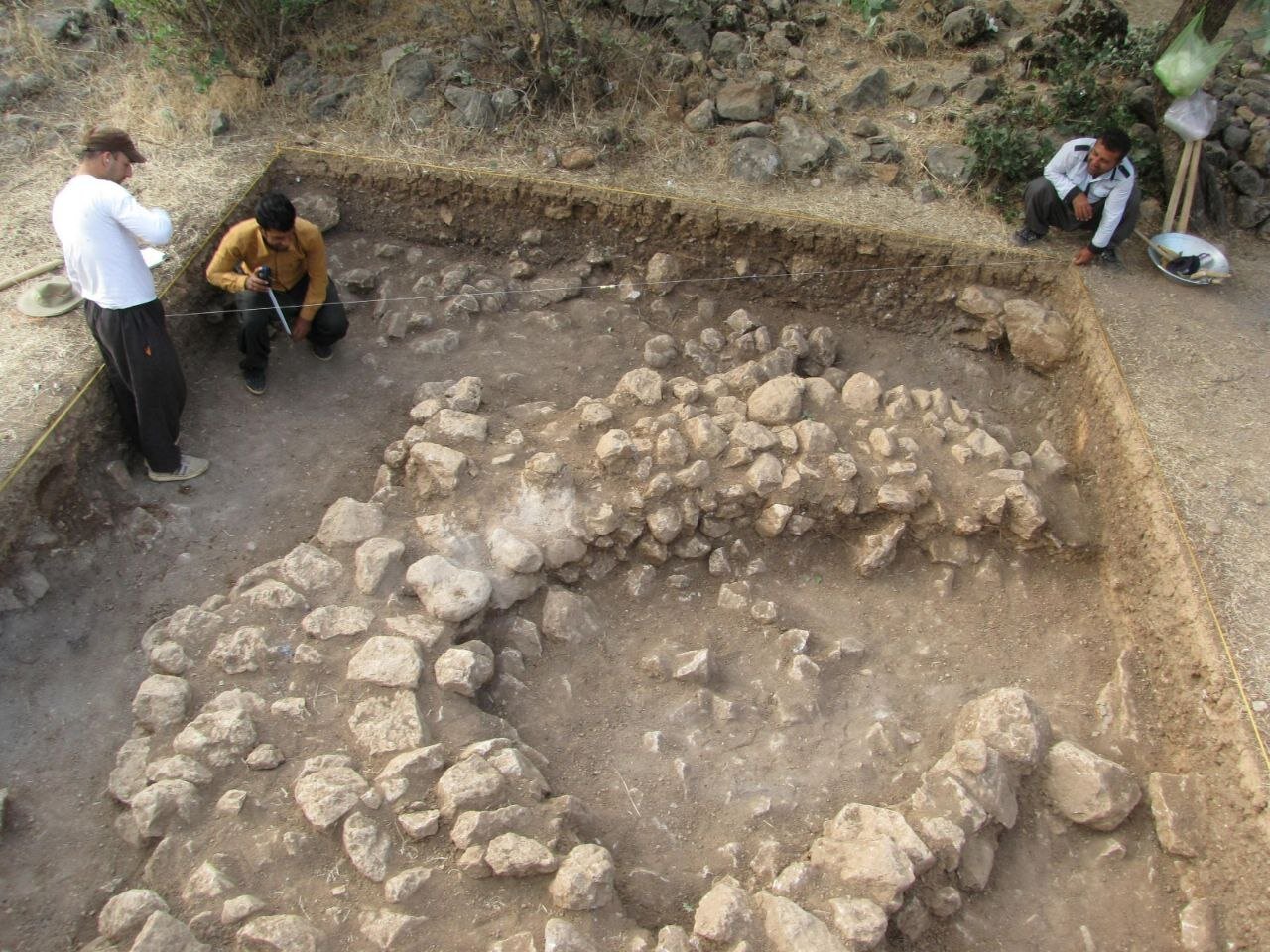
TEHRAN — New discoveries from rescue excavations at the Barde Mar ruins in Iran’s Hauraman region shed new light on the seasonal rhythms of pastoralism during the Islamic period.
The first excavations carried out in 2015, prior to the reclamation of the Dalian Dam reservoir, focused on a site long known to local pastoralists as a hawal (temporary winter encampment). According to a recently published report, archaeologists have found clear evidence that the camp was used during two different periods: the Middle Islamic period (12th-13th century AD) and the Late Islamic period (18th-19th century AD).
Researchers say the discovery provides a rare glimpse into how nomadic pastoral communities organized winter settlements in the rugged highlands of western Iran. Structural artifacts, tools, and household items found at Valde Mar suggest that nomads adapted their shelters and material culture over time while maintaining long-standing traditions tied to transhumance.
Located in the rugged mountains of Kordestan province, the site was characterized by simple circular drystone structures built without the use of mortar. Unlike the permanent villages of the region, which are characterized by rectangular architecture, the buildings of Valde Mar were modest temporary shelters.
“The architectural evidence is clear and convincing,” said Dr. Amir Saeed Muchesi, lead archaeologist on the project at Kordestan University. “Our focus is on seasonal campsites, rather than permanent villages. The seasonal round houses and combinations of houses and huts, built quickly and efficiently using locally available stone, are directly comparable to the Howards used by Hauraman’s modern pastoralists for winter grazing.”

An important line of evidence supporting the site’s functionality came from detailed analysis of animal bones recovered during excavations. Most of the animal herds were carcasses of domesticated sheep, goats, and cattle, indicating that the economy was heavily dependent on pastoralism. The study also identified bones from wild animals such as deer, fox and wild boar.
Dr. Marjane Machecoeur, a leading zooarchaeologist from France’s CNRS who studied the site, said: “The zooarchaeological data clearly show that the subsistence economy of Valde Mar was based on pastoralism. The inhabitants were mainly herding goats, sheep and cattle. These animals were the main source of food and by-products, and this is fully consistent with the interpretation of the site as a seasonal camp for pastoralists.”
Artifacts recovered from the site further support the interpretation that the site was a short-term settlement. The excavations unearthed approximately 4,300 pottery shards, most of which were simple, primarily handmade, and brown in color. The absence of glazed pottery and the limited variety of vessel shapes (primarily small and medium-sized bowls and jars) suggest a minimally owned community, carrying only the items necessary for their seasonal stay.
The age of the site was established using both radiocarbon dating of bone and charcoal samples and thermoluminescence dating of pottery. As a result, the two main phases of occupation were firmly placed in the Seljuk-Ilkhanid period and the post-Safavid to Qajar period.
An important discovery that contributed to its late settlement was a clay tobacco pipe found on the floor of one of the buildings. These artifacts date back to the 18th century and are consistent with historical records of the introduction and popularization of tobacco in the region during the Ottoman period.
Perhaps the most important outcome of this study was the demonstration of cultural continuity. The spatial arrangement, architecture, and pastoral function of the site persisted for centuries during the middle and late Islamic periods and reflect the same pattern of seasonal nomadism practiced in Hauraman today.
Barde Mar’s research is extremely important in that it sheds light on a type of archaeological site that is often overlooked in Iranian archeology, which has traditionally focused on large-scale settlements. Another valuable outcome of this study was the use of ethnoarchaeological data in explaining the functionality of the site.
“This study fills a critical gap in our understanding of the rural economy and land use system in the highlands of western Iran,” explained Dr. Saeed Muchesi. “This shows how an ancient community successfully adapted to a difficult mountain environment through a mobile pastoral lifestyle, a tradition that has shaped Hauraman’s cultural landscape for generations.”
The finds from Barde Mar, now submerged beneath the Darian Dam reservoir, provide a rare record of the enduring relationship between humans and their environment in the Zagros Mountains.
The Barde Mar excavation was part of the wider Darian Dam archaeological salvage program, which was started before the reservoir flooded in 2015-2016. Under the general direction of Mr. Fereydun Biglari, this rescue project led to the discovery and excavation of a number of important sites in the Hauraman region, dating from the Middle Paleolithic period to the present day. Major excavated sites included the Dalai Caves (Middle Paleolithic), Kenache Cave (Late Paleolithic), and Sal Cham (Chalcolithic, Bronze, Iron, and Historic). The program provided an important snapshot of human habitation in this mountainous region, where most of the archaeological sites, including Valde Mar, are now permanently submerged under water.
morning