
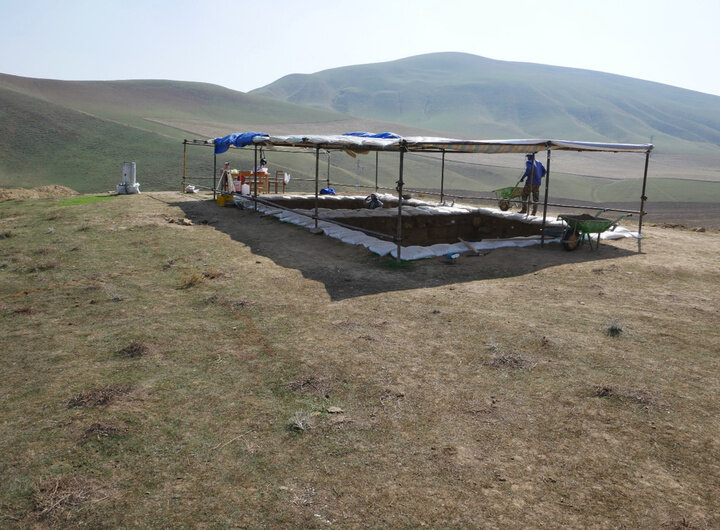
TEHRAN – Excavations are underway at the Keshraq Tapashi site in Ardabil province with the aim of summarizing the Neolithic cultural characteristics of the northwestern region of Iran and presenting the period of these cultures within the framework of Iranian archaeological chronology.
According to Mirash Aliya (CHTN), head of the archaeological team Garder Ebrahimi said that the eastern part of Azarbaijan region is considered as one of the unknown, anonymous and abandoned areas in archeology in the field of archaeological research on prehistoric Iran.
Despite the region’s high environmental capacity and potential, very few studies have failed to adequately explain the region’s prehistoric cultural framework, he added.
He stressed that the excavation of this site began at the same time as the start of archaeological excavations in ancient Susa, as well as the excavations of French archaeologist Jean-Jacques de Morgan, carried out in the unique cemetery of the region, but that the framework of a specific cultural order has not yet been developed in Iranian archeology in this region.
He added that the excavation of the Keshlak Tappashi site is an attempt to fill the gap in research in the area during the Neolithic period.
Ebrahimi said that the site is one of the few Neolithic sites in Ardabil province, adding: “Keshlak Tappachi is a small Neolithic settlement built on a completely natural hill.”
Unfortunately, in recent years, more than half of the site has been completely destroyed by road-building machinery due to the expansion of the Bile Savar transport road, and now only a small portion of the Neolithic settlement in the western corner of the site remains, he added.
Ardabil Governorate, located in northwestern Iran and consisting of 12 districts with a population of 1.28 million people, is considered an important destination for domestic and international tourists due to its natural, historical, religious and economic attractions.
The provincial capital, Ardabil, has been selected as the ECO Tourism Capital of 2023 by the Organization for Economic Cooperation. Situated on a high windswept plateau, Ardabil is well known for its rich natural beauty, hospitable people, and tradition of silk and carpet trade. It is also home to the UNESCO-listed Sheikh Safi al-Din Khanega and the Shrine Ensemble. With its freezing winters and mild summers, it attracts thousands of tourists each year.
KD