
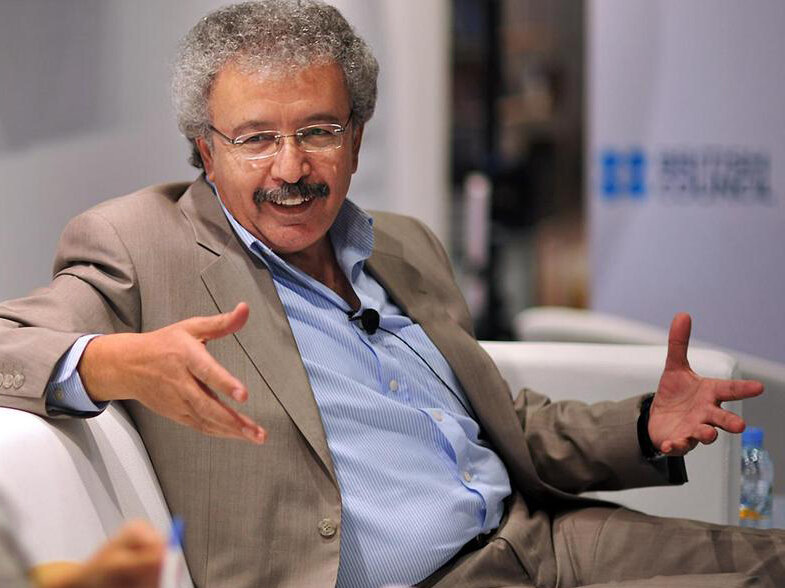
TEHRAN – A Persian translation of Ibrahim Nasrallah’s acclaimed literary work was unveiled in a ceremony dedicated to resistance and Palestine at an important cultural event in Tehran on Monday, drawing new attention to the Palestinian writer’s enormous contributions.
The Persian version of The Eye of Bethlehem, The Shadow of the Key, and The Chariot Under the Christmas Tree, published by Amir Kabir Publishing in Tehran, was released, highlighting the enduring struggle and sacrifice of the Palestinian people and the resilience of the resistance.
Known for his poetic voice and the depth of his stories, Nasrallah stands as a towering figure in contemporary Arabic literature. His work, which cuts across themes of resistance, identity, and history, resonates not only in the Arab world but around the world. The opening of his translated works in Tehran provides a timely opportunity to explore his creative journey, the origins of his famous “Bells Trilogy” and his enduring commitment to depicting Palestinian resilience and multicultural identity.
After the unveiling, Tehran Times conducted an exclusive interview with Nasrallah, in which he reflected on the origins of the Bells Trilogy, a series of interconnected novels inspired by Beit Sahour’s indomitable spirit during the First Intifada. Nasrallah revealed that the idea was born in 1990 during the resistance movement against the Zionist occupation. In particular, the resilience of Beit Sahour’s Christian community inspired him to depict the perseverance of Palestinian Christians. He believes this theme is essential to understanding the broader Palestinian struggle. The trilogy, which includes “Shadows of the Keys,” “The Eye of Bethlehem,” and “A Tank Under the Christmas Tree,” is conceived as a homage to Palestinian Christians and their cultural and resistant contributions.
Nasrallah’s work is characterized by its emphasis on the multifaceted nature of Palestinian identity and resistance. He emphasized that his trilogy aims to highlight an often overlooked side of the Palestinian story, namely the Christian side, and to challenge the simplistic portrayal of Palestinian resistance as merely Muslim. “My research aims to prove that Palestine is a multi-religious state,” he explained. “The struggle is shared and our cultural fabric is enriched by this diversity.”
“A large group of Palestinian Christian writers have played an important role in disseminating Palestinian culture and communicating it to the world, including Emir Habibie, Jabra Ibrahim Jabra, and certainly Edward Said, as well as many others who have made truly significant contributions,” he said, adding: From the beginning to today. ”
He further stated, “The beauty and importance of this trilogy also lies in the fact that it was written by a Muslim writer who respects and takes pride in this role of Christianity.”
Mr. Nasrallah noted the broader implications of his work and emphasized that his literary goal is to promote understanding and solidarity. “The message I want to convey is that Palestinian culture and resistance is a collective effort that transcends religious boundaries,” he said. “The world needs to understand the diversity within Palestine and recognize the unity that underpins our resilience.”
As Persian translations of Nasrallah’s works gain recognition in Iran, his message of resilience and multicultural coexistence resonates strongly in the region. His literary journey, marked by a resolute stance against oppression and a deep appreciation for cultural diversity, continues to inspire readers across borders. Nasrallah’s voice is an important testament to the enduring spirit of Palestine and its people, resonating across geographic and cultural divides and fostering empathy and understanding in an increasingly complex world.
Nasrallah’s own life story, marked by migration, cultural activity, and artistic expression, continues to influence his voice. His childhood in a refugee camp, his experience as a journalist, and his dedication to documenting the history of Palestine through ambitious projects such as an eight-volume series on contemporary Palestinian history give his work authenticity and urgency. His novel The Time of the White Horse (2007), which follows three generations of a Palestinian family through periods of occupation and upheaval, demonstrates his mastery of blending personal narrative and collective history.
Born in Amman in 1954 to Palestinian parents who were displaced in the 1948 Nakba, Ibrahim Nasrallah’s life is deeply intertwined with the Palestinian refugee experience. Raised amidst the hardships of life in the Alwedat refugee camp, Mr. Nasrallah’s childhood was marked by a keen awareness of displacement and cultural survival. His educational journey through UNRWA schools and the UNRWA Teachers Training College laid the foundation for a prolific literary career that now spans over 40 years.
As a poet, novelist, and photographer, Nasrallah has published numerous works. He has 17 collections of poetry, 2 children’s books, and 16 novels translated into several languages, including English, Italian, Danish, and Turkish. His literary pursuits have received international recognition, including the prestigious International Award for Arabic Novel for his novel The Second Dog War and the Jerusalem Prize for Culture and Creativity.
SAB/