
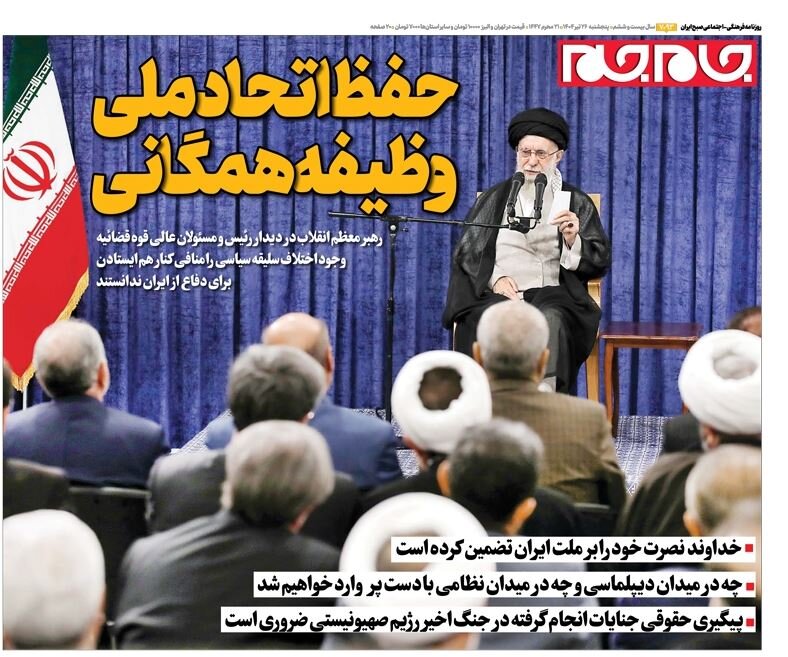
Tehran – In the analysis, Jam-e-Jam worked on Israel’s goals sought at the start of the war with Iran in June.
Israel was pursuing three main goals in its conflict with Iran. It has prevented Iran from gaining nuclear weapons claims, weakening or destroying axis of resistance and loyal forces to Iran in the region, and severely limiting Iran’s ballistic missile programmes. These three goals have been articulated in recent years in Israel’s security doctrine and have been driving decisions to take direct military action against Iran. Due to domestic policy goals, the Zionist government’s cabinet has sought to change the political atmosphere and public opinion in the short term in favor of the government and the government’s political leaders by attacking Iran. In the regional field, by attacking Iran and weakening its position as its main strategic rival, the regime hoped to change the balance of power in the Middle East, leading to a relative improvement in the geopolitical position of the Zionist regime, and form a practical but informal correlation with the Arab Arab clauses against Iran. However, these goals were not achieved, and the international community condemned the attack.
Ettelaat: What happens if the snapback mechanism is activated?
In an interview with senior geopolitics expert Abdolreza Faraji Rad, Ettelaat looked at the results of the activation of snapback mechanisms. He said: It doesn’t hide the fact that snapback mechanisms and their activation are considered good tools for Europeans and Americans to put pressure on Iran. However, the problem is that with the activation of this mechanism, Iran will also be removed from the management of the International Atomic Energy Agency. This means the possibility of increasing regional tensions and conflict. If Iran withdraws from the NPT, the interests of Europeans will also be at risk. If Iran had control of the institution, it would be undesirable for Europeans. Iranians need to enter dialogue with Europeans as soon as possible. Iran must be able to clarify its policies to Europeans, share important issues with China and Russia, and work on the Security Council. China and Russia should not adopt a passive position. We need to talk at the same time with Europe and the US. In addition, direct negotiations must be initiated if necessary. Europe and the US are getting closer every day with their opinions, reducing their differences with Iran, and postponed negotiations are not for our interests.
Etemad: Only Power Provides Guarantee
In an interview with former MP Heshmatra Farahatpissy, Etemad discussed the issue of obtaining guarantees from the United States. He said: In the international field, only power provides guarantees. If Iran had not appeared as the decisive party that won the war with Israel, he would not have even spoken about negotiating with Iran now. Iran took a final blow to Israel in this war, and as the war approached its end, Iran unveiled more devastating weapons. This indicates that the power continues to offer guarantees. The 12-day war (June 13-24) brought lessons. Now, if the Iranian government observes these lessons in managing the operations of the country, it will approach the same elements of guaranteed power. Governments must make every effort to boost morale in the current situation, in terms of software, hardware and military power. The message that these actions will be sent to the US and Israel is that if war begins, Iran will use modern, destructive tools.
Iran: Tehran moves to coordinate policy against Western monopoly policy
In the article, the Iranian newspaper discussed the purpose of Foreign Minister Araguchi’s visit to China, saying: Araguchi’s recent visit to China was in line with strengthening the performance of the Shanghai cooperative organization. In this environment, Iran is trying to win the legal and political support of independent global actors to tackle policies of pressure, sanctions and military threats by utilizing multilateralism and regional alliances such as the Shanghai Cooperation Agency. After the 12-day war, Beijing and Moscow are not only Iran’s economic partners, but also actors with important diplomatic and geopolitical roles in integrating Iran’s legitimacy in the international system. The trip was an attempt to coordinate policies against Western exclusive strategies, giving Iran the opportunity to expand multilateral diplomacy to the Security Council from Central Asia.