
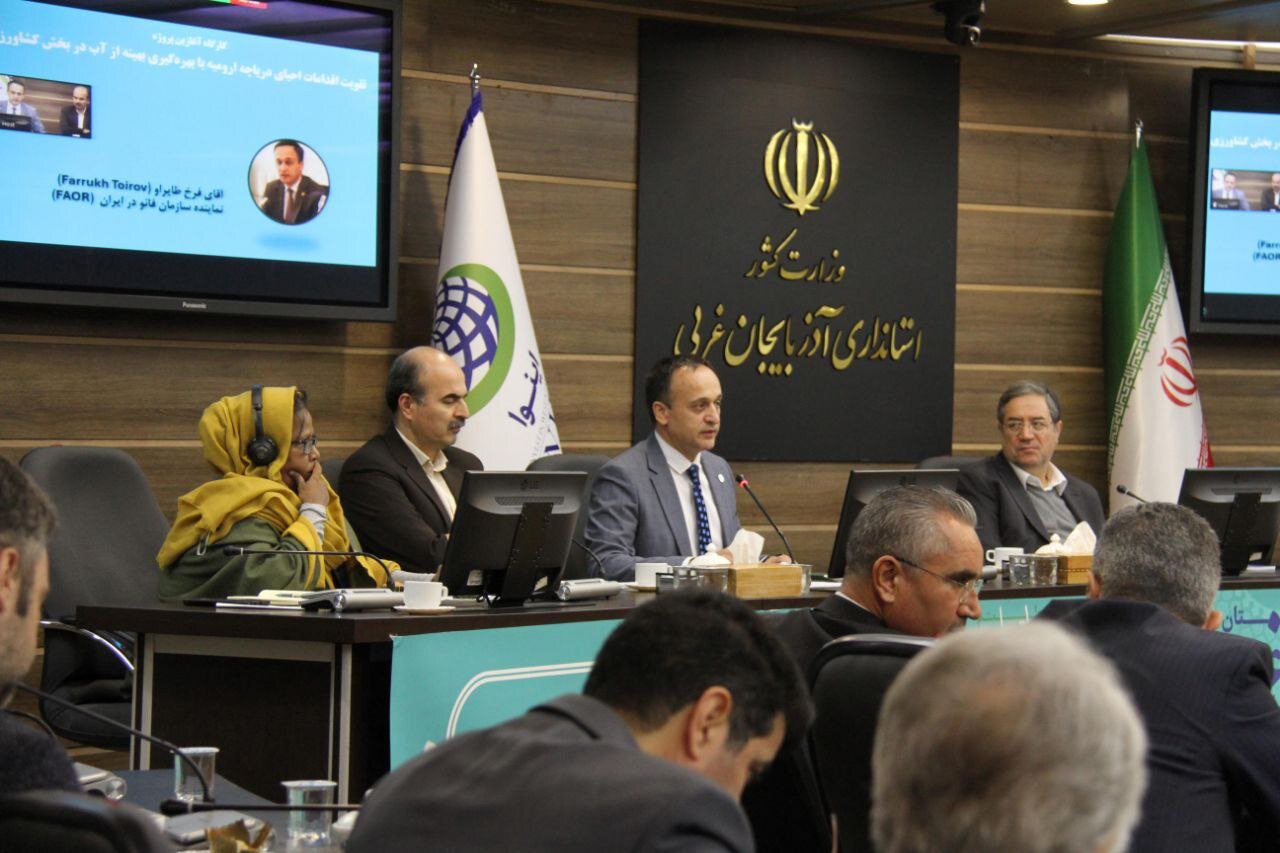
TEHRAN – The Food and Agriculture Organization (FAO), in cooperation with the West Azarbaijan Governorate, held a workshop on the project entitled “Strengthening Lake Urmiyah Restoration Activities through Effective Use of Agricultural Water” to mark the official launch of the second phase of the project.
The project aims to promote sustainable agriculture and support the restoration of Lake Urmia, one of the country’s most important ecosystems.
Speaking at the workshop, Farouk Toirov, FAO Representative to the Islamic Republic of Iran, stressed the importance of cooperation, practical technologies and localized approaches to increase water use efficiency across the Urmiyah Lake Basin, announced in a press release on FAO’s website on 4 December.
“Today’s workshop marks the beginning of a new chapter. We have brought together the most experienced experts to ensure that this project moves forward on a strong foundation, guided by scientific knowledge and grounded in local realities. Your expertise will be essential to ensure we are moving in the right direction from the beginning,” he said.
Building on lessons learned from previous interventions, he noted that agriculture is a complex sector with diverse agroecological conditions, requiring tailored solutions. Toilov emphasized that farmers need simple, effective and user-friendly technology – tools that can be used without high technical expertise.
He also pointed to disparities in farm size and financial capacity, noting that while large-scale farmers may be able to install sophisticated irrigation systems, many small and medium-sized farmers cannot. Therefore, we emphasized the need for accessible, affordable and scalable solutions. “Our program must ensure that modern irrigation systems are simplified and available to all farmers. Achieving this will require the joint efforts of government agencies, research centres, the private sector and international partners.”
The FAO representative reaffirmed FAO’s commitment to work closely with national counterparts and local experts throughout the implementation of the project. “During my time in Iran, I witnessed remarkable scientific progress and strong organizational capabilities,” he said.
Mr. Toilov concluded by expressing his gratitude to domestic and international partners. “I would like to sincerely thank the West Azerbaijan Oblast, all the participants here today, and the Japanese government for generously funding this project. We look forward to continuing to work together to support the region’s farmers and contribute to the recovery of Lake Urmia.”
In October, with financial support from the Japanese government, the United Nations FAO and the United Nations Development Program (UNDP) signed a cooperation document aimed at supporting the restoration of Urmia Lake in northwest Iran, which is drying up.
The signing ceremony took place during President Massoud Pezeshkian’s visit to West Azarbaijan, the FAO website announced in a press release on October 23.
The document was signed by Reza Rahmani, Secretary of the National Committee for the Rescue of Urmiyah Lake, and Ali Nazaridoust, FAO Representative to the Islamic Republic of Iran.
The Urmiyah Lake Basin plays an important role in ensuring food security and agricultural productivity in Iran. However, in recent years, the basin’s water resources have decreased significantly due to rising temperatures, changing precipitation patterns, and unsustainable water use.
Recognizing the urgency of these challenges, FAO is implementing this project to promote integrated water resource management and climate-smart agricultural practices across the basin.
The Urmia Lake portion of the project will be implemented jointly by FAO and the Urmia Lake Rescue National Committee (ULRNC). The aim is to scale up and operationalize agricultural water efficiency and productivity improvements to protect livelihoods and reduce pressure on water resources.
The project will help farmers and rural communities become more resilient to water scarcity, while contributing to restoring the lake’s ecological balance through capacity building, introducing efficient irrigation techniques, and promoting sustainable farming practices.
This project represents a strong example of collaboration between the Government of the Islamic Republic of Iran, FAO, UNDP and the Government of Japan in supporting national efforts towards sustainable agriculture, water management and environmental conservation.