
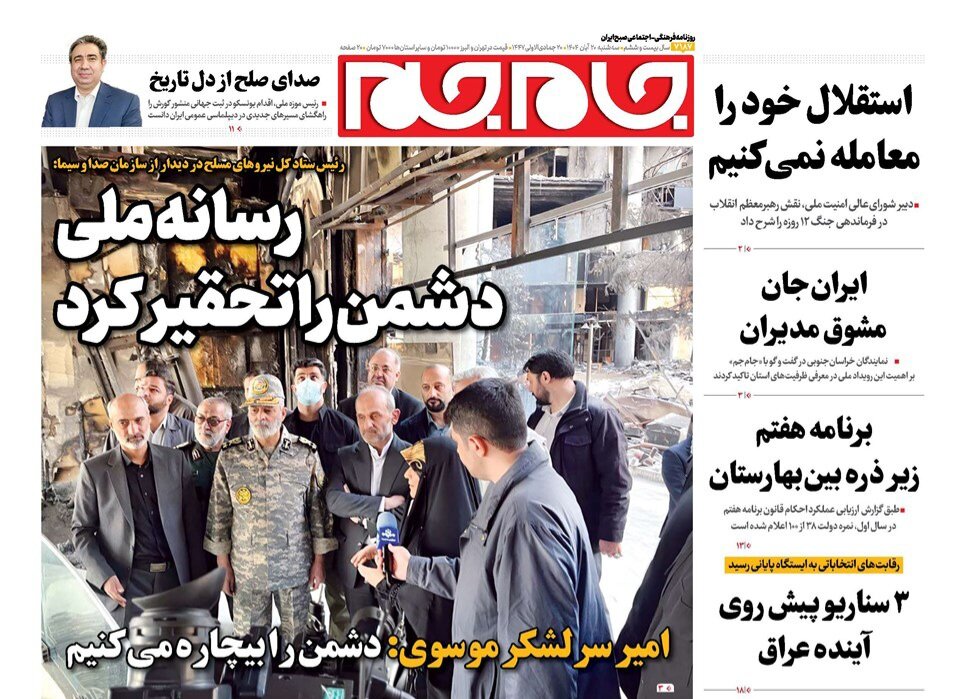
TEHRAN – In an article, Jam-e-Jam highlighted the Financial Action Task Force (FATF)’s double-standard approach towards Iran.
Although Western countries present the FATF as a neutral body, they do not hide its blatant double standards. Even if all Western sanctions were lifted, Iran would remain on the institute’s blacklist. The decision announced at the end of the FATF meeting in Paris confirmed this reality. Despite Iran’s ratification of the Convention against Transnational Organized Crime (Palermo) and the Convention for the Suppression of the Financing of Terrorism (CFT), the country remains classified as a high-risk jurisdiction. Meanwhile, the institute removed four African countries from its gray list. This flexibility never applies to Iran. These double standards, formed by US influence, have turned the FATF into a completely ideological and political tool. Ten years of experience shows that it continues to blacklist Iran while promising to suspend countermeasures in exchange for progress. This latest decision serves as a warning to domestic factions that still want to make concessions to the West. The article argues that joining the body would sacrifice Iran’s economic independence and undermine its legitimate foreign policies, such as support for the Axis of Resistance.
Sharg: Tehran needs to engage quickly and seriously with its eastern neighbor
Mr. Sharq suggested that given the failure of peace talks between eastern neighbors Afghanistan and Pakistan, there is an urgent need for Iran to play an active role in preventing the emergence of a crisis. “Following the failure of Istanbul negotiations between Afghanistan and Pakistan, the need for Iranian involvement in the eastern border crisis has become more urgent than ever,” the newspaper claimed. Direct threats to Iran’s border security are increasing as tensions between Iran’s eastern neighbors continue and conflict could flare up again. If negotiations between Afghanistan and Pakistan remain stalled, Iran’s national security could be rapidly jeopardized and instability could spread beyond its borders. Given its geopolitical position and balanced relationship with both sides, Iran is well-positioned to act as a pragmatic and active mediator. In the short term, Iranian mediation could prevent another war between the two countries. In the long term, it could enhance Tehran’s diplomatic standing in South Asia’s regional dynamics. Ultimately, Iran’s success as a mediator depends on thorough coordination between security, diplomatic, and regional institutions. With renewed conflict likely, Iran must act quickly and decisively to protect its national security, eastern borders, and vital interests.
Batan-e-Emruz: President Trump’s defeat in the oil war
In his commentary, Batan-e-Emroos evaluates Donald Trump’s “maximum pressure” strategy against Iran. “President Trump’s oil war against Iran has not only failed to achieve its objectives, it has been a complete strategic defeat,” the paper said. This failure, the article argues, is due to factors beyond the mere ineffectiveness of sanctions. Mr. Trump operated under the banner of classical economics and dependence on Iranian oil revenues, but failed to account for the emergence of new global players and changing dynamics. Iran’s strategy to neutralize sanctions, coupled with the entry of China into the equation as a key actor, upended President Trump’s calculations. China’s move to diversify its energy sources and Iran’s strategic role in Beijing’s efforts have allowed Iran to avoid sanctions and maintain a source of oil revenue. The article suggests that this result shows that in today’s multipolar world, a single great power like the United States cannot single-handedly isolate a country economically, especially when a major power like China pursues interests that run counter to U.S. policy. Ultimately, President Trump’s failure in the oil war against Iran is more than just a political setback. It signals a shift in the global balance of power and the emergence of a new order in which unilateral strategies are no longer as effective as they once were.
Armand-e-Meli: Tehran and Washington in diplomatic stalemate
Arman e-Meri examines the current state of relations between Iran and the United States after the 12-day war orchestrated by President Donald Trump. “Relations have once again reached a critical juncture, characterized by stagnation and low expectations for direct dialogue,” the magazine wrote. The article emphasizes that Iran’s current economic reality cannot sustain the status quo. Widespread financial and oil sanctions, a sharp decline in foreign investment, and banking restrictions are putting enormous pressure on Iran’s economy and affecting the lives of its people. In this context, restoring diplomatic channels and lifting some sanctions could play an important role in improving the economic situation and stabilizing the country. However, deep mistrust between Iran and the United States, conflicting demands, and the complexity of the nuclear documentation are preventing meaningful progress in negotiations. The article argues that breaking the diplomatic impasse is an inevitable need not only to restore Iran’s international engagement, but also to ease economic pressure and restore stability to its foreign policy.