
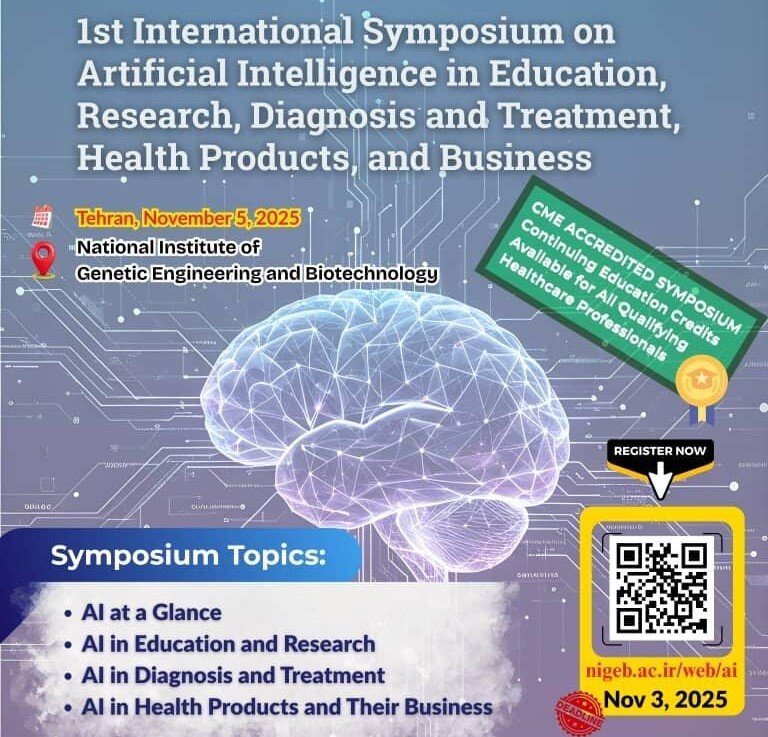
TEHRAN – The National Institute of Genetic Engineering and Biotechnology in Tehran will host the first international artificial intelligence (AI) symposium on education, research, diagnosis, treatment and production in the health sector.
IRNA reports that the event will be held on November 5th, focusing on the role of AI in education and research, AI in diagnosis and treatment, and the role of AI in health products and business.
Currently, the most common roles for AI in healthcare settings are clinical decision support and image analysis.
Clinical decision support tools that provide quick access to information and research relevant to each patient can help healthcare providers make decisions about treatments, medications, mental health, and other needs.
Medical imaging uses AI to analyze CT scans, X-rays, MRIs, as well as images for lesions and other findings that may go unnoticed by human radiologists.
Other applications of AI in the health sector include disease diagnosis, personalized treatment, efficiency in clinical trials, and the rapid growth of the pharmaceutical sector.
AI is essential to combat disease
In August, Health Minister Mohammad Reza Zafarkandi highlighted the importance of AI, telemedicine and mobile health in managing non-communicable diseases (NCDs).
IRNA quoted Zafarkandi as saying that developing smart health systems and raising public awareness through preventive education and promoting health literacy are key points for the future of the health system. He added that as the introduction of modern technology is inevitable, these tools can be used to reduce costs and ease access to services.
The official made the remarks while addressing the first meeting of the National Committee for the Prevention and Control of NCDs.
In January, the Office of the Vice President for Science and Technology and Tehran University of Medical Sciences signed a memorandum of understanding on the use of artificial intelligence for medical purposes.
The agreement, signed on January 11, aims to foster targeted support for a knowledge-based ecosystem in the health sector, focusing on innovations in omics and genomics research, cell therapies in endocrinology and metabolism, person-centered medicine using artificial intelligence tools for prevention, prediction, diagnosis and treatment, and finally the commercialization of products and services, ISNA reported.
Statistics show that the use of artificial intelligence in healthcare in developed countries has resulted in significant cost savings of around 40%. In certain cases, such as breast and lung cancer, artificial intelligence could reduce healthcare costs by 80%. Therefore, a knowledge-based economy should aim to leverage AI to save on healthcare costs, IRIB quoted Mostafa Karney, Secretary of the Headquarters for Biological Development, as saying.
MT/MG