
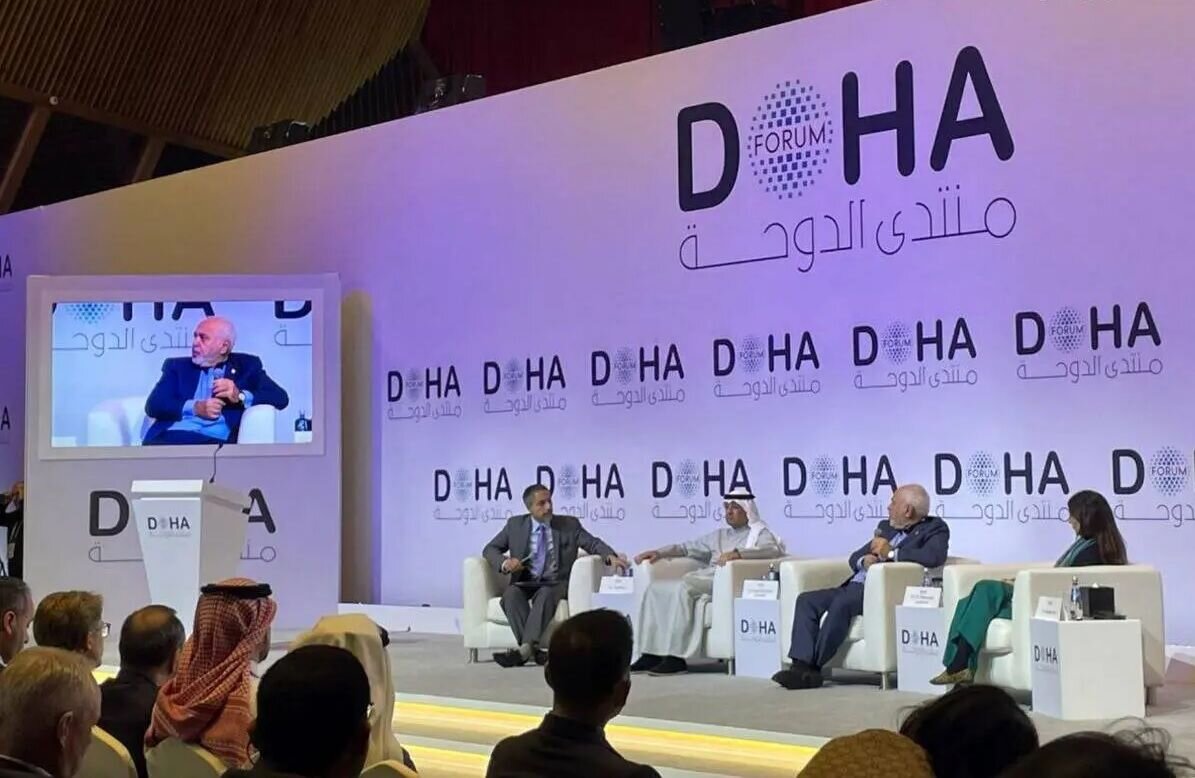
TEHRAN – Iran’s former foreign minister Mohammad Javad Zarif said Saturday that Iran faces significant challenges this year but the country “will remain resilient.”
Foreign Minister Zarif made the remarks during the panel “Iran and the Changing Regional Security Environment” at the 2025 Doha Forum.
At the outset, Foreign Minister Zarif pointed out that Iran was going through difficult times. “There have been many ups and downs in Iran, but today is by no means one of the ‘ups and downs,'” he said. “Iran has been weathering storms for almost 7,000 years. It has been attacked and occupied, but it has never collapsed. We are still standing and will continue to stand.”
Zarif rejected claims that Iran had become “weakened” and maintained that Iran’s military and security capabilities in the region remain unparalleled. He said that after the attack on Iran’s nuclear facilities by the United States and Israel, the Iranian government had shown the ability to “inflict significant damage to Israel.”
He further said that the withdrawal of U.S. military bases prior to a U.S. attack on Iran is itself evidence of Iran’s deterrent capabilities.
He added that it is “in everyone’s interest” to recognize this reality and begin working with Iran.
Zarif said Iran had returned to its long-standing strategy of “resistance to the United States” after a brief engagement under the 2015 nuclear deal (JCPOA), which US President Donald Trump abandoned in 2018.
“We have gone back to a resistance strategy, a strategy that we know well and that works well,” he said. “This may not be the strategy I would ideally prescribe for Iran, but it is by no means a strategy in which we are weak. We know how to resist. The two-year JCPOA was an exception, not a resistance.”
Zarif said the main threat to regional security was Israel, not Iran, and accused it of having expansionist ambitions. “This is a disease in our region: a regime that considers itself above the law, above international law, above humanitarian norms,” he said.
He expressed hope for improved relations between Iran and Arab countries and asserted that regional cooperation will benefit both sides. He said Iran has paid a heavy price for supporting Palestine and has historically provided more aid to Arab countries than other countries. “Our friends in the region have nothing to gain and nothing to lose by cooperating with Iran,” he added, stressing that Iran has no territorial claims against its neighbors.
In another panel discussion at the Doha Forum, Saeed Khatibzadeh, Director of the Institute of Political and International Studies (IPIS), highlighted the changing landscape of international politics. Speaking at the session “US-China Relations: Managing Opportunities and Risks in a Changing World Order,” he said the era of unilateral hegemony is “over.”
“No country can ignore China,” he said, calling this not just a view of the Global South but “a deep-seated reality in mainstream international politics.” He argued that the world was moving from an order established by law to one increasingly shaped by power.
Mr. Khatibzadeh also pointed to China’s mediation in the Iran-Saudi Arabia deal and China’s growing role in West Asia as evidence of China’s constructive influence in international affairs.
The 23rd Doha Forum was held in Qatar from December 6th to 7th, 2025. The annual meeting brought together current and former world leaders, policymakers, and experts to discuss key regional and global challenges, including security, economic issues, and technological innovation.