
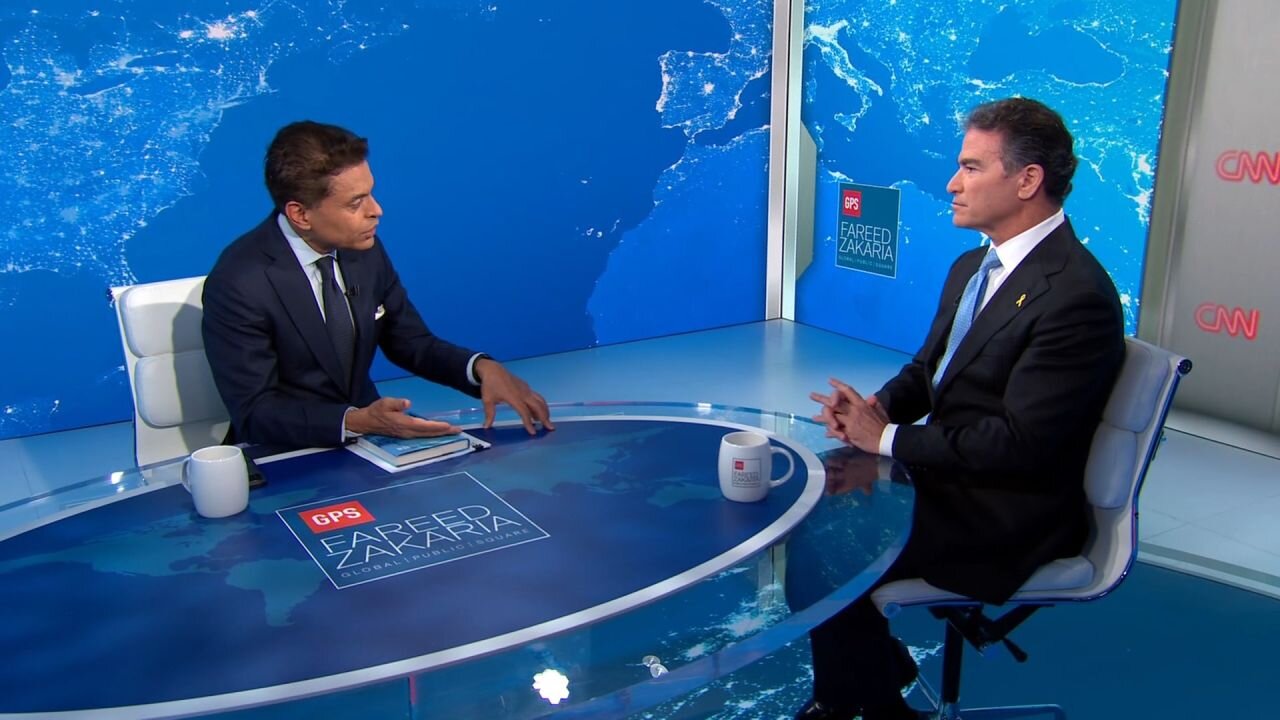
MADRID – A few days ago, CNN International aired an interview between Fareed Zakaria, one of the most prominent voices in the US geopolitical landscape, and Yossi Cohen, former director of the Mossad, Israeli intelligence agency. The question Zakaria has brought to guests – “Will the Islamic Republic of Iran exist in ten years?” – goes beyond mere speculation about the future of the country.
More than analysis, it has a prediction of desire: the expectations shared by Israel and the Western power sector should be that the political order born in 1979 will disappear from the international stage.
This article examines the political and symbolic density of that question, reflecting Israel’s explicit desire to witness the disappearance of Israel’s political system and the implicit accomplices of Western media that present that desire as an objective analysis. Without relying on demagogury or propaganda, we consider the limitations and meaning of such framing, the locations that Iran occupy in the regional and global political imagination, and the instrumental role of major media platforms in transforming normative expectations into seemingly neutral diagnoses.
Questions you try to command so you don’t understand
Zacharias’ formulation should not be interpreted simply as geopolitical curiosity. In practice, it establishes a normative framework. Rather than exploring the “will it exist?” trend, it justifies hope that Iran will disappear in its current political structure. Therefore, this issue not only defines the horizon of possibilities, but also imposes implicit political mandate.
It is no coincidence that this kind of question is repeated in interviews between Western journalists and people in the establishment of Israel. Far from reflecting analytical neutrality, they reveal the personality of the encounter performance. Political desires are created and justified, but counterpoints and spaces for different interpretations are neutralised.
Cohen’s response – “My prediction: It does not exist” – explains its obligation. The disappearance of the Islamic Republic is presented as an explicit purpose and is a declaration of intent more than mere prediction. Israel is not only analyzing, but also projecting and working actively for its results.
The desire to see the Islamic Republic disappear is at the heart of Israel’s recent political history. The construction of Iran as an existential enemy permeates official discourse, security strategies and media expression. Iran is an absolute antagonist. This is a reference point that will legalize and give meaning to future-projected conflict policies.
This desire is not merely expressed in media discourse. It has supported closure operations, international lobbying, and regional initiatives of containment and pressure. Media questions are both echoing and expanding the desire. It does not ask, predict and strengthen the architecture of oppressive politics. The accomplice between the interviewer and the interviewer is not coincidental, but structural. It normalizes the “End of Iran” fantasy as a framework for the possibility of replicating, amplifying and organizing international media.
This mission is not innocent. It lays the basis for acceptance and justification of political action, which are military, economic and diplomatic, by eroding Iran under the idea that its loss disappearance is a “natural”, “desirable”, “inevitable” variant.
Western Media: From Description to Normative Framing
Here we uncover the ambiguous but important role of Western media. CNN and Zakaria wield the weight of analytical reliability – reinforce the most fundamental expression of Israeli desire, and perhaps unconsciously contributing to transforming interviews into acts of political appeal. Rather than interpreting context, tension, or spaces of negotiation, questions set themselves up as seeking confirmation of expectations rather than understanding historical processes.
In this sense, international journalism acts not as observers, but as active builders of norms. Enemy survival is presented as an abnormality rather than a geopolitical complex phenomenon. Thus, the only “realistic” future in the dominant media imagination is vanishing. Simply rephrasing this possibility repeatedly will begin normalizing the idea as legitimate and desirable in regional and global terms.
This journalistic approach highlights how the political desires of fact and multiple analyses form the replacement of multiple perspectives with evidence that underpins international public opinion and serious assessments of the region’s future.
Iran and the resilience of facts
In response to the flow of international normative desires, the reality of the Islamic Republic shows a steady tenacity and a prominent capacity for reorganization. Since the revolution in 1979, Iran has endured massive sanctions, secret operations, sabotages and international lockdowns, adapting to many economic and political crises without losing its essential structure.
Far from anecdote, this reflects the strength of political projects that revolutionary professions have been updated accurately through resistance to adversity and strategic management. For decades, predictions of “inevitable collapse” have been circulating in international media, but Iran has transformed its periphery into legitimacy and strength, building social and institutional resilience that can maintain an autonomous vision under external pressure.
Rather than sticking to “threats,” countries mobilize internal and local resources to navigate the challenges and maintain political and cultural continuity that disrupts critics. This resilience capacity, as confirmed by multiple experts, shows that its lost media and diplomatic fantasy is far more likely in discourse than it actually is.
The issue of Iran’s survival embodies, on the other side, the logic of exclusion and justification for external intervention. Presenting the transformation or restraint of sovereign states serves as desirable within the legal framework of the neocolonies, although other states are invited to survive, but other states must accept a denunciation or forced reconstruction.
This trend is reinforced by Western press, where political actors deemed “disobedient” are automatically placed under doubt, and their continuity is relied on the granting or revocation of international legitimacy. The Iranian case clearly shows how the Western media and political framework assume that “normality” requires a state’s loss of failure rather than coexistence, adaptation, or redefinition at the global stage.
At this point, journalism should restore critical capabilities and question not only the validity of desire, but also its political and ethical justification.
Beyond desire: Geopolitical pluralism and the limits of prediction
Iran’s resistance to external erosion should be understood as part of a broader process of geopolitical pluralization in the region. Despite Israel and Western pressure, Iran has established, maintained and expanded its network of influence and cooperation in Lebanon, Syria, Iraq, Yemen and others. The ability to build alliances and negotiate intertwined interests shows singular adaptability, and its survival exposes a lack of normative frameworks that seek its extinction.
Contrary to the predictive obligations of Israel’s political desires, expressed in media questions – reality presents a political architecture in which states resist, negotiate and reinvent the will of their enemies. The 21st century shows that multiple poles and actors challenge the design of a single force. In this sense, the question of Iran’s existence over the decade is less of an analytical window than the repetition of desires and exclusive politics that govern the international narrative.
In a rigorous analysis, international journalism must go beyond merely reenactment of the desires and expectations of dominant actors. Iran’s future must be explored in sociopolitical, structural and cultural complexity, taking into account internal challenges, external legitimacy, and regional aspirations.
Zacharias’s questions and Cohen’s responses show a tendency to turn political narratives into normative obligations, and journalism becomes a conduit of strategic desires. This logic is problematic, normalizes exclusive thinking, promotes the justification of interventions and pressure campaigns, and results in millions of outcomes.
The future is built in a space of multiple, negotiation and political imagination. Turning a question into obligation closes that horizon and returns to the death of desire.
The interviews with Fareed Zakaria and Yossi Cohen are more than exploring the future of Iran, setting the limits of separating political desires from geopolitical reality. The survival of the Islamic Republic does not depend on the will of its enemy or the duty of the media, but on its resilience, adaptability, and legitimacy in facing internal and external challenges.
This media scene confirms that major Western outlets often align more integrity with local authority figures and their transformative ambitions than harsh criticism. The challenge for the future is to develop analyses that acknowledge desires without being confused with diagnosis. It probes contradictions without turning them into doctrine. And it treats politics as a process, not the fulfillment of fantasies.
Iran’s future is shaped by the complex interactions of history, power, sovereignty and resistance. True journalism must provide space to open the door to the coexistence of understanding and possibilities, rather than reinforcing exclusive obligations.