
BEIRUT – Since its founding, Israel has relied on its physical and ideological walls as a central pillar of its security principles. The project itself was born out of a logic of “preventive isolation” to fortify settlements against an Arab environment portrayed in Zionist discourse as inherently “hostile.”
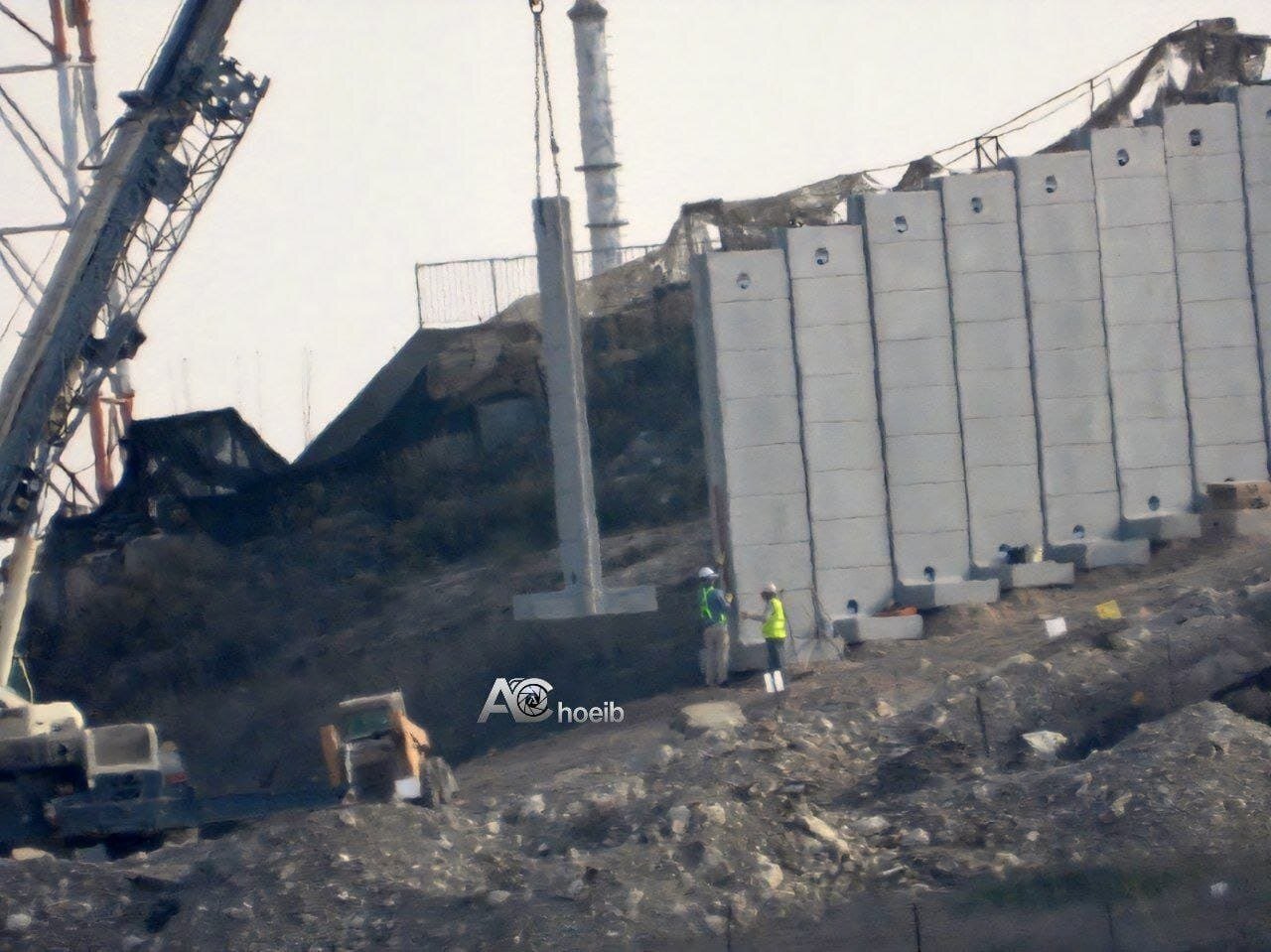
This deep-rooted paranoia has led to generations of barriers, from the enclosure around Gaza, to the apartheid wall in the West Bank, to the giant concrete blocks that Israel is currently building along the Lebanese border, particularly on the other side of the Plain of Yarn. There, it wants to create a “secure border” to protect its northern frontier from resistance forces (Hezbollah).
But none of this is new. It is simply a repeat of decades of failed strategies built on the false promise of “absolute security,” a concept the Israeli military has touted since its creation.
A history of retreating behind barriers
Since the 1950s, Israel has surrounded its borders with Lebanon, Syria, Gaza and Egypt with barbed wire, minefields and fences. However, the 1973 war and subsequent growing Palestinian resistance in southern Lebanon exposed the fragility of these so-called “protected borders.”
Each time a new barrier appeared, a new form of resistance emerged to transcend it.
The apartheid wall, built in the West Bank in 2002 after the Second Intifada, was presented as a shield against “Palestinian terrorism.” In reality, it isolated Israel from the world.
In 2004, the International Court of Justice declared the wall illegal and a violation of Palestinians’ rights to land, movement, and life. The wall, which is more than 700 kilometers long, has failed to stop resistance, including attacks from the occupied territories themselves.
In Gaza, Israel has built subway walls equipped with electronic sensors designed to detect tunnels. But the wars of 2021 and 2023 have proven its limits, proving that resistance fighters can use simple tools to break through the limits and that no technological barrier can overcome the will that drives people to fight for freedom.
wall across palestine
Now, Israel has extended this isolation structure to the Lebanese-Syrian border.
The most impressive example is the huge barrier that rises on the opposite side of the Yaroun Plain, reaching up to 9 meters in height and part of a defensive network that stretches from Nakoula to Al-Adaiseh. Israel says the wall is aimed at preventing “Hezbollah infiltration” amid rising tensions in the north.
But behind this story lies a deeper truth. It is a security principle so insecure that it considers every hilltop, stone, orchard, and village in southern Lebanon, including Yaroun, an existential threat.
Historically, Israel has never been successful in defending its northern border.
From its invasion in 1982 until its withdrawal in 2000, the Lebanese resistance forces repeatedly penetrated and destroyed Israeli fortifications, from iron gates to electronic surveillance systems.
Today, Israel is pouring ready-mixed concrete on the other side of Yaloun, but it is only reviving old delusions. Concrete can replace justice, and the danger comes from outside rather than from the nature of the occupation itself.
between the wall and the sky
Politically speaking, Israel’s wall symbolizes the failure of the “regional integration” project promoted by Western countries through normalization agreements.
Israel claims to belong to the “New Middle East,” but in reality it has retreated further inward, isolated behind barricades.
These walls provide no safety. They deepened Israel’s psychological and political siege and strengthened its identity as a terrorized settler.
Environmentally, these projects have devastated Palestinian and Lebanese farmland, divided communities, and deprived them of water resources.
This wall is a monument not only to separation but also to the slow erosion of the place. Especially in the face of villages like Yaloun, Israel is trying to transform its geography into a buffer zone of insecurity.
And now, as Israel builds a state-of-the-art barrier on the edge of Yaloun, it is unwittingly building another monument to its failure to understand the logic of history. People under siege do not disappear; they adapt, endure, and resist.
Every wall that Israel builds becomes a mirror of its own vulnerability and a new source of strength for those who oppose it.