
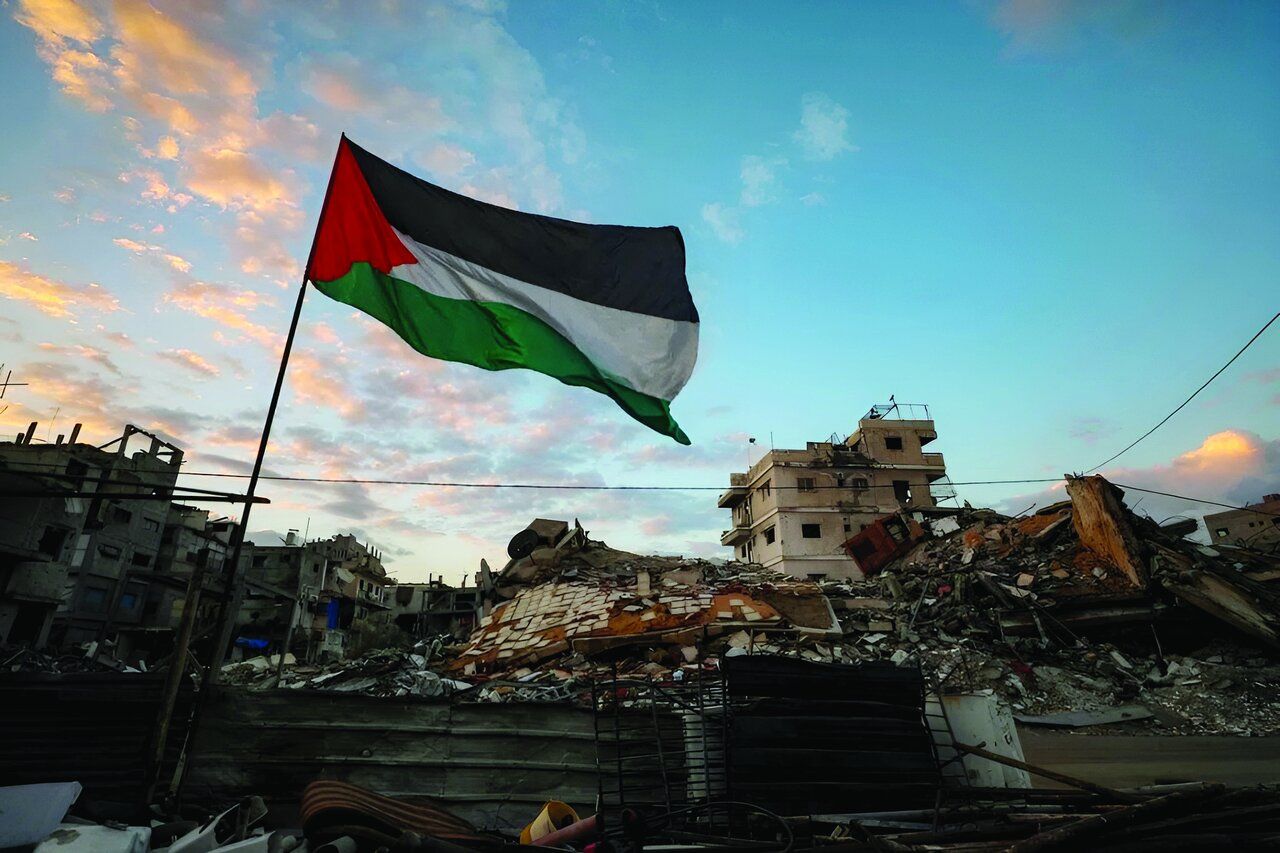
TEHRAN – The United Nations Security Council has approved a U.S.-drafted resolution on Gaza that was hailed as a diplomatic breakthrough in Washington. But for Palestinians and many others around the world, this is yet another failed plan, one that prioritizes police over justice and control over freedom.
On Monday, the board voted 13-0 in favor, with Russia and China abstaining. Their abstention was significant, and Russia warned that the resolution must not become a “death sentence for the two-state solution.” At the same time, China claimed that Palestinian sovereignty and property rights were “almost invisible” in the text.
Both sides criticized the minimal role of the UN and the lack of genuine Palestinian participation, exposing the legitimacy gap at the heart of the plan.
The resolution is part of President Donald Trump’s 20-point plan for Gaza. President Trump celebrated the vote and declared that he would chair a new “peace commission.” His central role highlights how this resolution is designed to advance U.S. political interests.
Meanwhile, the humanitarian crisis continues. More than 69,000 Palestinians have been killed since Israel began the war in Gaza on October 7, 2023. Despite a ceasefire announced on October 10, Israel has repeatedly violated the ceasefire, including with deadly attacks and limited aid. For many Palestinians, the ceasefire and resolution are not a means of peace but a cover for Israel and the United States to normalize relations with Arab countries and distract from what rights groups describe as a massacre in Gaza.
Hamas rejected the resolution outright, calling it an attempt to impose international guardianship on Gaza and strip stabilizing forces of their neutrality. The group argues that sending foreign troops to disarm resistance movements makes them support the occupation and become a party to the conflict.
Although this resolution is presented as a path to peace, in reality it is fraught with flaws that make it inefficient and unfair. Each of these flaws undermines Palestinian rights, weakens international legitimacy, and perpetuates the occupation rather than ending it. Ten different issues stand out.
Israel’s blatant rejection of Palestinian statehood: The resolution speaks of a “credible path” to statehood, but the Israeli leadership has already closed that door. Prime Minister Netanyahu and ministers from around the world have vowed that there will be no Palestinian state, and some deny the existence of Palestinians altogether. This collective rejection turns the resolution’s promises into empty rhetoric before they even begin.
Statehood has been reduced to a vague and conditional promise: even without Israeli opposition, the resolution itself offers only symbolic language. Sovereignty is tied to benchmarks for Palestinian Authority reform and redevelopment, with no timeline or guarantees. This makes self-determination a distant possibility rather than an inherent right.
The Palestinian Authority lacks credibility: The resolution envisages that the Palestinian Authority will ultimately be in charge of Gaza. However, the PA is widely distrusted among Palestinians due to corruption, incompetence, and complicity in the occupation. Leaving Gaza’s future in the hands of such groups risks undermining legitimacy and deepening divisions.
Peace commissions lack definition and accountability: The transitional authority has broad powers for governance, reconstruction, and security, but its membership and accountability are undefined. Palestinians have no say in who governs them, and a foreign trusteeship has been created that deprives them of agency and representation.
The United Nations is removed from oversight: By minimizing the role of the United Nations, this resolution eliminates neutral accountability. Russia and China abstained precisely because the United Nations has been marginalized, leaving the Palestinians exposed to unilateral rule. Without a strong UN presence, oversight is weak and trust is undermined.
Abstentions expose legitimacy gap: Russia and China’s abstentions weaken the authority of resolutions. Without a full agreement, countries asked to contribute troops and resources may hesitate and implementation may be undermined. The lack of unanimity indicates that the plan is seen as serving US and Israeli interests rather than embodying a truly multilateral approach.
Stabilization Forces Empowered, No Protection: The International Stability Force (ISF) has been authorized to use “all necessary means” to demilitarize Gaza, but it does not guarantee protection from Israeli attack. This is why Hamas has threatened to renounce its neutrality and become a party to the conflict. Instead of protecting civilians, the military risks tightening its control.
No mechanism to restrain Israel: Israel has repeatedly violated the ceasefire since October 10, and the resolution provides no enforcement tools to stop the attacks or hold Israel accountable. Without deterrence, civilians remain at risk and ceasefires lack credibility.
Humanitarian crisis ignored: The resolution prioritizes policing and demilitarization over urgent humanitarian needs. With tens of thousands of Palestinians killed and aid limited, the developments deepen suffering and demonstrate that security interests outweigh human rights.
Conditionality undermines sovereignty: Progress is tied to external benchmarks: PA reforms, redevelopment milestones, and international recognition. This externalizes Palestinian rights and turns self-determination into a conditional reward rather than an inalienable right.
In summary, this resolution functions more as a political tool than a peace initiative, allowing powerful states to claim progress while leaving core injustices unaddressed. Unless future efforts center Palestinian ownership, accountability, and enforceable protection, Gaza will remain trapped in cycles of domination and crisis. What was celebrated as a milestone abroad was another reminder for Palestinians of how injustice can be perpetuated when the international system refuses to confront the realities of occupation.