
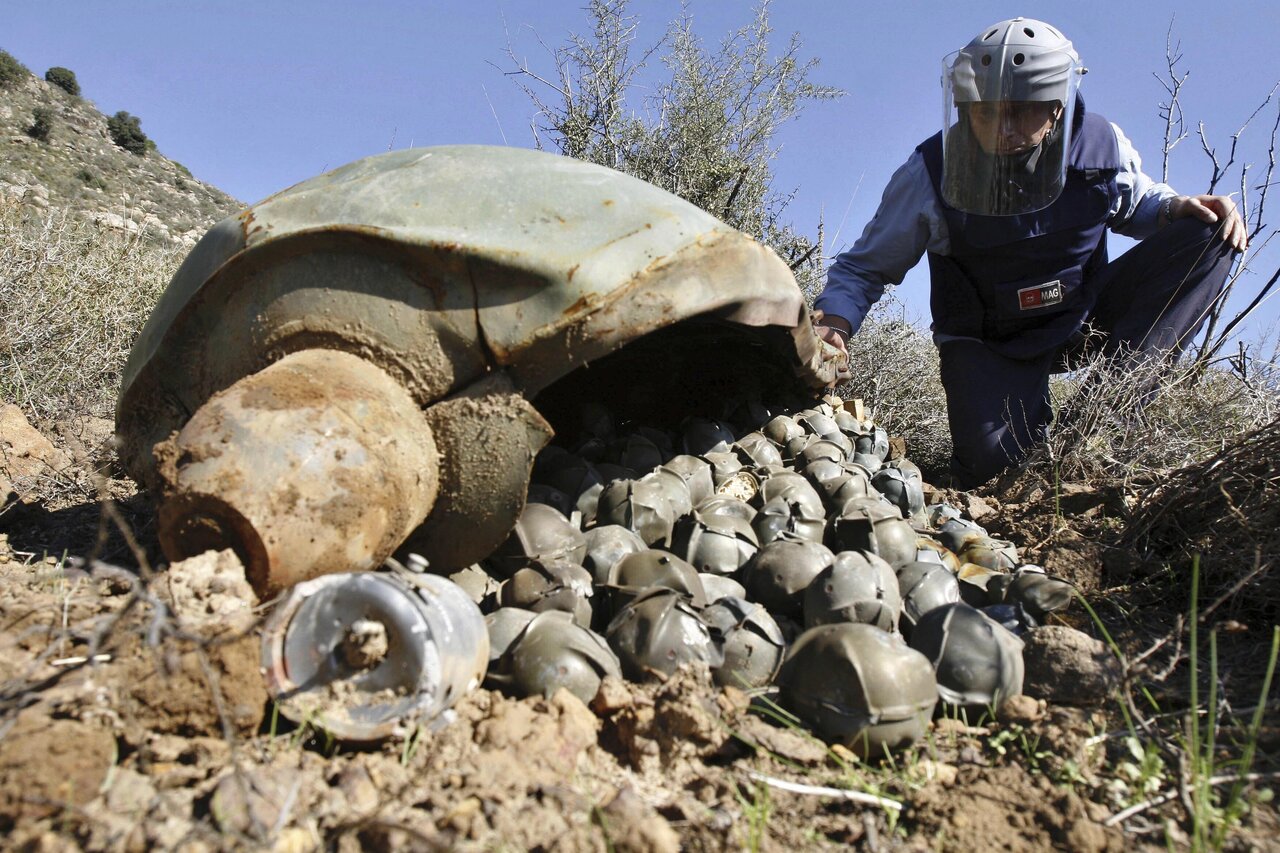
Photographs of ammunition debris in south Lebanon seen by the Guardian suggest that Israel used widely banned cluster munitions in Lebanon’s recent 13-month war.
The images, examined by six different weapons experts, appear to show the remains of two different types of Israeli cluster munitions found in three different locations: south of the Litani River in the forested valley of Wadi Djiboutin, Wadi Barghuz and Wadi Deir Siryan.
This evidence is the first evidence that Israel has used cluster munitions in nearly two decades, since it used them in the 2006 Lebanon War. It is also the first time that Israel is known to have used two types of cluster munitions discovered: the 155mm M999 Barak Eitan guided missile and the 227mm Ra’am Eitan guided missile.
A cluster bomb is a container bomb that releases many small submunitions, small “bombs,” over an area the size of several soccer fields. The use of cluster munitions is widely prohibited. Up to 40% of submunitions do not explode on impact, posing a danger to civilians who may later accidentally encounter them and be killed during the explosion.
To date, 124 states have signed the Convention on Cluster Munitions, which prohibits their use, production and transfer. Israel is not a party to the treaty and is not bound by the treaty.
“We believe that the use of cluster munitions is always inconsistent with the military’s obligation to respect international humanitarian law, due to their indiscriminate nature during and after their use,” said Tamar Gabelnik, director of the Cluster Munitions Coalition. “Their far-reaching effects mean that military targets cannot be distinguished from civilian targets, and cluster munitions debris can kill or injure civilians for decades after use.”
The Israeli military did not confirm or deny the use of cluster munitions, but said it “accords to international law and uses only lawful weapons while mitigating harm to civilians.”
The war between Israel and Hezbollah, which began in October 2023, has killed around 4,000 people in Lebanon and 120 in Israel. Much of southern Lebanon remains in ruins, and despite a cease-fire signed last year, Israel still carries out near-daily airstrikes in the country.
Lebanon in particular has a painful history with cluster munitions. Israel blanketed Lebanon in the final stages of the 2006 war with cluster bombs 4 meters long, but an estimated 1 meter did not explode. The presence of unexploded cluster munitions continues to endanger life in southern Lebanon, with more than 400 people killed by unexploded ordnance since 2006.
The large number of unexploded cluster munitions in Lebanon was a major factor in the drafting of the 2008 Cluster Convention.