
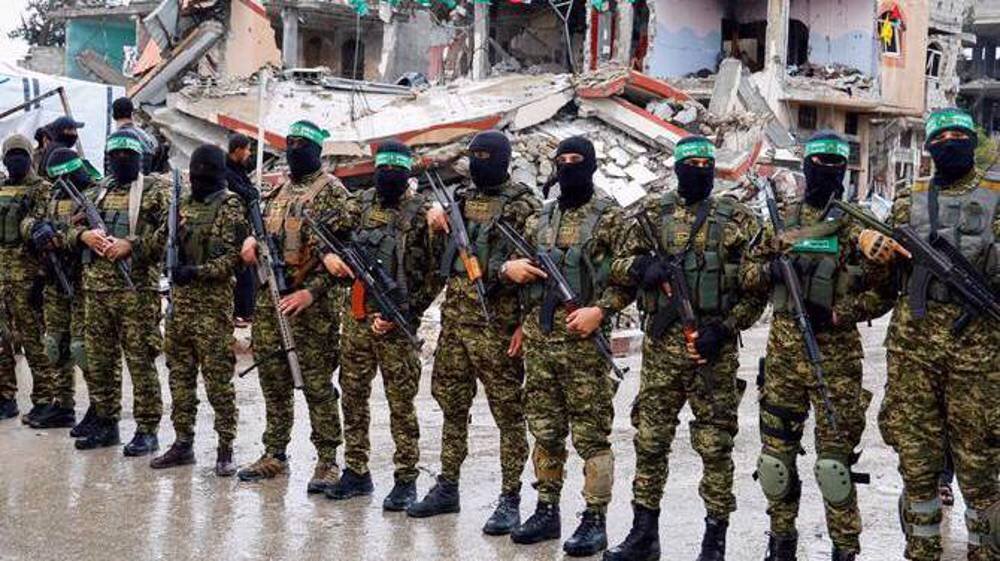
Gaza’s Interior Ministry security official said Hamas will soon launch its largest operation to date to dismantle the remaining armed groups that continue to collaborate with Israeli occupation forces, Press TV reported.
Since the October 10 cease-fire, Hamas forces have actively targeted these militias and succeeded in disarming some of them, including Gaza City’s notorious Domush clan.
However, some militias remain active in areas under Israeli control, particularly the so-called People’s Army led by Yasser Abu Shabab in eastern Rafah and the People’s Army led by Ashraf al-Mansi in northern Gaza.
These groups have been identified as collaborators who receive weapons, funding, and logistical support from the Israeli military.
“The number of gang members collaborating with the occupation is currently limited to a few hundred across Gaza, but the Abu Shabaab militia alone has around 2,000 members,” the security official said.
“These groups have been implicated in kidnappings, assassinations, sabotage, and providing armed support for Israeli forces.”
Recent information gathered through interrogations reveals the extent of coordination between militias and the Israeli military, including carrying out security sweeps and attacks on resistance fighters.
“Militia groups often attempt attacks near Israeli military positions, but Hamas security forces confront and neutralize them,” the official added.
The Israeli military has acknowledged that Hamas has reasserted control of the evacuated areas, and local militias, with the exception of the tenacious Abu Shabab, have reportedly been disbanded or defeated.
The Interior Ministry said al-Mansi’s People’s Army, which operates near the northern Erez crossing, is the weakest force and operates under close Israeli protection, complicating efforts to directly confront Hamas.
The crackdown on Hamas includes the seizure of large quantities of weapons supplied by Israel to these militias, including Kalashnikovs, machine guns, ammunition and vehicles.
Although these groups receive only small arms, their leadership has access to funding, advance supplies, and direct orders from Israeli soldiers for operations targeting Palestinians and resistance members.
Several high-profile kidnappings have been linked to these militias, including the kidnapping of Dr. Marwan al-Hums, director of the Gaza Ministry of Health Hospital, and his daughter, further highlighting the threat posed by militias to internal security in Gaza.
Despite Western criticism of Hamas’s security efforts, many local tribal leaders and communities have expressed support for it, seeing it as essential to ending cooperation with Israel and protecting Gaza’s sovereignty.
Hamas security officials said there is a window for amnesty for militia members willing to disarm and surrender, excluding those involved in killings and torture. This period officially ended last Sunday, but operations continue.
“In the coming days, we will launch our largest security operation to date, targeting multiple areas where these groups remain,” the official said. “Our goal is to eliminate all collaborators and ensure peace and security for the people of Gaza.”
Hamas officials and Gaza security officials say elements within the Israeli military and the U.S. policy establishment are seeking to use the militia as a proxy to undermine Hamas’s authority and divide Gaza after the ceasefire, but months of Israeli military aggression have foiled their efforts.
Last Thursday, US President Donald Trump warned that if Hamas continued to target gangs and Israeli collaborators in the Gaza Strip, he would effectively break the ceasefire and support attacks on Hamas.
“If Hamas continues to kill people in the Gaza Strip, which was not a deal, we will have no choice but to go and kill them,” Trump wrote in a social media post.
The threats against Hamas appear to signal a change in tone from President Trump, who earlier this week suggested he had no problem with the organization’s crackdown on gangs in the Palestinian territories.
MNA