
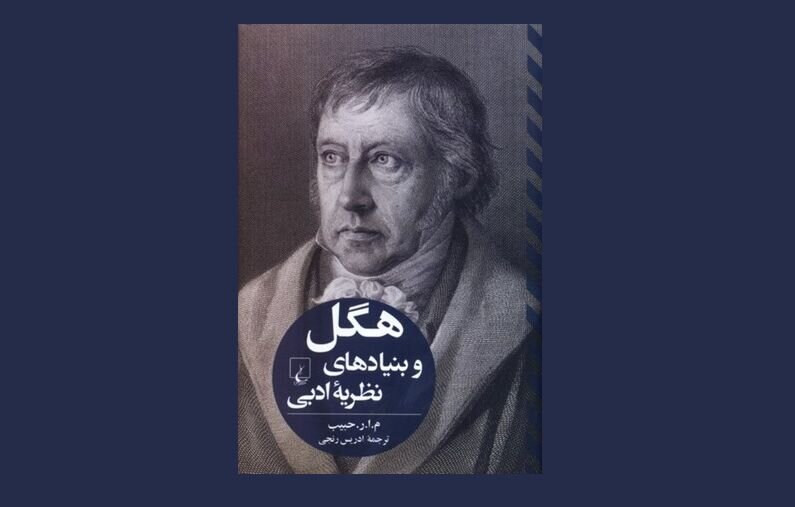
Tehran – A Persian translation of the book “Hegel and the Fundamentals of Literary Theory,” written by Habib, has been released in bookstores nationwide.
Edris Ranji translated the book, and Qoqnoos Publishing House published it on 520 pages, Irna reported.
Is there anything about the various forms of literary theory, such as deconstruction, Marxism, new historicism, feminism, postcolonialism, cultural/digital studies? If so, what are the basic principles of theory? What is the direction of that ideology? Can it still help us in understanding the fundamental intellectual and ethical dilemmas of our time? These questions continue to confuse both students and literary theory teachers.
In the thinking of German philosopher Hegel, Habib finds the answer to the unapproved roots of most of theories. Habib explains Hegel’s intricate ideas and how they permeated throughout the intellectual history of the last century.
Originally published in 2019, the book is interested in teachers and students of literature, literary theory and history of ideas, revealing how our modern world has become and how we can better understand the salient issues of our time.
Georg Wilhelm Friedrich Hegel (1770-1831) was a German philosopher and a leading figure in the German idealistic tradition. His influence on Western philosophy spans a wide range of topics, from epistemology and ontology metaphysical issues to political philosophy and art philosophy.
Hegel was born in Stuttgart. His life spanned a transition between enlightenment and romantic movement. His ideas were shaped by events interpreted from a philosophical perspective, the French Revolution and the Napoleonic Wars. His academic background peaked with his appointment as chairman of the philosophy committee at the University of Berlin, where he remained a prominent intellectual until his death.
Throughout his work, Hegel worked to correct what he claimed was a commonly unacceptable dualism in modern philosophy. His main achievement was the development of an inclusive philosophical system, often referred to as absolute idealism, to explain reality as a unified whole.
Hegel’s distinctive procedure, often referred to as dialectical or speculative, assesses concepts and forms of consciousness according to their own internal standards, revealing their contradictions and unilateral gender. This leads to a higher, more comprehensive unification solution, cancelling and saving the initial stage. His major works, including “The Phenomenology of the Psyche” (1807) and “The Science of Logic” (1812–1816), detail this systematic vision. In his political philosophy, he famously argued that “world history is the progress of the consciousness of freedom.”
Hegel’s influence is serious and divided. After his death, his followers were split into rivals, “right” and “left” Hegel camps. The left, including Ludwig Feuerbach and Karl Marx, adapted dialectical methods for materialistic criticism of society. In the 20th century, his ideas developed further in traditions such as French Hegelism and critical theory, becoming a major reference point for existentialism.
SS/