
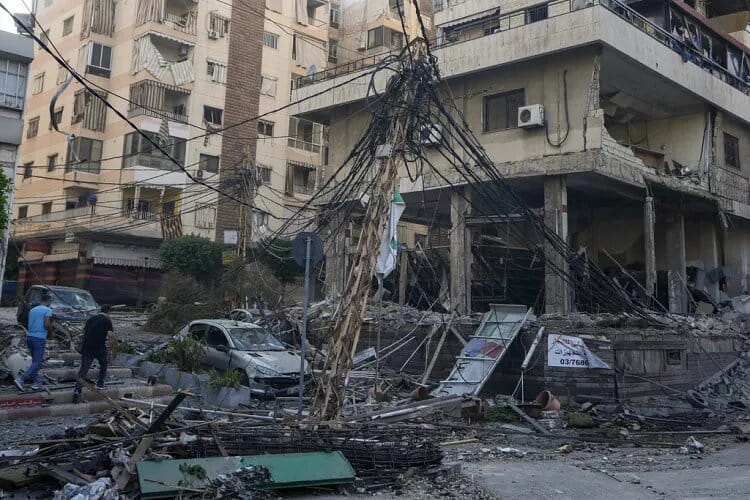
BEIRUT — The first anniversary of a massive US-led Israeli attack on Lebanon that lasted more than two months raises questions about Hezbollah’s position today in light of regional and international transformation.
Despite enormous political, economic and military pressure, Resistance (Hezbollah) managed to maintain its position and develop its structure.
First, Lebanese resistance emerged from the pressing needs in the absence of genuine sovereignty protection. It is a fundamental element of the power balance of the Levant.
Since 2006, it has proven its ability to counter and increase its costs to combat uncontrolled Israeli attacks.
Without a doubt, the rhetoric that seeks to portray resistance as a burden on Lebanon reflects years of US and Israel’s political intentions that are updated at every stage. Their main, malicious goal is to strip Lebanon from its elements of power and turn it into a state of submissiveness.
Meanwhile, spies at the US embassy in Beirut have clearly falsified the facts by embracing the resistance that has caused the destruction caused by the war over the years. However, attacks are a direct cause of losses, and resistance controls its long-term outcome.
Deterrence caused by resistance is not an absolute guarantee. Rather, it is a dynamic process influenced by military, technical and political transformation.
Nevertheless, resistance represents a unique experience compared to other resistance movements in modern history.
A year later, the facts reveal that Israeli professional groups have not abandoned the project to weaken resistance, and that Washington continues to place Lebanon at the heart of its regional strategy.
The coordination between Tel Aviv and Washington transcended the scope of the final war to a comprehensive program of action that includes everything in West Asia, including Iran.
Meanwhile, observers confirmed that Hezbollah has actually managed to restore military and organisational capabilities at an astonishing rate, demonstrating its important financial ability to compensate those affected, raising concerns in Washington about the source of Hezbollah’s funding and the effectiveness of the sanctions imposed on it.
In contrast, Americans focus on putting Duliban, in the heart of the Lebanese army and banks directly under supervision, and believe that support for them must be conditioned on the extent of movement to suppress resistance, despite the perception that the military cannot carry out its mission to disrupt resistance.
Israeli occupational groups have also demonstrated that they are not interested in the time limits that Washington is rumoured to grant to Lebanon. This means continuing assassination and raids whenever it appears necessary.
In fact, leaks from Western sources indicate Israel’s intention to resume attacks through a massive ground operation aimed at controlling Southern Lebanon to the Ritani River, and has since imposed a new security arrangement on the north.
This approach intersects with efforts to impose facts on the ground in southern Syria by establishing unarmed zones and preventing the possession of strategic weapons. This reaffirms that this fight involves redrawing security maps not only for Lebanon, but also for the entire West Asia.
This is because Tel Aviv and the Washington behind it believe that the face of the axis of resistance is not limited to Hezbollah, Hamas or Ansalara, but is expanding primarily to Iran. This view is supported by Europe.
Therefore, Lebanon’s resistance is not a burden, but rather a security and political pillar facing projects that continue to pose a direct threat, as its enemy promises.
On the first anniversary of a massive attack, it is clear that the continuedness constitutes Lebanon’s resilience and actual assurances of people throughout the region, which are actually the real guarantees of Lebanon’s resilience.