
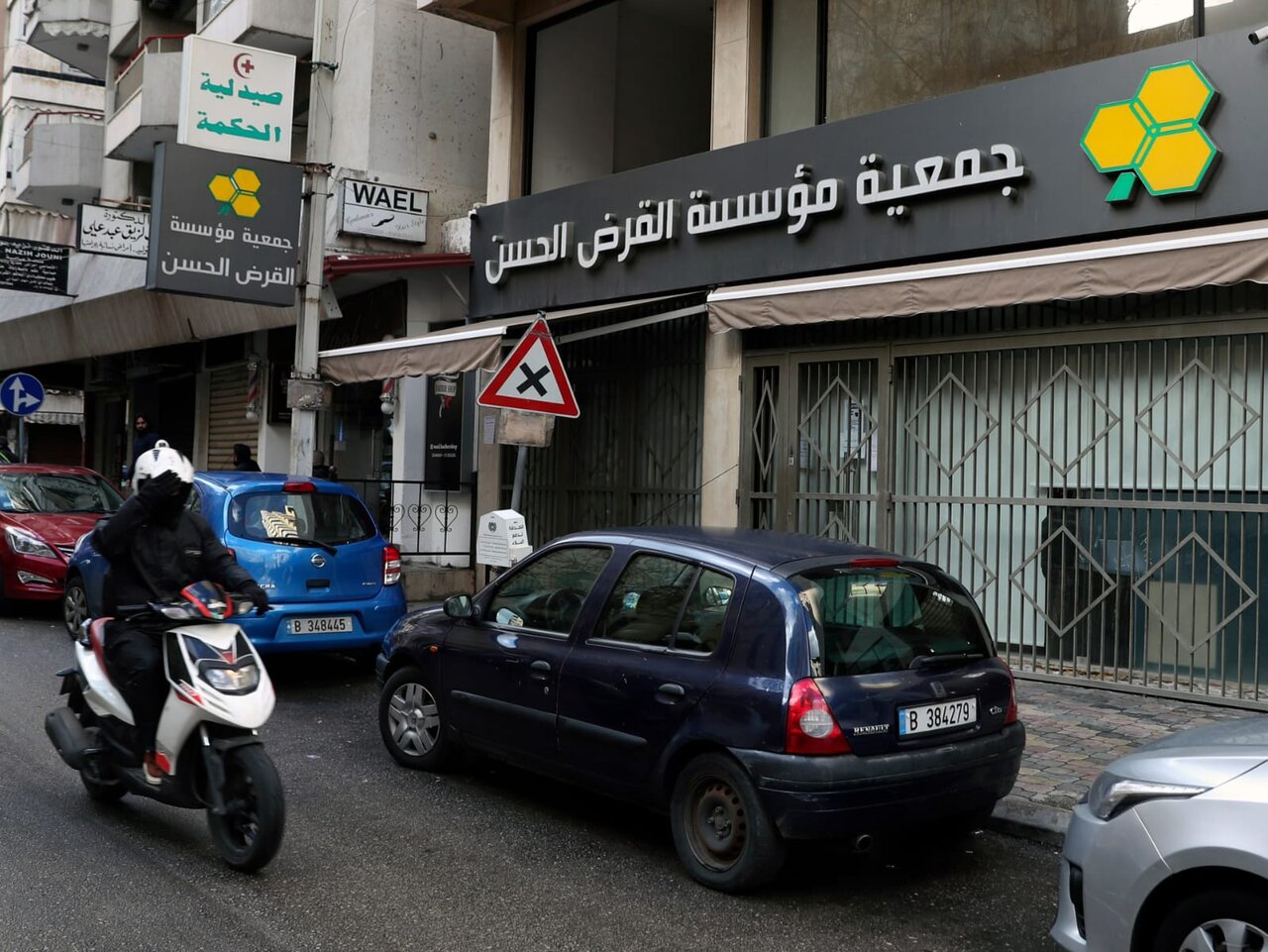
BEIRUT – Hezbollah Secretary-General Sheikh Naim Qassem has warned the Lebanese authorities and the Bank of Freedom (BDL) against taking any measures to strangle the Al-Qaad al-Hassan Institute, calling it nothing less than the “social lungs” of a country where the state structure has all but collapsed.
Hezbollah’s warning did not come out of the blue. It was a signal in the dark as financial, political and military pressures were converging towards a single objective. The goal was to weaken the resistance by means quieter and no less destructive than air strikes.
The latest wave of economic and political pressure on Hezbollah coincides with Israeli media leaks hinting at a possible expansion into Lebanon, while the US government blatantly ignores President Joseph Aoun’s initiative to resume indirect negotiations.
The timing reveals a coordinated choreography. There is military expansion from the one side and economic suffocation from the other, and both are working together to open the northern front to war and the domestic arena to a slow and severe financial siege.
Among these tightening measures, a recent circular issued by BDL requires non-bank financial institutions to collect detailed customer data on transactions over $1,000.
Although touted in the familiar phrase “enhancing compliance,” this measure arguably extends beyond financial regulation to the realm of tracking liquidity flows in social environments of resistance, particularly in societies that have returned to a cash-based economy after the collapse of the banking sector.
On the anniversary of the martyrdom of media figure Mohammad Afif al-Nabulsi and his comrades, Qassem’s message was clear. International pressure must not be allowed to infiltrate domestic regulations in a way that suffocates the very communities that the state has abandoned.
Qassem’s warning underscores Hezbollah’s belief that economic pressure is just one chapter in a broader political and security conflict aimed at weakening resistance through non-military means.
To understand the significance of the latest circular, it is necessary to remember that this is not an isolated event, but part of a legislative chain dating back to the early 2000s, driven primarily by Washington and the FATF.
Lebanon was gradually integrated into the international compliance framework under the banner of anti-money laundering and combating the financing of terrorism. Although this framework was touted as a reform, in reality it transformed Lebanon from a “participant” to a “subject” in the global financial order.
A series of laws, from Law 318 of 2001 to Laws 44, 42, and 55 of 2015, and the expansion of the definitions of “financing” and “risk”, reinforced by increasingly onerous KYC requirements, created a permanent international surveillance system for all customers, all institutions, and all economic sectors.
As the definition of “terrorist financing” expands to include indirect or unintentional support, any person or company may be exposed to charges based on mere speculation.
What is even more troubling is that Lebanon has evolved from a mere compliant state to a full partner in the global news network, with the task force becoming the essential gateway through which all financial movements must pass.
In effect, Lebanon’s economy has become transparent, not to its own people, but to external regulatory and intelligence organizations that can politicize any activity related to the resistance’s support base.
This entire structure, presented under the lofty slogan of “international transparency,” turned Lebanon’s financial sector into a strategic pressure tool, especially after the 2014 amendments that incorporated Hezbollah into the HIFPA law and expanded the scope of sanctions to include Hezbollah-linked companies, professionals, and institutions.
Lebanon’s addition to the CRS tax information system has further opened up Lebanon’s capital flows to external analysis, especially by Washington.
Today’s pressure is just a natural extension of a two-decade trajectory aimed at cutting off the resistance from its social and financial lifeline by posing “operational risks” to all those dealing with it.
But Americans’ belief that a financial war could stifle Hezbollah has collapsed since 2019, when the movement successfully transitioned to a parallel cash-based economy. We have built a functional and resilient financial ecosystem through liquidity networks, exchange channels, non-bank remittances, and internal redistribution systems.
The roughly $1 billion raised in a few months came not from “shadow banks,” as some have claimed, but from Hezbollah’s ability to convert cash into a stable socio-economic framework within its constituencies.
This is where Al Qard Al Hassan establishes itself as the most durable financial institution in Lebanon’s emerging economy. This is not just a philanthropic loan fund, but a full-fledged parallel economic model: it is not subject to sanctions, it is cash-based, and it can mobilize entire communities around an alternative fiscal vision.
Any attempt to undermine it is therefore correctly interpreted as a direct act of economic warfare.
Meanwhile, the US government is increasing pressure on BDL to expand its KYC enforcement to unprecedented levels and bring even minor transactions under scrutiny. This move is clearly part of an effort to suffocate the cash economy on which the Resistance relies.
But Hezbollah, which has demonstrated its adaptability on the battlefield, has applied that same flexibility to the financial realm. The shift toward diversification of financial channels, from gold to crypto assets to regional donor networks to local military manufacturing, suggests that every financial obstacle will be met with even more complex financial workarounds.
Thus, the economic war becomes a long-term war of attrition. Any American action will be countered by new tactics of resistance, and “financial hegemony” will be far less decisive than Washington imagines.
Today’s situation is characterized by dangerous escalation. Washington is tightening the screws on Lebanon to force “full compliance” and dangles the threat of a gray list, while Hezbollah is raising its own ceiling, declaring attacks on financial networks are as serious a red line as attempts at disarmament.
This is not a technical financial measure. This is an economic, political and strategic conflict whose effects mirror those of military conflict. The most dangerous scenario is a hybrid explosion of financial collapse and military escalation that could push Lebanon to the point of uncontrollable state collapse.
But experts say the Resistance maintains a multi-layered financial safety net that combines regional support, parallel economies and domestic manufacturing. The tools of pressure are powerful, but the tools of survival are just as deep-rooted.