
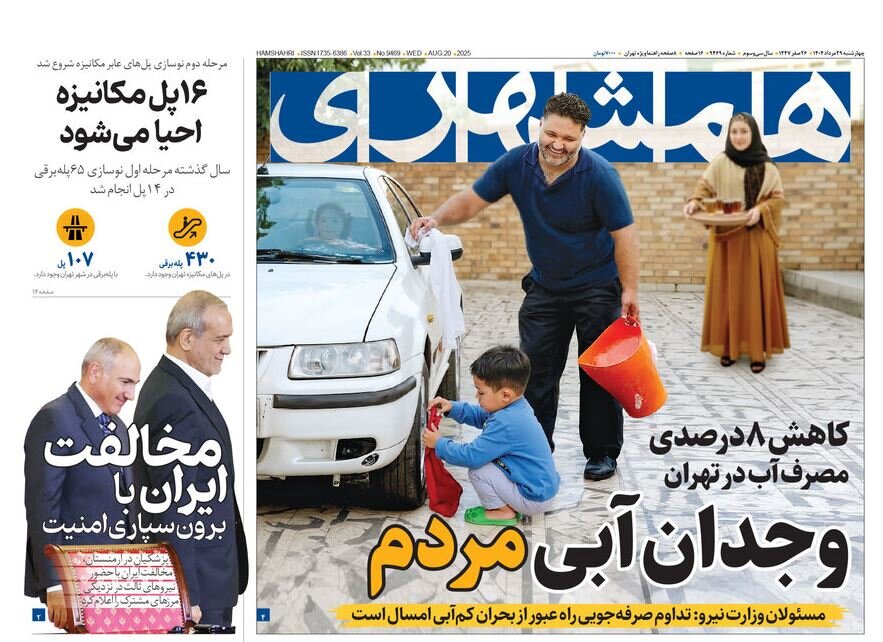
Tehran – In a memo, Hamshari discusses President Masuud Pesheshkian’s trip to Armenia, and about ten days after signing a peace agreement between Armenia and the Republic of Azerbaijan in the White House (on the establishment of the Zangezur Corridor), a visit to Yerevan Kar’s strategic important president.
It included consultations focusing on recent geopolitical developments in the South Caucasus, in addition to bilateral relations. The emphasis on the need to observe Iran’s (security and economic) considerations in Iran was one of the most central points raised in discussions between the two parties in the agreement under the Yerevan-Bak-Washington Agreement. Considering recent developments in the region, consultations highlighted important points, including special commitments by the Armenian side, compliance with Iranian considerations, agreements on strategic instruments, detailed private consultations and private consultations. The discussion of Zangezur corridors and Iranian considerations, which were the main focus of the travel, comes with a special commitment to Tehran’s interests in Yerevan, and the Armenian side says it has guaranteed there is no threat to Iran from its territory.
Etemad: Zangezur Games
In an analysis of the Zanegzur corridor, Etemad wrote: This project is not just a transport route, but a deep geopolitical development that threatens economic benefits in the short term and limits regional impacts in the long term. Iran has to decide today whether it’s the audience, player, or even the stage manager for the game. The bitter experience of missed opportunities should make Iran realize that this race is equivalent to retreating silence and losing a position that could take more than a century. Iran must adopt a field-based, intentional approach to Armenia. This existence should not simply remain in the form of political conferences or symbolic military operations, but should be extended to the operational levels of logistics, intelligence and military fields. Iran must go beyond the position of “passive conflict” in relation to the development of the Caucasus and reach the doctrine of “active deterrent leadership.” In an evolving global order, effective actions require timely presence, intelligent actions, and correct awareness of threats. In this respect, the Caucasus is not only a threat, but also a platform to strengthen Iran’s role in the global equation, if a purely defensive approach is avoided.
Kayhan: Foreign policy lessons from the 12-day war
Kayhan dedicates and writes to the lessons of foreign policy from the 12-day war: the 12-day war showed that Iran still faces the reality of strategic isolation. Neither China nor Russia were overcoming cautious positions. This fact shows that relying solely on great powers is a strategic mistake and that multi-layered foreign policy must be pursued. At the same time, Iran’s membership in BRICS and Shanghai Cooperation Agency provided the opportunity to elaborate the country’s status at the global stage. The main condition for exploiting these opportunities is to link them to actual economic projects and collaboration. Another lesson was the importance of media diplomacy. In the early days of the crisis, Western media narratives dominated, but the active involvement of domestic media changed the balance to some extent. This experience highlighted the importance of investing in public and media diplomacy. The 12-day war also highlighted the importance of neighbourhood policy. The region’s countries were the first to be affected by the crisis, and their concerns about the spread of war suggested that regional diplomacy should be the main focus of Iran’s foreign policy.
Arman-e-Emrooz: Trump’s diplomatic transformation to Iran
In his commentary, Arman-e-Emrooz said that Donald Trump is willing to sign a contract with Iran for his second term as president. It writes: The US President has repeatedly spoken about his willingness to negotiate with Iran during his second term. This approach contrasts with his hard-line policies during his first term, showing a change in his strategy towards Iran. However, there are several challenges ahead of the possibility of negotiation. While Iran wants to agree within the JCPOA framework, the Trump team is seeking a more comprehensive agreement that includes not only nuclear programmes but Tehran’s support for the Resistance Group. Differences in expectations complicate negotiations. Meanwhile, Iran’s domestic pressures have been affecting the negotiation process. Trump’s willingness to negotiate with Iran reflects his efforts to achieve great diplomatic achievements in his second term. However, the success of these negotiations depends on several factors, including flexibility by both sides, management of internal conflicts at home, and Trump’s ability to balance pressure and diplomacy. Iran is motivated to ease sanctions, but the broader US demands could derail consultations unless both parties reach an acceptable compromise.