
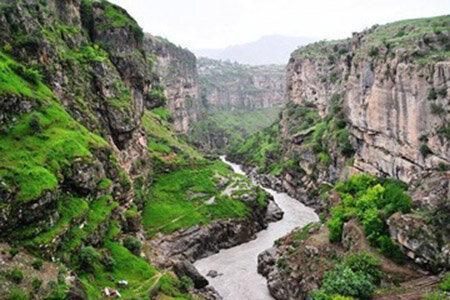
According to archaeological research in Tehran, tool-making humans have lived in the Khoreiran Valley in Ilam province for about 100,000 years, and after an early stage they achieved irrigated agriculture and domesticated livestock.
Prehistoric archeology expert Habibollah Mahmoudian told ISNA that the western part of the Ilam Plateau is particularly important from a historical and archaeological research point of view, as it is located in the fertile Zagros region, is covered by water resources, pastures and forests, and is on the route connecting the Central Asian Plateau with Mesopotamia and other parts of West Asia.
He pointed out that according to archaeological reports, population and human life in this geographical region has continued from at least the Paleolithic period to the present day. The passage of ancient roads, such as the Silk Road in the northern part of the state, which was considered the main trade route in the east, and the Royal Road connecting Susa with Asia Minor, and the presence of ancient bridges, the most densely populated area of the Seymale River and its tributaries in Ilam state.
Lorestan and Khuzestan oblasts demonstrate the communication role of the region in different historical periods, he added. Mahmoudian continued that studying the cultural development of this region of Iran is of great value in understanding its historical identity.
The Horeilan Valley is considered the northernmost point of Sylvan and Chardabel districts, is located on the western bank of the Seymale River, and is an important site from an archaeological point of view.
He noted that artifacts such as stone axes and other stone tools that evolved as production and distribution methods evolved have been found in the area.
He explained that after early settlement and habituation to agriculture, the people of Holeylan approached the stage of irrigated agriculture and domestication of cattle, sheep, goats and horses. The discovery of countless examples of Stone Age stone blades and cultural tools is evidence of the increasing cultural growth and development of monocultural settlement systems in the region’s villages and urbanization, he added.
Mahmoudian recalled that the Horeilan Valley was first explored in 1936 by British archaeologist Sir Aurel Stein. He identified ancient hills and excavated them. His goal in this excavation was to discover Bronze Age artifacts in Lorestan.
He emphasized that the Danish archaeological expedition led by Peder Mortensen resumed operations in Lorestan in 1973. Considering the slight morphological changes in northern Lorestan during the Pleistocene, it is possible to find archaeological sites that could explain early human settlement patterns. Therefore, research began to focus on the Horeilan Valley, one of the best water valleys in the Lorestan region.
The archaeologist added: “Mortensen conducted two extensive research seasons in the spring of 1973 and the fall of 1974. During these two seasons, 161 archaeological sites were discovered and recorded in an area of 140 square kilometers,” he said. Only 16 parts of the complex had previously been identified by Aurel Stein and other archaeologists, he added.
KD