
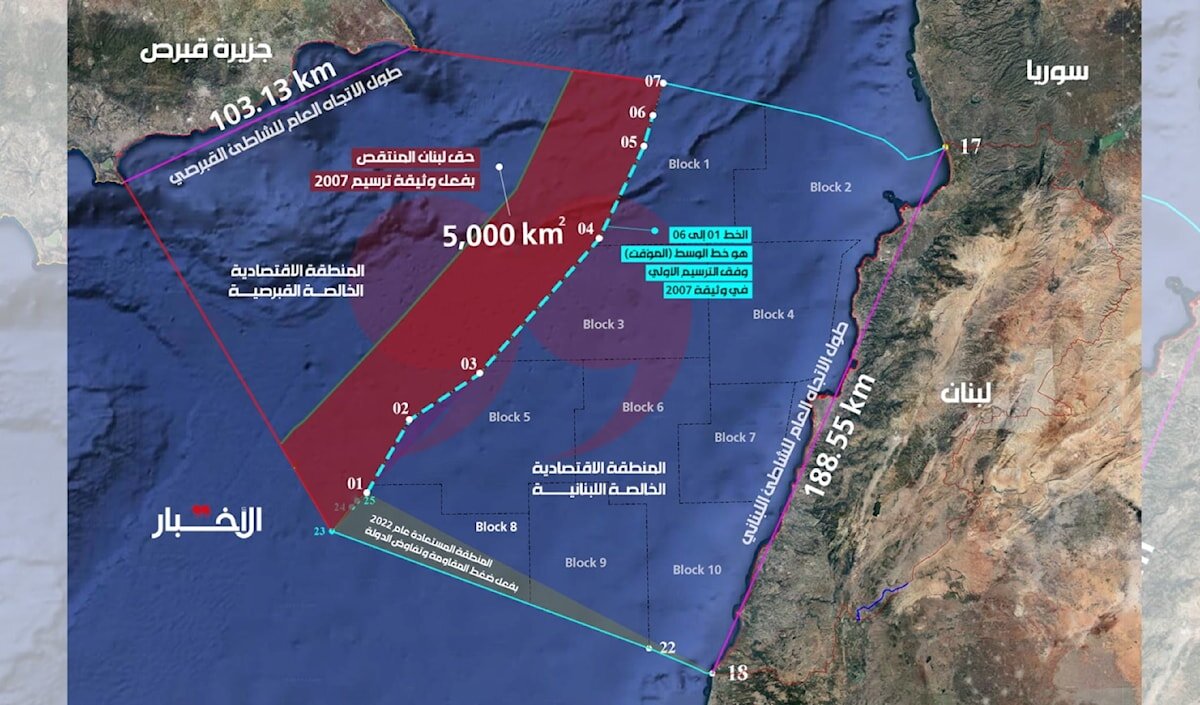
Beirut – Every time Lebanon takes to bound the boundary to assert its rights, the outcome appears to be yet another loss. This also applies to 2007 and 2022, and is being unfolded again today.
Lebanon’s waiver of maritime rights began with a 2007 agreement signed by the government of Fouad Siniora (despite the loss of the charter due to the withdrawal of Shia ministers).
The agreement adopted median value, neglecting the principle of fairness and proportion, resulting in Lebanon losing thousands of kilometers of its exclusive economic zone to Cyprus.
A study prepared by the Ministry of Foreign Affairs’ Legal Consultation Centre under the guidance of Ambassador Saad Zakia in 2014 showed that Lebanon lost 2,643 square kilometers, while a waterway study by the Lebanese military using modern measurement methods and satellites showed that the loss exceeded 5,000 square kilometers.
Thus, Cyprus is a long, open coastline that is the greatest winner at the expense of Lebanon, completely inconsistent with the principle of the laws of the sea, with short coastlines.
A few years later, especially in 2022, Prime Minister Najib Mikati formed a committee that studied the issue and tried to correct the imbalance.
The committee concluded that three broad approaches to fairness should be adopted, starting by drawing a tentative central line and adjusting according to the specific circumstances and leading to a test of proportion.
It also recommended that two statutes be amended to amend two statutes 6433/2011 according to the new coordinates, renegotiations with Cyprus, registration of these coordinates with the United Nations, and even relying on international arbitration if negotiations failed.
These recommendations opened the door to reclaim thousands of kilometres for Lebanon, but were quickly ignored in the establishment of the government of Nawaf Salam.
On July 11, 2025, Salam decided to establish a technical committee led by Minister of Public Works Fayes Rasamni. The committee included Brigadier General Mazen Basbous, representative of the Army, and lawyer Najib Massihi, an expert in international law.
Of note, the exclusion of notable experts such as retired brigadier Afif Ghaith, known for his opposition to the 2007 agreement.
The new committee once again adopted the median, ignoring international court jurisprudence that bases fairness on its boundary, and disregarding the recommendations of the Mikati Committee.
What’s even more suspicious is that they completed the work in an unfair hurry, reflecting the American direction seeking to accelerate the agreement with the American agreement.
Just a few days after the creation of the Peace Commission, Cyprus’ intelligence director Tasos Tzionis visited Beirut and threatened his country to demand additional regions if Lebanon failed to implement the 2007 agreement.
This threat has been under blatant American cover since 2017 as a reward for Cyprus, which opened airspace and territory to the Israeli Air Force to simulate Lebanon’s invasion.
With this development, the Congressional Public Works and Energy Committee was chaired by MP Sajih Attieh on September 18, 2025, attended by Rasamni, Basbous and Masihi, as well as well as well as well as prominent experts including Attorney General Khalil Gemayel and Dr. Isamu Kalife.
Basbous and Masihi present the committee’s justification, noting that the principle of “estoppel” prevented the revision of 6433, and that the difference in length of the coasts in Cyprus and Lebanon is not important.
However, MPS and experts responded firmly, and Article 3 of the decree allowed amendments when new data became available, highlighting that the length of Cyprus coastline was intentionally bulged by introducing wavy waves, and that the courts of the sea ruling rely on the principle of proportion rather than pure central lines.
Brigadier Jemaier presented eight international rulings certifying Lebanon’s right to reclaim the vast area of Lebanon, recalling that while Cyprus represents only 3% of the area’s coastline, it claims 10 times the land area of the maritime area, while Lebanon claims less than 1.7 times the land area.
During the session, a strong council voice was raised, especially from Hezbollah.
MP Hussein Hajj Hassan called for the agreement to be frozen with Cyprus until the boundary with Syria is complete. He warned against the use of the threat of companies withdrawing as an excuse, as this is primarily a foreign political decision, and pointed out that Cyprus is the most likely to hurt.
On his part, resistant MP Jamil Al Seyed emphasized the need to seek the support of professional international experts to form a comprehensive scientific picture that guarantees Lebanese rights.
At the same time, Dr. Isamu Khalifa described the case as a high crime of treason, urging committee members to be prosecuted if it proved to have wasted the rights of the Lebanese people.
Many lawmakers, including Halima Kaakour, supported this position.
The chronology reveals that the government of NAWAF SALAM has revived the unfair 2007 agreement and ignored the recommendations of the Mikati Committee. This confirmed the right to amend Lebanese Order 6433 in accordance with the principle of fairness, eliminated citizen experts, and formed a weak committee that relied on flimsy legal arguments.
It then succumbed to American pressure and consecrated the loss of more than 5,000 square kilometres of Lebanon’s maritime rights. However, this waste was not a challenge. It was met with voices from parliamentary and national experts, especially from Hezbollah. He considered the surrender to American leadership and the intentional waste of Lebanon’s sovereignty and wealth.
The observers propose establishing independent institutions to address boundary issues so that the fate of Lebanon’s maritime resources is not based on scientific and interest-based principles, and thus become subject to submission to international pressures to impose accomplices of marine fairies suitable for foreign agendas.