
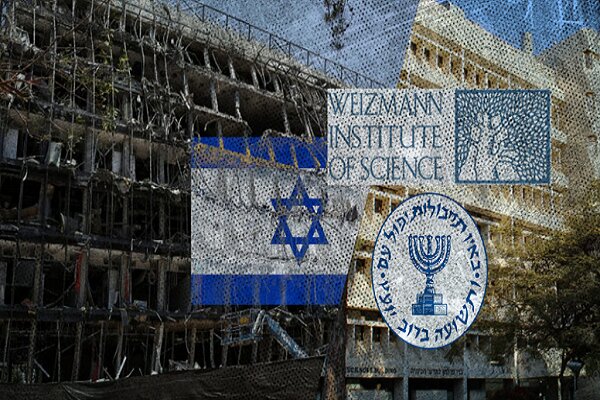
Once the cornerstone of the Israeli regime’s scientific and military research, the institute is known for its close ties to Israel’s military industrial complex, but is now devastated and inoperable.
According to Israeli media, the precision strike was “accidental” and targeted cutting-edge research hubs linked to the Tel Aviv regime’s military in areas such as physics, biotechnology and artificial intelligence.
In a media interview with Alon Chen, president of the Israeli Wiseman Institute, he acknowledged that Iranian ballistic missiles hit major buildings with extreme accuracy within a vast complex, causing widespread and irreparable damage.
His statement contradicted previous claims made by several administration officials that missile strikes were random and the damage caused was minimal.
“The destruction is widespread and our initial valuation shows damage ranging from $300 million to $5 billion,” Chen told Israeli TV channels.
He added that the institute complex consists of two parts, smaller residential parts and larger scientific parts, “Iran targeted the latter, meaning it hit the centre of the institute, and the strike was very accurate.”
When a reporter asked him about the regime’s censorship of images indicating the extent of the damage, Chen explained that he was looking to check the restrictions and prevent Iran from obtaining information that could help with future attacks on these sites.
“Iranians must admit that they are monitoring the location of Israeli missile strikes not only at Wiseman, but at many military bases and strategic locations that have not previously been publicly disclosed,” he said.
Channel 13 reported that the situation was so unconscious that Israeli settlers’ communities were unaware of the accuracy, scope and damage of Iranian attacks in many locations.
Despite censorship efforts, surveillance footage and photographs appeared, revealing the ballistic attacks on the buildings and the serious destruction they caused.
Decades of research lost
On June 15, 2025, Iran’s ballistic missile strike caused major damage to the Wiseman Institute of Science in Rehobot, located in the occupied Palestinian territory.
Several facilities within the laboratory complex were targeted and destroyed.
There have been several reports describing the newly constructed Institute of Chemical and Materials Science, which is scheduled to open in 2025, suffered catastrophic damage and effectively destroyed it.
Existing buildings dedicated to life and computational science were also ravaged, causing fires to break out in at least one lab. The facility had important research programs, including cancer research and regenerative medicine.
Among the most intense hits was the lab of cardiac regeneration expert Professor Eldad Tzahal. His lab was completely destroyed, destroying thousands of cardiac tissue samples, DNA and RNA collections, custom antibodies, and viruses that represent more than 22 years of research.
“Within 15 minutes, I saw images of a fire consuming its second home in 22 years, the lab. The entire third floor collapsed. Nothing remains. No data, images, notes, history.”
Approximately 45 research laboratories throughout the laboratory were damaged, affecting approximately 400-500 researchers. The affected labs spanned life sciences, molecular biology and neurobiology, resulting in the loss of irreplaceable materials such as tissue slides and cell lines.
The planetary science building, which houses geochemical labs and other chemical programs, was seriously affected by the shock waves of missiles that hit adjacent chemical buildings rather than a direct strike. Although it was not directly targeted, this facility was barely available.
Overall, about 90% of the laboratory buildings suffered some form of damage. From direct missile hits to shock waves, rap shotguns and collateral damage caused by fires, there are crushed windows, collapsed laboratory floors, destroyed electrical systems, and floods caused by fire extinguishing.
The strike also disrupted access to shared scientific equipment, expensive, specialized machines used by multiple research groups, further exacerbating the institute’s enormous losses.
Physical damage is estimated between $300 million and $570 million, and reconstruction efforts are expected to take years. However, in many cases, loss of decades of biological samples and research data is considered invaluable.
Institute with strong military links
The Weizmann Institute of Science has established itself as a “civilian” scientific institution, with much of its research being published openly in academic journals. However, while many of the projects overlap with military research, these connections are not always public.
Sources in Israeli and Western media highlight the institute’s achievements in fundamental and applied sciences, such as physics, chemistry, biology, and mathematics, and downplay their relationship as military application.
However, the Weizmann Institute maintains a clear and documented link to the Israeli military through collaboration with military contractors such as ELBIT systems, Artificial Intelligence (AI) Research (AI), drone technology, dual-use innovation, and nuclear research.
In October 2024, the institute announced a partnership with Elbit Systems, a leading Israeli military contractor, developing “groundbreaking bio-inspired materials for defense applications,” explicitly linking the institute to military technology development.
Additionally, the Weizmann Institute is working with the ELBIT system on a project that includes the development and supply of space telescopes for the Israeli Ultrasat programme. Officially scientific, the program allows for dual-use applications.
At nearby Kiryat Weizmann Science Park, major Israeli arms companies such as Rafael, Israeli Aerospace Industry (IAI) and ELBIT Systems, the Israeli regime’s three largest military contractors, are hosting large Israeli arms companies, creating a research and development environment where the laboratories work indirectly support the defense industry.
Many research programs at the Institute are also funded by the Israeli Ministry of War, further strengthening their role within the military industrial complex.
The Weizmann Institute is recognized as a key contributor to the Israeli military’s capabilities in areas such as artificial intelligence, drone technology, cybersecurity, materials science, quantum computing, autonomous systems, electronic tracking and jamming, and alternative GPS navigation.
The technologies reportedly support Israeli military operations, including airstrikes, medical advances on the battlefield and cyber defense strategies.
Institute graduates often serve elite military forces such as Unit 8200, the administration’s top signal intelligence and cyber warfare division, and the Talpiot program that trains Israeli science and technology experts.
Certain laboratories, such as Professor Elan Segal, have been linked to the development of algorithmic systems for decision-making and real-time surveillance of the battlefield used in Israeli military attacks, including Gaza and Iran.
Some researchers also focus on protecting drones from drone protection attacks and directly contributing to military technology.
The militaristic roots of the Institute
During the war of attacks and ethnic cleansing by the Palestinians known as Naqba in 1948, the Wiseman Institute officially placed equipment and campus facilities at the freeway of the Zionist paramilitary group Hagana, and later the newly established Israeli army.
The institute’s faculty and students began developing and producing a variety of weapons, including plastic explosives, synthetic propellants, mortars, cannon shells, napalms, tear gas, and mine ignition mechanisms.
By the end of Nakba in 1948, the Institute had become a central pillar of the military science forces. In addition to Technion, it emerged as the main military scientific hub of the Israeli regime.
Senior administrators and faculty members of both the Wiseman Institute and the Technology continued to lead the development of Israeli military industrial complex. They defended the idea of establishing Israeli scientific research as a foundation for military power, promoting indigenous peoples’ development and advanced weapons production.
In this pursuit, these scientists often clashed with Israeli military leaders. Israeli military leaders tended to support a more conservative approach to military R&D and prefer to sourise weapons from foreign suppliers.
In the end, the scientists won and achieved a huge impact. The Military Science Corps was separated from the General Military Command and transformed into the Research and Design Bureau led by Ernst David Bergman, one of the founders and senior managers of the Wiseman Institute.
The mastermind of Israel’s illegal nuclear program
The Wasman Institute has long been linked to Ernst David Bergman, the first chair of the Israeli Atomic Energy Commission, which was established in 1952, and in particular Israel’s secret nuclear program.
Bergman is widely recognized as a key architect in Israel’s illegal nuclear weapons development. In the 1950s, the institute contributed to early nuclear research, including uranium extraction from phosphate deposits in the Negev Desert.
Many scientists working at the Simon Perez Negev Nuclear Research Centre (Dimona), a core facility of Israel’s nuclear weapons programme, were graduates or faculty members of the Wiseman Institute.
Recent research, such as a 2014 joint report by the University of Cincinnati and Tel Aviv University, shows that the institute has played a key role in training scientists with expertise in nuclear physics, thereby laying the foundation for Israel’s nuclear capabilities.
The FBI investigation claims that the Weizmann Institute conducted research related to both nuclear and traditional weapons development, and may have secretly accessed the US military system.
For decades, Israeli media and officials have described the institute as the “technical backbone” and the “scientific and military brain” of the administration, highlighting its strategic significance.
However, following the success of last month’s missile strike, Israeli officials and the media quickly portrayed Iran as purely civilians, trying to deflect the blame and portray the attack as unfair retaliation against Iran’s civilian science programmes and personnel.
Source: presstv
MNA/