
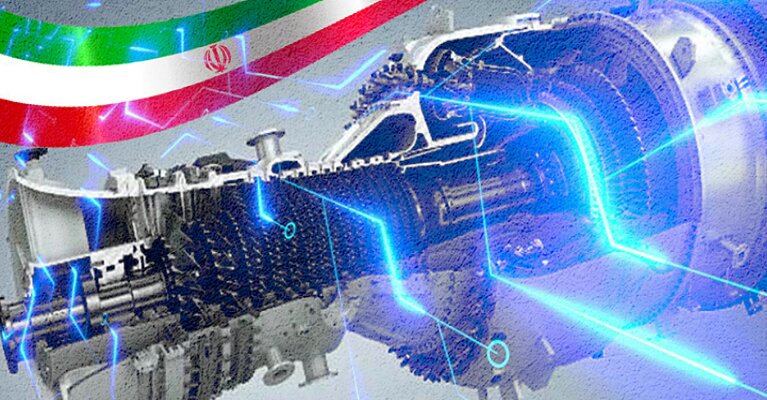
The turbine boasts world-class efficiency, innovative hydrogen-enabled combustion, and stands as a testament to Iran’s self-supporting industrial capabilities, positioning the country as a major competitor in the global energy domain.
On Monday, Iran’s Energy Minister Abbas Aliabadi addressed a gathering of industry leaders and government officials to launch a new era of the country’s energy independence.
He took great pride and introduced the MGT-75 as Iran’s first nationally designed and manufactured F-Class gas turbine.
Aliabadi praises the turbines as “an engineering masterpiece” and “honor of Iranian engineers,” emphasizing that the milestone is the result of efforts made by young engineers who have proven their ability to develop technologies that meet the highest international standards.
He declared that the implementation of the MGT-75 project marks a major leap in the development and modernization of Iran’s power plant industry.
He also highlights its important timing and notes that electricity demand is set to surge dramatically as the world undergoes the third and fourth industrial revolutions and enters an age of intelligence.
In this evolving landscape, he argued that relying on traditional methods only exacerbates the challenges, and embracing innovation and modern solutions to build a sustainable future for the next generation.
The Minister issued instructions to Mapna Group, urging them to rise to the global level and actively enter the international market. This is the goal he described as essential to strengthening the country’s technical height.
What did the Mapuna official say?
Mohammad Owliya, CEO of Mapna Group, echoed the Minister’s visionary statement and detailed the broader technical ecosystem being developed alongside the groundbreaking turbines.
Adding a layer of Abbas Fakhr Tabatabaei, Product Development Manager for MAPNA’s Turbine Engineering and Manufacturers (TUGA), provides a detailed overview of the features of the MGT-75.
He placed the turbines on the technical frontier and categorized performance at the boundary between F and more advanced H class.
Fakhr Tabatabaei has revealed that this engineering marvel is the product of the total effort of over 500,000 people in precise engineering work, testament to the high level of expertise cultivated at Mapna’s subsidiaries Tuga and Parto.
Homayon Hali, Deputy Minister of Electricity and Energy, praised Mapna’s evolution from producer to owners of Indigenous technology and offered a closing statement.
He confirmed that the group is recognized as a key and productive brand in 5-6 technologically advanced countries, and praised the dual role of solidifying Iran’s position as a fundamental pillar of energy security and technical wear, and promoting both the economic and strategic goals of the country’s electricity industry.

What is an F-Class Gas Turbine?
F-class gas turbines represent an important category of high-efficiency, large industrial gas turbines, primarily used for large-scale power generation.
These machines are characterized by advanced engineering and typically offer 150-250 megawatts in simple cycle operation with thermal efficiency ranging from 38% to 40%.
When integrated into a combined cycle system that uses exhaust heat to generate additional steam power, the power output exceeds 350 megawatts and the overall efficiency exceeds 58%.
The main technical features are as follows:
A sophisticated air-cooled system for turbine blades. An advanced combustion chamber designed to reduce nitrogen oxide emissions. High temperature alloys and single crystal components that can withstand extreme operating conditions.
F-Class turbines also offer the flexibility of fuels that operate with natural gas, photodistillates, or hydrogen blends, supporting modern decarbonization strategies.
First introduced in the 1990s by manufacturers such as General Electric and Siemens, F-Class turbines showed greater advancements than previous E-Class models.
Today, they continue to be the global benchmark for reliable, high power generation across both baseload and flexible grid support applications.
Which gas turbines are used in Iran?
Gas turbines are systematically categorized into categories such as E, F, H, and more, with new designations such as G, HA, and HL being introduced by various manufacturers, reflecting the progressive technological layer.
These categories are based on key performance metrics (reliability, operational efficiency, and output power) driven by advances in aerodynamic design, sophisticated cooling systems, high performance materials, precision manufacturing, digital process control, and improved operational flexibility.
Iran’s installed power generation capacity reached approximately 92,000 megawatts by 2024, and includes a diverse mix of renewable energy sources, a combined cycle system, and traditional gas and steam plants.
Within this infrastructure, gas turbines play a dominant role, contributing almost half of total capacity and serve as the basis for the national energy supply.
The majority of Iranian gas turbines rely on outdated E-Class or older technologies that operate at a fairly low efficiency level compared to modern alternatives, despite their substantial share.
Currently, advanced classes of turbines account for only 5% of the total nominal capacity of the grid. Of Iran’s 50,000 megawatts of gas turbine capacity, only 5,000 megawatts utilize relatively new F-Class technology.
To address this gap, Mapna Group is actively pursuing commercialization and market expansion of new Indigenous F-clusterbins.
Double the F-clusterbine installation capacity from 5,000 to 10,000 megawatts over the next five years will significantly improve the country’s energy balance and reduce fuel consumption.
Operating these new units in simple cycle mode will save you nearly 1 billion cubic meters of natural gas per year. When integrated into a combined cycle configuration, savings could reach around 4 billion cubic meters.
These conservation efforts provide significant economic benefits from reducing energy costs, reducing greenhouse gas emissions and mitigating ecological impacts, resulting in meaningful environmental benefits.

What is the MGT-75 gas turbine?
Iran’s energy sector achieved a groundbreaking breakthrough with the development and unveiling of the MGT-75, the country’s first fully native F-Class gas turbine.
This advanced turbine offers a cycle configuration that combines 222 megawatts and up to 330 megawatts with simple cycle operations, reaching impressive thermal efficiency of over 59%.
Designed to meet domestic energy needs and compete globally, the MGT-75 is tailored to Iran’s unique climatic conditions and diverse fuel resources.
The ability to operate with natural gas, diesel and hydrogen blends is positioned towards sustainable energy solutions at the forefront of the global transition.
Turbines make a dramatic leap in efficiency, tripling the performance of older generation units in Iran and significantly reducing carbon emissions. A 1% increase in efficiency leads to an estimated 2.5% reduction in CO₂ output.
Abbas Fakhr Tabatabaei, director of the F-Clusterbine Development Project, emphasized that the achievement reflects the extraordinary skills and decisions of Iranian engineers in mastering advanced skills despite external constraints.
He said the world-class performance of the MGT-75 is driven by cutting-edge innovations, including 3D axis compressors, single crystal and directionally solidified blades, advanced cooling systems and latest thermal coatings.
Comprehensive design and manufacturing upgrades covering advances in software, hardware and specialized production facilities, and was fully achieved within Iran.
These capabilities position Mapna to expand Mapna to other strategic sectors such as the development of oil field turbines.
The MGT-75 integrates cutting-edge features, including sophisticated aerodynamics, advanced materials and an IoT-based surveillance platform known as “Mapna Mind.”
The results are based on the successful upgrade of Mapna’s E-Cluster Bin in 2017, reflecting years of intensive research and development with a team of 1,500 engineers, highlighting the company’s strategic commitment to technology independence and innovation.
What is the importance of this turbine?
Full-scale production of advanced F-Class gas turbines is currently concentrated within a selection group of seven technologically advanced countries, including Iran.
The US, Germany and Japan have long led fields, represented by industrial giants General Electric, Siemens Energy and Mitsubishi Power, respectively.
Italian Ansaldo Energy also holds a prominent position as an established manufacturer of this high-end technology. In recent years, China has joined the elite group through major state-owned companies such as Dongfang Electric. Russia has also achieved independent production through power machines, primarily for domestic use.
With around 15 F-clusterbines already operating across Iran, Mapna has built a robust local supply chain for strategic components, with complete domestic capabilities for maintenance, repair and overhauling.
This self-sufficiency not only strengthens Iran’s energy infrastructure, but also opens the door to export advanced engineering services and turbine components to local markets, generating valuable foreign currency and supporting increased overseas energy demand.
Going forward, the MGT-75 is set to play a transformative role in modernizing the Iranian power generation fleet. It increases grid stability, reduces environmental impacts, and advances the country’s broader goals for industrial independence.
Mapna’s pioneering achievements reflect the strength of Iran’s high-tech manufacturing strengths, laying the foundation for ongoing innovation and leadership in the global energy sector.
MNA/
Source: presstv