
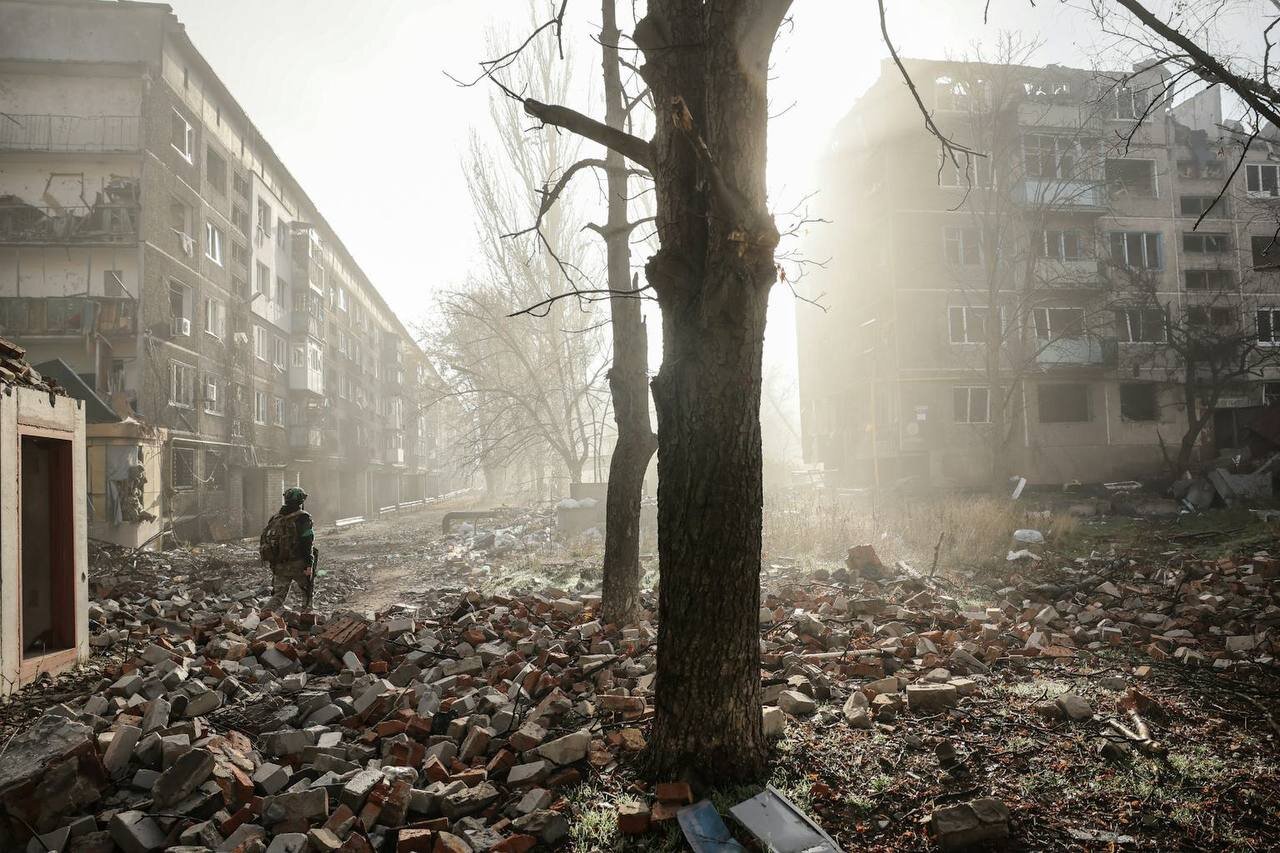
TEHRAN – Nearly 1,370 days after the start of the Russia-Ukraine war, President Donald Trump’s 28-point peace plan has exposed the contradictions of Western policy. The United States and Europe have long encouraged Ukraine to confront Russia and promised NATO membership and protection. Now, as the war drags on, those same powers retreat and Ukraine faces the consequences of a fire that the West itself has started.
President Trump’s proposal, reported by multiple news outlets, is shocking because it reflects Russia’s longstanding demands.
Territorial recognition: Crimea, Luhansk and Donetsk will be officially recognized as part of Russia. Kherson and Zaporizhia would be frozen along the current line of contact, effectively locking in Moscow’s control.
Military restrictions: Ukraine’s military will be reduced to 600,000 soldiers, far fewer than its current strength. NATO has pledged not to advance into Ukraine, and NATO troops will not be stationed there.
Diplomatic reintegration: Russia will be welcomed back into the G8, sanctions will be lifted, and $100 billion in frozen Russian assets will be directed toward rebuilding Ukraine. The remaining portion will be invested in a joint US-Russian fund to strengthen ties.
Security: Ukraine would receive vague promises of protection, but the actual military presence would be European jets stationed in Poland, not mainland Ukraine.
Social measures: Ukraine will hold elections within 100 days, and both sides will introduce educational programs aimed at promoting tolerance and reducing prejudice.
President Trump’s proposal is a settlement that reflects demands that Russia has made since the early stages of the conflict, dating back to its annexation of Crimea in 2014, and demands that have remained consistent ever since.
What is new is that these demands are now before President Volodymyr Zelenskiy, who must decide whether to accept them under pressure from Washington.
President Putin’s calculating welcome
President Vladimir Putin welcomed the proposal, calling it a “modernized version” that could form the basis for peace. He noted that Ukraine was still resisting, but argued that Kiev and its European allies were clinging to the illusion of defeating Russia on the battlefield.
Putin’s special envoy, Kirill Dmitriev, reportedly held talks with U.S. officials for several days to demonstrate Russia’s seriousness. The Kremlin’s reaction was cautious but clear. Russia sees the plan as confirmation of its long-standing demands. For Russia, this is not a concession, but a confirmation that patience and persistence have paid off.
Zelenskiy’s tightrope
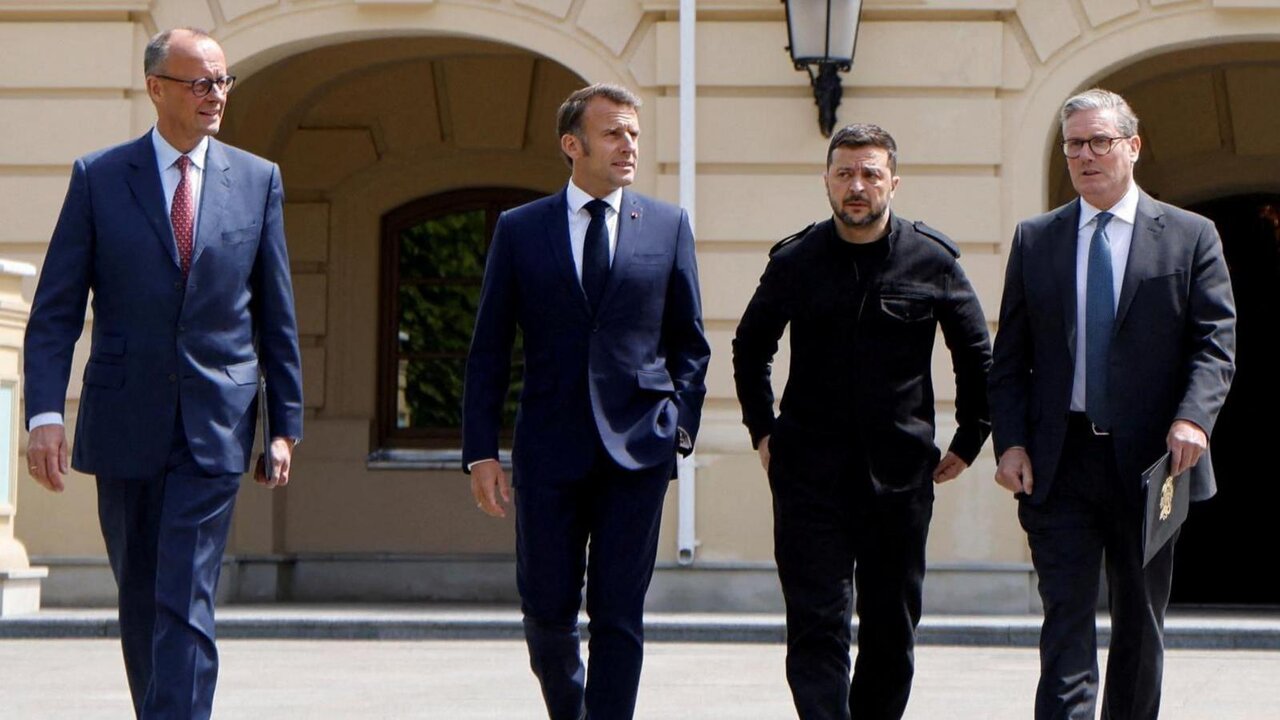
President Zelenskiy appears to be caught in the middle. He argues that any peace must respect sovereignty with “dignity.” Still, he acknowledges the pressure from Washington is immense. In his words, Ukraine risks “losing its dignity or losing an important partner.”
President Trump has asked for an answer within a week. Some Ukrainian officials have denounced the plan as a “capitulation” and “the end of Ukraine as an independent country.” But President Zelenskiy knows that rejecting the plan would mean losing U.S. support, while accepting it would mean surrendering territory and abandoning his dream of joining NATO.
While Zelenskiy is struggling abroad, a domestic crisis is brewing at home.
corruption scandal
Ukraine is rocked by the biggest corruption scandal under Zelenskiy. Investigators found bags of cash hidden in a Kiev apartment, a gold-colored toilet installed in one house, and records of huge kickbacks related to government-backed energy projects. The fallout forced the resignation of Justice Minister German Galushchenko and Energy Minister Svitlana Hrynchuk, and sanctions were imposed on Timur Mindić, a close aide accused of laundering $100 million. Public anger is rising, with headlines alleging that people close to the president stole from the country during the war. Critics say Mr Zelensky’s response has been slow and weak, raising concerns about political instability. The twin pressures of foreign diplomacy and corruption within the government now threaten Mr. Zelenskiy’s credibility.
Europe’s vain aid
European leaders were caught off guard by Washington’s initiative. Germany’s Friedrich Merz, France’s Emmanuel Macron and Britain’s Keir Starmer quickly pledged Zelenskiy’s “full and unwavering support.” Leaders welcomed the U.S. efforts, but stressed that Ukraine’s military must maintain its ability to protect its sovereignty.
Their words were carefully chosen. Europe cannot afford to openly challenge Washington, but it also cannot ignore the risk that President Trump’s plan could undermine Ukraine’s independence. This cautious diplomacy reveals Europe’s weaknesses. It is following America’s lead, even if it means supporting plans that legitimize Russian interests.
Behind the rhetoric is a sense of helplessness. Europe has neither military power nor political unity to independently shape outcomes. Its role has been reduced to praising US efforts, even when those efforts contradict Europe’s own stated principles.
Roots of Fire: Bucharest 2008
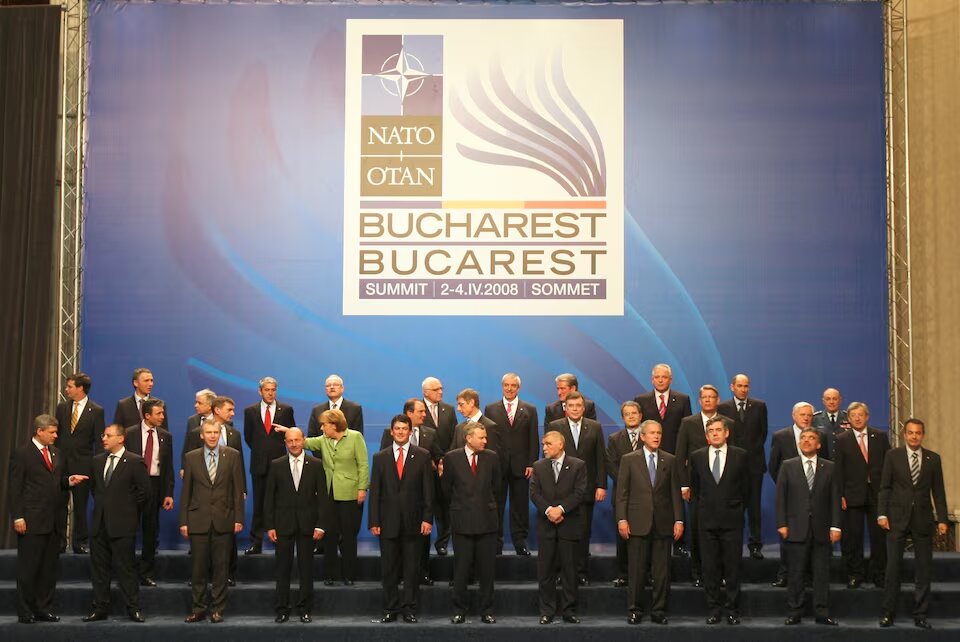
Top official attendees of the NATO summit pose for a family photo in Bucharest, April 3, 2008. Photo: Reuters
The war did not start in 2022. Its roots date back to the NATO summit held in Bucharest in April 2008. At that meeting, Western leaders announced that Ukraine and Georgia would “become NATO members.” For Moscow, this was a red line drawn on a security map.
Russia has long warned that NATO expansion into its borders is unacceptable. President Putin, who attended the summit in person, delivered a harsh message to the leaders of allied countries. He argued that recognizing Ukraine and Georgia would be a “grave strategic mistake” that would destabilize the region. His intervention underscored Russia’s determination to resist what it sees as a siege.
Under President George W. Bush, the United States pushed for immediate steps toward membership through the Accession Action Plan (MAP). The U.S. government believed that anchoring Ukraine and Georgia firmly in NATO would strengthen democratic reforms and deter what it called Russian “aggression.”
However, Germany and France resisted, fearing that such a move would provoke Russia and destroy European stability. German Chancellor Angela Merkel and French President Nicolas Sarkozy have insisted that neither Ukraine nor Georgia is ready for NATO integration, citing domestic political weaknesses and unresolved territorial disputes.
The result was a compromise that satisfied no one. NATO promised eventual membership but offered no timeline, no roadmap, and, importantly, no security. This half-hearted step created what many analysts later called “the worst situation for both countries,” raising hopes in Kiev and Tbilisi while leaving them exposed to Russian pressure.
Years later, Bucharest’s influence became clear. Georgia faced war with Russia a few months later in August 2008, with Russian forces intervening in South Ossetia and Abkhazia. Meanwhile, Ukraine remained in limbo, eventually pledging to join NATO but being denied real protection. This vulnerability paved the way for Russia’s annexation of Crimea in 2014 and culminated in all-out war in 2022.
Many historians and strategists now see the Bucharest summit as a turning point. NATO has inadvertently created a dangerous vacuum by offering distant promises to Ukraine and Georgia without providing immediate safeguards. It demonstrated an incompetent engagement, left both countries in a precarious position, and the gap between words and deeds helped set the stage for the current war.
promise without protection
Ukraine’s predicament today is a direct result of misplaced trust in the West. The United States and Europe encouraged Kiev to fight, but are now negotiating terms that legitimize Russian interests. What is called a “peace plan” is actually a solution to Ukraine’s fate decided by Washington and Moscow, with Europe following suit.
The West set Bucharest on fire in 2008, fanned the flames in Crimea in 2014, and burned down Ukraine in 2022. Today, Ukraine is paying the price for Western hubris and hypocrisy. President Trump’s plan only reveals what has been true all along. Western powers pushed Ukraine into conflict, but the prolonged war left Ukraine in a state of destruction.