
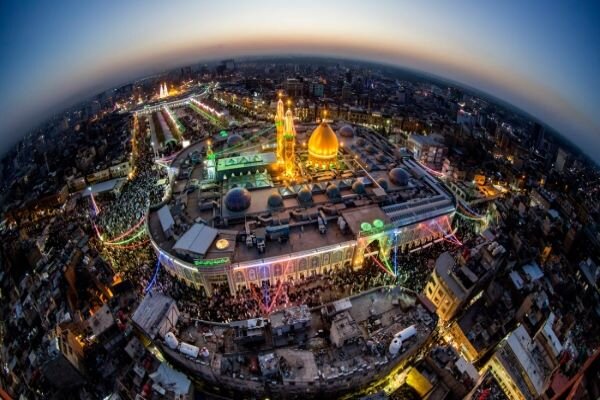
There are no doubt billions of people all over the world looking for human values such as truth, freedom, justice, peace, kindness, integrity, loyalty, and love.
Looking at the history of Islam, we can see that the lifestyles of the Holy Prophet Muhammad (Pbuh) and his Ahl al-Bayt (family) are the best role models for achieving high moral values and concepts for all humans.
All such high values can be found in the tragedy of Karbara and the grandson of Imam Hussein’s martialism (AS), Prophet Muhammad (Pbuh), and in the Battle of Kalbara on the day of Ashura, 72 of his faithful companions (Muharam 10, 61 Ah).
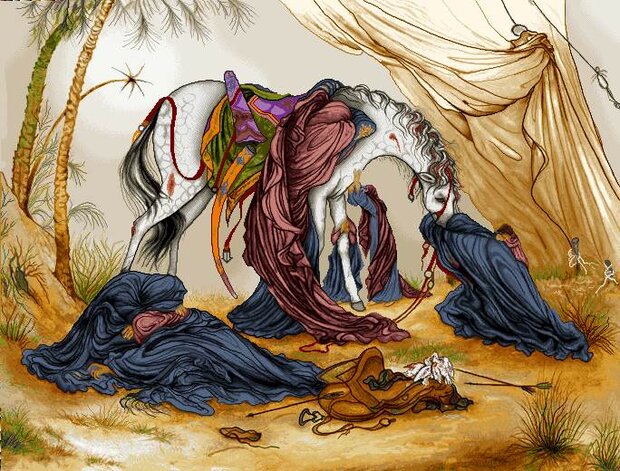
Ashura’s evening. Paintings by Mahmoud Farshchian
Imam Hussein (AS) was martyred after refusing to pledge his allegiance to the tyrant ruler of his then-twitter.
This great Imam presented a role model to all of humanity.
Today, the situation is like they feel humbled when intellectuals learn about Islam’s history and the story of Imam Hussein (AS).
Imam Hussein (AS) From the perspective of Muslim and non-Muslim scholars and thinkers:
Different non-Muslim scholars pay tribute to Imam Hussein (AS) as follows:
Edward G. Brown, a famous British Orientalist, wrote in his book, “The History of Persian Literary.”
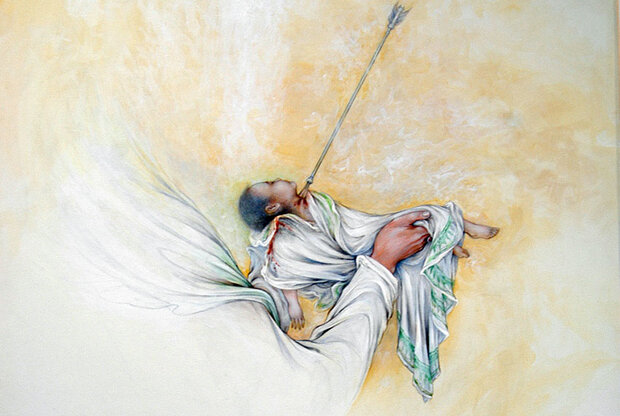
The Gift of Love; Painting by Mahmoud Farshchian
Scottish essayist, historian and philosopher Thomas Carlisle stated, “The best lesson we can learn from the tragedy of Karbala is that Hussein and his companions are strictly believing in God.
“If Hussein was fighting to heal his worldly desires… he doesn’t understand why his sister, wife and children accompanied him. So it makes sense that he sacrificed purely for Islam,” says Charles Dickens, a well-known British novelist.
The Bengali poet Rabindranath Tagore stated, “Hussain’s sacrifice shows spiritual liberation. Success can be achieved by sacrificing exactly what Imam Hussain did, instead of the army or weapons, in order to keep justice and truth alive.”
Indian philosopher and politician Sarvepalli Radhakrishnan said, “Imam Hussein gave his life years ago, but his destructive soul still rules the hearts of people today.”
Mahatma Gandhi, India’s political and spiritual leader, said, “I have learned how to achieve victory while being oppressed from Hussein. My faith is that progress in Islam does not depend on the use of the sword by believers, but is the result of the highest sacrifice of Hussein, the great saint.”
Edward Gibbon, considered the greatest British historian of his time, writes about the decline and collapse of the Roman Empire.
“Imam Hussein uprooted his tyranny forever until the day of his resurrection. He watered the garden of dry freedom with the surge in waves of his blood, and in fact he awakened the sleeping Muslim nation,” says Mohammed Iqbal, Pakistan’s great poet and philosopher.
Hungarian scholar Ignaz Goldjar wrote, “Karbara symbolizes the true face of the struggle against injustice – non-violent resistance. Instead of taking a life, sacrifice your life for Islam.”
Khalid Sheldrake, a British manufacturer who converted to Islam, said, “In that brave band, the enemy army was not only merciless and ready to fight, but even water was refused for the sake of their children. But at the best sacrifice, and all members bravely faced the greatest odds without flinching.”
Former Indian Prime Minister Pandit Jawaharlal Nehru and scholars stated, “The sacrifice of Imam Hussein is an example of the path of justice for all groups and communities.”
Former India President Rajendra Prasad also wrote, “The sacrifice of Imam Hussein (AS) is not limited to one country or country, but it is the genetic state of fraternal love of all humanity.”
Sarojini Naidu, an Indian political activist, and the poet, “I congratulate Muslims on the birth of Hussein (AS) and being fully respected and respected by all communities.”
“The battle in modern and past human history has not only provided more lessons than Hussein’s martialism in the Battle of Kalbara, but has also gained more sympathy and praise,” writes Kuwait-based Syrian Christian writer Antoine Bala, who is the author of “Imam Hussein, a Christian ideology.”
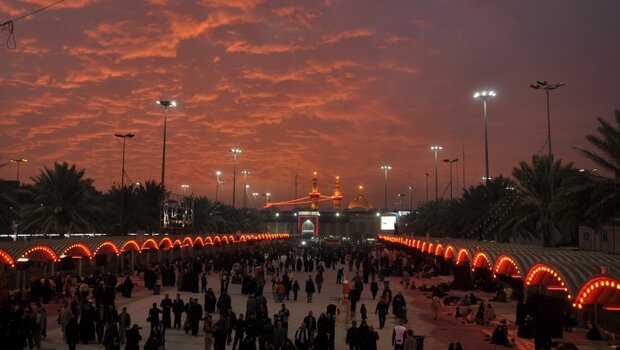
The tragedy of Kalbara, the martialism of Imam Hussein (AS), is one of the most important events. The lessons are not just about men’s groups, but also about all humanity, not just their relationship with the world. It is a moral paradigm. It teaches the opposition to sacrifice and injustice. It teaches purposefulness, family love, kindness and courage. In fact, in Imam Hussein’s tragic journey and martial accounts, there is a lesson in all moral virtues.
Edited by Marziyeh Rahmani