
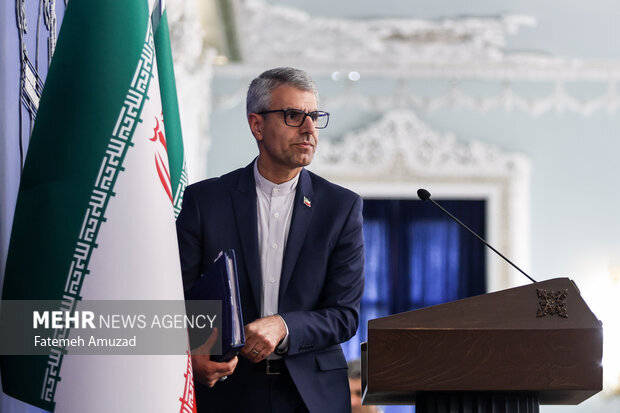
In an interview with Al Jazeera, Foreign Ministry spokesperson Esmail Baghai said Grossi’s previous statements paved the way for the US and Israeli regimes to invade Iran in June.
He added that the IAEA chief should avoid expressing unfounded opinions regarding Iran’s nuclear program.
In his remarks Wednesday, Grossi acknowledged that Iran does not appear to be actively enriching uranium, but claimed that the agency had recently detected new activity at Iran’s nuclear facilities.
He added that despite not having full access to Iran’s nuclear facilities, inspectors have not seen any activity via satellite that would indicate that the Islamic Republic has accelerated production of enriched uranium beyond what it had accumulated before its 12-day war with Israel in June.
On May 31, 2025, in a confidential report to the IAEA Board of Directors, the IAEA Director-General asserted that Iran had failed to report nuclear activity at three undeclared locations and expressed concern about the country’s stockpile of up to 60% enriched uranium.
In response to the IAEA report, the Atomic Energy Agency of Iran said that the inclusion of several irrelevant issues in the agency’s report is contrary to the IAEA’s professionalism, objectivity and impartiality.
AEOI added: “60% uranium enrichment is not prohibited under the (Nuclear Non-Proliferation Treaty) NPT, and Iran’s 60% enrichment and stockpiling are fully subject to regulatory oversight and verification.”
AEOI also stressed that all Iranian nuclear materials and activities are “fully declared and verified to the authorities.”
On June 13, Israel launched an unprovoked war against Iran, assassinating numerous senior military commanders, nuclear scientists, and civilians.
More than a week later, the United States also entered the war by bombing three Iranian nuclear facilities in serious violation of the United Nations Charter, international law, and the NPT.
Before the unprovoked war began, Iran had warned the IAEA of any politically motivated moves against Iran, saying it could derail cooperation between the U.N. nuclear watchdog and Iran.
Iranian officials claim that Mr. Grossi’s report on Tehran’s nuclear program paved the way for Israel’s invasion of the Islamic Republic.
In late June, Iran’s Constitutional Council approved a parliamentary bill on suspending cooperation with the IAEA.
The bill requires the Iranian government to cease all cooperation with the IAEA, citing violations of Iran’s sovereignty and attacks on its territorial integrity in the wake of the U.S. and Israeli invasion of Iran’s peaceful nuclear facilities and vital interests.
Iranian President Masoud Pezeshkian said in a phone call with European Council President Antonio Costa on July 9 that Iran would resume cooperation with the IAEA if double standards regarding its nuclear program were lifted.
RHM/Press TV