
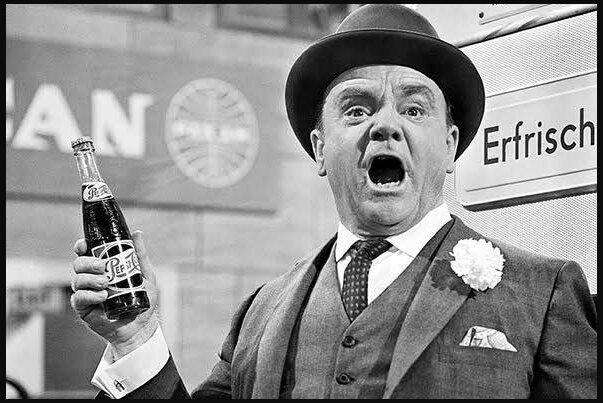
TEHRAN – The Iranian Artists Forum (IAF) Cinematheque will screen American director Billy Wilder’s 1961 political comedy film “One Two Three” on Monday.
Starting at 5pm, a screening will be held at the Forum’s Naseri Hall with Iranian critic Amir Reza Fakhri followed by a review session.
One, Two, Three is a high-octane satire set in Cold War-era Berlin that combines sharp humor and political commentary. The play is loosely adapted from Ferenc Molnár’s 1929 Hungarian one-act play Egi, Ketto, Halom, and was inspired by the 1939 film Ninotchka, which Wilder himself co-wrote.
The film features a star-studded cast, including James Cagney. Next to him are Horst Buchholz, Liselotte Pulver, Pamela Tiffin, Arlene Francis, Leon Askin, and Howard St. John. “One, Two, Three” is widely known for its fast pacing, witty dialogue, and satire on Cold War politics, capitalism, and American foreign policy.
Set primarily in West Berlin before the construction of the Berlin Wall, the story follows CR “Mac” McNamara, a high-ranking executive at the Coca-Cola Company. Mack is based in West Germany after a major business failure in the Middle East. Ambitious and eager to climb the corporate ladder, Mack is working towards becoming head of Coca-Cola’s Western European operations based in London. His plans are interrupted when his boss, WP Hazeltine, contacts him from Atlanta with an unexpected assignment. It involves taking care of Hazeltine’s passionate and somewhat innocent 17-year-old daughter Scarlett, who arrives in West Berlin.
Scarlett’s visit was unexpectedly extended from two weeks to two months. While there, Mac learns that she is married to Otto Piffle, an East German communist who is fervently anti-capitalist. Scarlett, a southern beauty with a rebellious personality, reveals that she is getting married to Otto, who plans to move to Moscow and start a new life. She proudly states that her marriage is anti-Yankee, not anti-American, and expresses her disdain for her Yankee origins.
Mac quickly realizes the complications this marriage brings, especially since Scarlett’s parents are soon to come to Berlin to pick her up. To take control of the situation, Mack secretly bribes an East German official to steal her marriage certificate and frames Otto for conspiracy, leading to his arrest. Mac’s plan involves planting a “Lasky Go Home” balloon on Otto’s motorcycle, giving him a strange wedding present: a cuckoo clock wrapped in a Wall Street Journal, and turning Otto into a spy. During interrogation, Otto eventually confesses to being an American spy under duress.
With his family’s future in jeopardy, Mac faces increasing pressure from his wife Phyllis, who wants to return to the United States, and the realization that Scarlett is pregnant and unmarried because their marriage certificate was stolen. Mac’s mission becomes to restore the marriage certificate and secure Otto’s release. To do this, he enlists the help of Soviet connections and resourceful secretary Ingeborg. Desperate to resolve everything before the Hazeltines arrive, Mac arranges for Otto to be adopted by a poor earl and fabricates an aristocratic ancestry by posting a photo of a ruined castle.
As a deadline approaches, Mac dresses Otto in aristocratic costumes and teaches him how to talk to Scarlett’s conservative Southern father, who is nostalgic for the Civil War. Meanwhile, Scarlett and Mac work together to help Otto pass as a member of the nobility. Miraculously, the Hazeltine family approves of Otto, and WP Hazeltine plans to appoint him head of Western European operations, allowing Mack to return to Atlanta for promotion.
The film ends with Mac reconciling with his family at the airport and celebrating his promotion by buying a Coca-Cola from a vending machine. In a humorous twist, the bottle he ends up offering is a Pepsi-Cola, emphasizing Wilder’s satirical view of American consumerism and corporate culture.
One Two Three received critical acclaim and was nominated for several awards, including the Oscar for Best Cinematography (Black and White), the Golden Globe Award for Best Motion Picture or Comedy, the Pamela Tiffin Award for Best Supporting Actress, and the Writers Guild of America Award for Best Comedy.
SAB/