
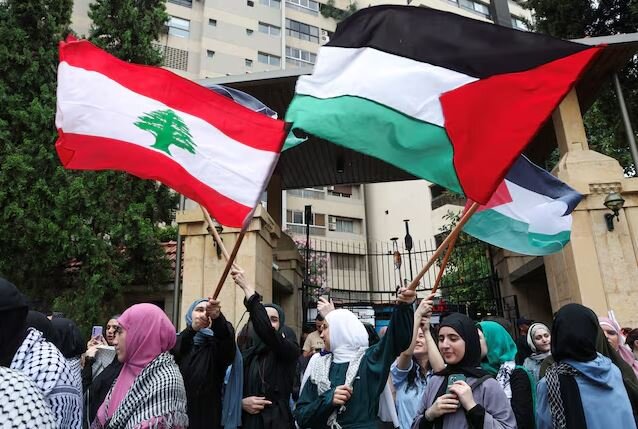
BEIRUT — If Lebanon were not a “corrupt state,” Lebanese students would have long ago shut down the den of “diplomatic occupation” masquerading as the U.S. embassy in Awkar, just as Iranian students stormed the U.S. embassy in Tehran in 1979 and declared a second revolution to protect the dignity of the nation.
On November 4, 1979, a group of Iranian students confronted American arrogance head-on and captured 52 spies posing as “diplomats” in an embassy that served as a headquarters for counterrevolutionary operations.
Their actions were not reckless, but a living embodiment of the slogan “Neither East nor West”: a rejection of domination and a declaration of sovereign will.
Lebanon stands at the other end of that moment today. Once a center of liberation thought, the university became a training ground for embassy-funded “civil society” projects.
The American “spy den” in Awkar is operating without any resistance. It is now a center of political, media, and even judicial manipulation. From airport screening to government formation, embassies touch every aspect of Lebanese life.
This is no ordinary diplomatic facility. 90,000 square meters of reinforced concrete hides intelligence facilities, data centers and coordination halls where Washington’s “soft war” against Lebanon is designed and deployed. Awkal is Beirut’s version of Baghdad’s Green Zone, except that it uses the words “freedom” and “aid.”
Ironically, the person who calls Lebanon a “corrupt state” is none other than US envoy Thomas Barrack, a product of the same imperial system that built Lebanon’s financial and political corruption.
At the Manama Dialogue in Bahrain on Thursday, Mr. Barrack derided Lebanon’s leaders as “dinosaurs,” ridiculed Lebanese institutions and declared that the country could not meet Washington’s demands to disarm Hezbollah.
While lamenting four decades of “turmoil,” Mr. Barrack ignored Washington’s own imprint on every phase of Lebanon’s instability, from the post-Taif debt trap to the central bank’s failure to the ongoing financial war orchestrated by Antun Senaoui, a banker with close ties to Washington’s Israeli economic lobby.
Yemen offers new lessons
When the Yemenis rose up in 2014, it was discovered that the U.S. embassy in Sanaa was the operational headquarters for the CIA and the Marine Corps, with equal control over cabinet, policy, media, and more.
After the success of the September 21st revolution, embassy staff fled, leaving evidence of the deep penetration of the US into the Yemeni state. Since then, even under war and siege, Yemen has regained its essence of freedom. In other words, sovereignty is freed from the dictates of embassies.
How envious the free people of Lebanon are of the free people of Iran and Yemen!
They envy those who dared to topple America’s idols, while Lebanon hides behind empty slogans of “sovereignty.” They envy those who have accepted suffering for dignity, but Lebanon clings to a false prosperity built on humiliation.
In Lebanon today, the word freedom has become empty. It is being reshaped by Washington’s Dictionary. Attack resistance while tolerating foreign occupation. American military attachés will be allowed to tour Beirut’s airport, but humanitarian flights from friendly countries will be prohibited. It has silenced its own military even as it accepts American bulldozers to dig near military areas.
This is not freedom, but guardianship in disguise. Until Lebanese rediscover their courage, Lebanon will remain a laboratory of foreign domination.
It’s time for Lebanese youth to take back their stories. This fight is not only against the Zionist regime of Israel, but also against the hands that run it. The American embassy’s influence in Lebanon transcends all diplomatic boundaries.
Closing Awkar’s spy den will be more than just symbolic. It will mark the return of sovereignty. A country that cannot stand up to U.S. interference cannot claim freedom or democracy.
If Lebanon were truly free, it wouldn’t need lectures from Washington.