
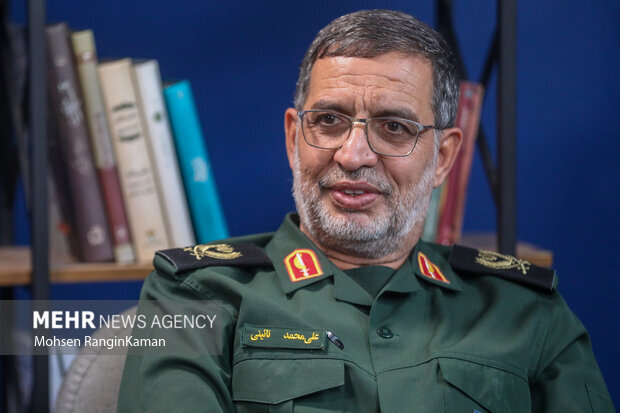
Speaking at an expert conference on scientific mobilization and education initiatives held at Farhanga University, Brigadier General Ali Mohammad Naini, Spokesman and Acting Public Relations Officer of the Revolutionary Guards, said that during the recent 12-day war imposed by the Israeli regime, Iran’s strategy was to rely solely on its own capabilities. According to Naini, this approach allowed Iran to “inflict defeat on its enemies.”
Mr. Naini emphasized the role of popular mobilization (Bashij) as a pillar of state power, and argued that political systems that are separated from the people are prone to collapse. He emphasized that the Basij is a force that unites diverse social groups and acts as a decisive variable in crisis situations.
Reflecting on aspects of recent conflicts, he said wars are a test of deterrence, strategic doctrine and national resilience. He said the Iranian Armed Forces has faced continuous threats over the past four decades, resulting in the principles of defensive, people-oriented, self-sustaining and asymmetrical power-building established after the eight-year Iran-Iraq War.
Naini added that evolving threats require investment in higher-range missiles and new capabilities. He noted that Iran had strong security ties with its neighbors during the conflict, and said regional countries “immediately condemned” Israel’s attack on Iran.
He also said that the average age of Iranian missile scientists is about 30 years old, and described them as young professionals who study hard “at the level of the martyr Hassan Tehrani Moghaddam.”
Naini said the recent attacks on Iran were violent, swift and highly coordinated, and were the culmination of multiple regime change efforts. He said Iran had attacked at least 45 strategic centers of the enemy, inflicting significant damage and forcing a call for a cessation of fighting.
He argued that adversaries have always misjudged the source of Iran’s power and cited statements by Israeli officials acknowledging losses and failures, stressing that if the conflict had continued for two more weeks, “there would have been nothing left for the Israeli regime.”
Naini said Iran’s military is now even more prepared than it was during the 12-day conflict and working to address past damage. He concluded that Iran was not seeking aid from any foreign country and aimed to neutralize the “weak Iran” narrative, a strategy that he said was ultimately successful.
On June 13, while Washington and Tehran were in the process of nuclear negotiations, Israel launched a blatant and unprovoked invasion of Iran. The Israeli attack sparked a 12-day war that left at least 1,064 people dead in the country, including military commanders, nuclear scientists and civilians.
The United States also entered the war by bombing three Iranian nuclear facilities in a serious violation of international law.
In response, Iranian forces targeted strategic locations throughout the occupied territories, as well as Al Udeid Air Base in Qatar, the largest US military base in West Asia.
On June 24, Iran successfully thwarted the invasion through successful retaliatory operations against both the Israeli regime and the United States.
MNA/IRIB5634575