
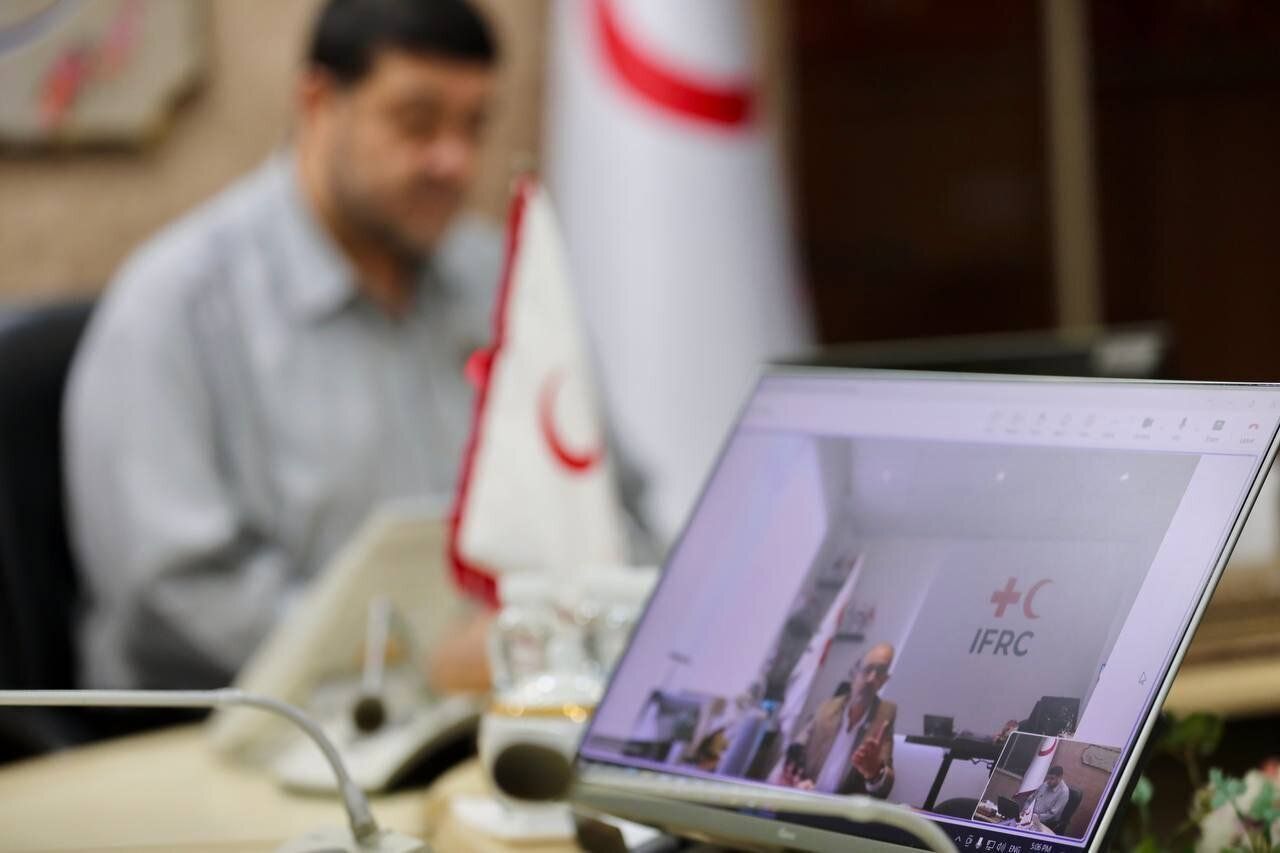
TEHRAN – Hossam Elshaqawi, Regional Director for the Middle East and North Africa (MENA) of the International Federation of Red Cross and Red Crescent Societies (IFRC), highlighted the role of the Iranian Red Crescent Society (IRCS) as one of the key humanitarian actors in the region and the world.
According to a report by IRNA, El-Sharkawy praised the efforts of IRCS, said that IRCS decisions are very effective at the international level, and congratulated Pirhossein Kolivand on his re-election as IRCS Director-General.
The official made the remarks during an online meeting with Mr. Kolliband on Thursday. During the meeting, the two officials discussed ways to foster cooperative efforts, develop rescue systems to strengthen the country’s preparedness and response capabilities, and hold international conferences and conferences in Iran.
IRCS proposed holding an International Islamic Youth Conference and a Conference of Leaders of National Societies of Islamic Countries.
Both sides also emphasized the need to implement the memorandum of understanding previously signed between the two organizations to lay the foundation for promoting educational, operational and logistics cooperation.
IRCS also proposed bringing in experts to follow up administrative and technical cooperation with MENA regional offices.
joint efforts
On 8 September, IRCS, in collaboration with the IFRC and the International Committee of the Red Cross (ICRC), held a workshop on the critical importance of rehabilitation.
“Rehabilitation is not just about providing medical services; rehabilitation is about restoring life,” said Faisal Mahboub, Head of the IFRC Mission to Iran.
“We are here because of our shared mission: to help people regain dignity, independence and hope through health and rehabilitation,” the IRCS website quoted Mahboub as saying.
The official made the remarks online while speaking at a workshop to familiarize himself with the services of the International Red Cross and Red Crescent Movement in the field of treatment and rehabilitation.
The official continued: “Strategy 2030 reminds us of three key priorities: strengthening local preparedness so that societies can rely on their strengths and capacities, investing in the future so that young people and volunteers can provide leadership, and promoting collaborative efforts because no society can face crises alone.”
Mr. Cassard, who attended the workshop, said: “This initiative underlines our joint efforts and mutual understanding within the International Red Cross and Red Crescent Movement and underlines the important role we play in the implementation of humanitarian work.”
In March, IRCS and ICRC discussed ways to expand cooperation to promote support and medical services, particularly rehabilitation services, across the country.
At the conference held on March 13, Mr. Cassard emphasized the need to prevent disability and develop psychosocial support services in disadvantaged areas. These valuable actions could pave the way for further cooperation.
IRCS Director of International Affairs Razieh Arishvandi highlighted the successful partnership between the two organizations. The official praised the ICRC’s efforts in the country and stressed the importance of holding training courses on international humanitarian law (IHL) and the need to learn about the Red Cross movement.
IRCS has taken various steps to leverage the capabilities of its 270,000 staff, relief workers and volunteers to serve the people, she noted.
Mr. Cassard commended IRCS for the measures taken during the Nowruz holiday and announced the ICRC’s readiness to support IRCS in organizing World Red Crescent Day and expanding medical, rehabilitation and humanitarian services in disadvantaged areas.
In February, IRCS and ICRC agreed to establish a joint secretariat for rehabilitation services in Tehran.
Speaking at a meeting in Tehran in preparation for the first international conference on disability and rehabilitation, Mr Koliband said rehabilitation is an important part of universal health coverage.
“Rehabilitation services are in great need in the country due to wars and other accidents. Therefore, the association has started providing rehabilitation services and manufacturing prosthetics and orthoses. Currently, 200 rehabilitation centers are operating in Iran and the conference will focus on the activities of these centers,” he added.
MT/MG