
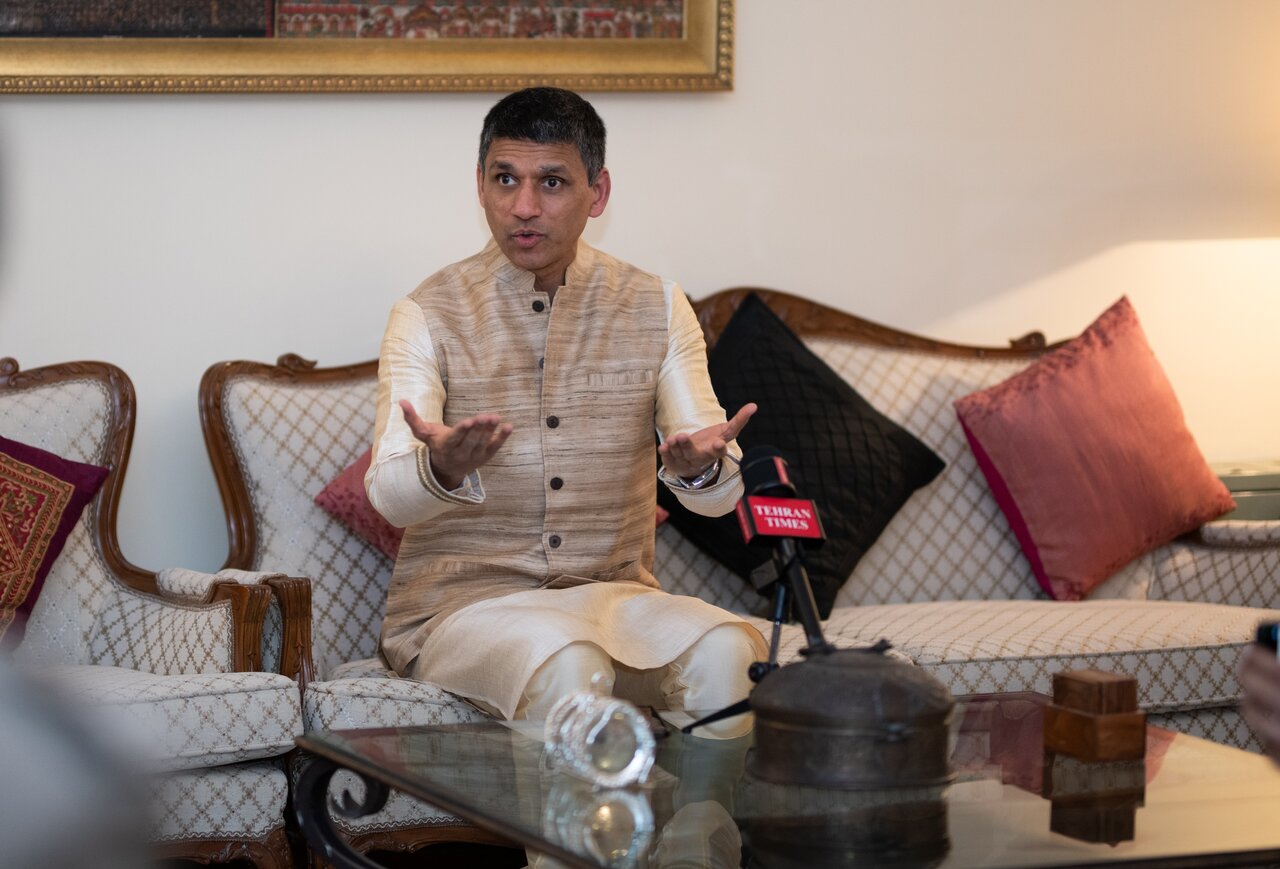
TEHRAN – In an exclusive interview with the Tehran Times on Saturday, India’s ambassador to Iran called for greater efforts to correct what he called a “distorted image” of Iran formed by Western media.
Ambassador Rudra Gaurav Shres emphasized that Iran is a safe, hospitable and culturally rich country with centuries-old ties to India.
The envoy encouraged further travel, cultural exchanges and media engagement, stressing that closer people-to-people contact could help Indians rediscover the warmth of Iran and the civilizational heritage it shares with India.
Below are excerpts from the interview.
Q: How many Indians and people of Indian descent currently live in Iran?
The number of Indians staying in Iran for long periods is not that large. Approximately 150 members of the Sikh community have lived here for several generations, primarily as merchants and businessmen. Another group of about 120 Indian women studied in India and married Iranians who settled here. In total, about 300 Indians reside here permanently.
In addition, about 10,000 Indian nationals are staying temporarily. Approximately 6,000 of these are Shiite students studying theology in Qom and Mashhad at Al-Mustafa University. The remaining approximately 2,000 to 2,500 are medical students enrolled in universities in Tehran, Shiraz, Isfahan, Arak, and even Urmia.
An additional 1,500 to 2,000 Indians work in Iran, many of them along the Makran coast in oil refineries, the steel industry, and ship maintenance. The Indian community totals approximately 10,000 to 11,000 people, making it one of the largest foreign communities in Iran after Afghans and Iraqis.
Q: How many Indians are visiting Iran as tourists? What do you think about increasing mutual tourism?”
Most Indian travelers visit Iran for religious purposes, namely pilgrimages to Qom and Mashhad during Muharram and Arbaeen. Approximately 20,000 Indian pilgrims visit Iran every year. However, there are only about 1,000 non-religious tourists. There is great potential to increase this number.
From the Iranian side, our embassy issues about 10,000 visas a year. However, many of these are aimed at business travelers due to the higher cost of business visas. Most visitors from Iran visit Delhi, Agra, Rajasthan, Goa and Hyderabad, but we want to expand our interest beyond these destinations. Recently, we organized a tourism promotion event in collaboration with Tehran Chamber of Commerce and Industry to connect Indian and Iranian travel companies.
Q: How do the general public in your country perceive Iran, considering the negative portrayal by Western media?
Unfortunately, the image of Iran in the minds of many Indians has been shaped by Western media, which often portrays the country as dangerous or unstable. This is far from the truth. Indians visiting Iran always express how warmly they were welcomed and how safe they felt.
Iranian hospitality is legendary and one of the best in the world. But not enough people in India are aware of this. More active promotion of Iran’s safety, culture, and natural beauty would correct this misconception.

On November 1, 2025, Rudra Gaurav Shres, the Indian ambassador to Tehran in northern Tehran, spoke to Tehran Times in an exclusive interview.
Q: What steps can Iran take to change this negative perception and attract more Indian tourists?
Iran may adopt some of the strategies adopted by other countries that have been successful in attracting Indian tourists. For example, 2.8 million Indians traveled to Thailand and about 36,000 to Armenia last year. Both countries are running aggressive tourism campaigns in India, advertising on television and in cinemas.
On the other hand, no such propaganda campaign has yet taken place in Iran. We recommend inviting Indian travel influencers, especially women, to Iran. If they share their experiences of how safe, friendly and attractive Iran is, it will go a long way in correcting misconceptions and attracting more visitors.
Q: Looking ahead, what message would you like to send to Iranian visitors who may come to your country, people who are looking for a shared cultural heritage and friendship rather than just as tourists?
I think what’s happened over the last 75 to 80 years is very interesting. Until 1947, India and Iran shared a common border and were direct neighbors. The people of both countries knew each other’s culture and history well. But after the Partition of India, that common border disappeared, and awareness of our deeply shared cultural history gradually faded.
Unfortunately, the image of Iran in the minds of many Indians has been shaped by Western media, which often portrays the country as dangerous or unstable. This is far from the truth. Indians visiting Iran always express how warmly they were welcomed and how safe they felt. Iranian visitors to India today have much to discover not only about India, but also about Iran itself. India has nearly 500,000 Persian manuscripts, far more than Iran.
The first Persian language newspaper was published in Kolkata. The first Persian dictionary and even the first collection of Persian poetry were created in India. Before British rule, Persian was the official language of India. At that time, the number of Persian speakers in India was about seven times the total number in Iran today.
India’s most famous monument, the Taj Mahal, is another beautiful symbol of our shared history. Its architect was Iranian, and the queen for whom this monument was built was also an Iranian princess. However, many visitors are unaware of this relationship.
Iranian tourists usually visit Delhi, Agra, Rajasthan, Goa, and sometimes Hyderabad. But India is vast and has many unexplored regions, from the snow-capped mountains of the north to the lush southern state of Kerala. In fact, this year’s Diwali is promoting Tamil Nadu, a culturally rich southern state that is still relatively unknown to Iranians.
We also recommend Iranian travelers to explore these lesser-known regions of India. And I hope more Indians discover Iran as well. Tourism exchanges help our young people rediscover the centuries-old mutual respect and love that binds our countries together.
Q: How do you see the possibility of celebrating Iran’s major festivals like Nowruz and Yalda Night at the Indian Embassy to promote mutual understanding?
Nowruz is already widely celebrated in India, especially in the Kashmir region, which has very strong cultural ties with Iran. Zoroastrian communities in Mumbai and neighboring areas also celebrate Nowruz, but on different dates as they follow the Jamshidi calendar.
Other festivals like Charshanbe Suri and Yalda Night are still lesser known in India. Personally, I feel it would be more effective if the Iranian embassies in Delhi and the Iranian embassies in Mumbai and Hyderabad organized such celebrations. Just like we are here introducing Indian festivals like Diwali and Holi to Iranians, Iran could also introduce beautiful traditions in India. This will generate a lot of interest and deepen your understanding of the culture.
In fact, Diwali, India’s festival of lights, is symbolically similar to Charushanbe Suri and Yalda, which celebrate the victory of light over darkness.
Ambassador’s closing words:
There is a Persian proverb that goes, “Dosti deraaz, ra kuta.” When friendship is deep, the path between us is short. That also applies to India and Iran. Our history, language and culture are deeply intertwined. Through expanded tourism, education, and cultural exchange, we can ensure that this ancient friendship continues to thrive in modern times.
morning