
TEHRAN – During the 12-day attack on Iran by Israel and the United States in June, a number of events had a major impact on the Iranian people, causing feelings of shock, sadness and fear. The targeting of residential areas, the bombing of Iran’s state television headquarters, the attack on prisons, and the horrific scenes in Tehran’s Tajrish Square, where cars and pedestrians were thrown into the air by Israeli missiles, are among the events that deeply moved Iranians.
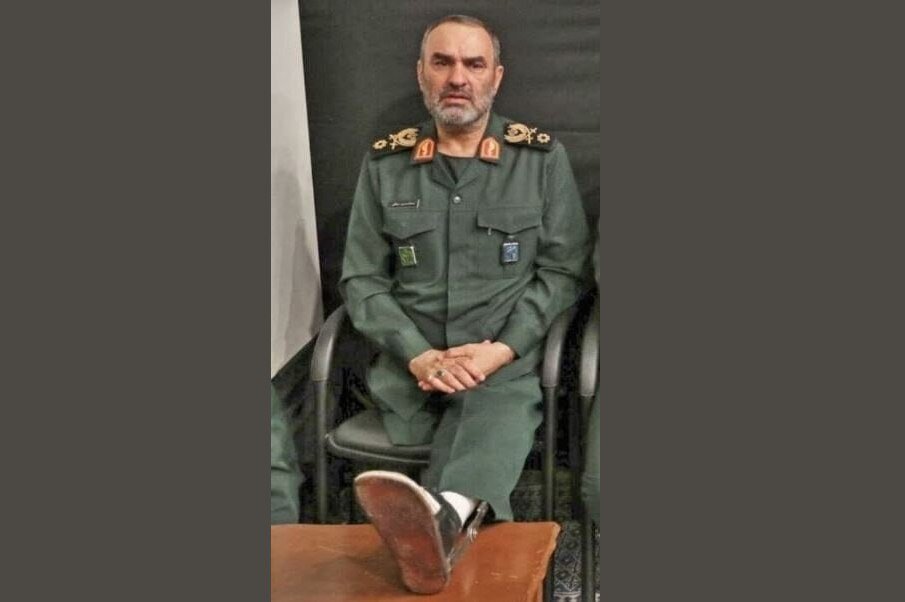
For Iranian journalists, especially those in Tehran, it was all just as frightening. Every day we walked around the city that had kept us everything, struggling to reconcile the familiar reality with the fact that we were under attack. During those 12 days, I remember intentionally not covering any one incident or news item for too long. My focus had to remain on reporting what was going on. I told myself that sadness, curiosity, and even pride would take their place after the war was over. One image, which I then decided to consider further, was an old photograph I first encountered during the invasion. A military commander-in-chief has lost a leg, and the other leg, clearly injured, rests on a coffee table. The photo from a year ago was of Brigadier General Mohammad Hassan Mohaghegh, deputy chief of intelligence for the Islamic Revolutionary Guards Corps (IRGC). The article was widely published on news websites on June 16, 2025, the day after Israel assassinated the commander.
Mohaggeg was one of the lesser-known commanders targeted by Israel during the Twelve Days War. This month I was finally able to get in touch with some of his family and friends. The first person I spoke to was Iranian parliamentarian Esmail Kousari, Mohaghegh’s comrade during Iraq’s invasion of Iran in the 1980s and later his brother-in-law.
“I don’t think I’ve ever seen anyone work as hard as Hassan,” Kowasli said. “Hassan was physically weaker than most people, but he worked harder than everyone around him.”
Mohagegh’s life was shaped by struggles from an early age. Born in Tehran in 1963, he grew up in the shadow of his father, a prominent cleric in Rafsanjan who was deeply involved in the political upheaval against the shah. As the eldest son, Hassan naturally followed in his father’s footsteps, and his teenage years were spent not in schoolyard worries, but in the dangerous world of political activity. This path put him squarely in the crosshairs of the Shah’s secret police, SAVAK, who arrested him in the turbulent months leading up to the 1979 revolution. The details of his imprisonment are largely lost to history.
In his late teens, he joined the front line as an Iranian soldier during Saddam Hussein’s invasion of Iran. A few years into the eight-year war, he assumed command of the Habib ibn Mazahir Battalion, part of the prestigious 27th Mohammad Rasulullah Division. This unit was known for its intellectual and religious composition.
“Hassan was seriously injured during an important Iranian operation in 1986. When I saw his body, one leg was missing and the rest of his body was covered in blood. We thought he had lost his life, so we placed his body among the martyrs and sent it to a field hospital in Ahwaz,” Kousari explained.
It was only by chance that the comrades checked one last time and detected a faint pulse in Mohageg. He experienced cardiac arrest once while hospitalized in Ahwaz hospital, but miraculously survived in the end.
After the war, Kousari introduced Mohagegh to his 23-year-old sister, a recent graduate working as a teacher. She said she wasn’t seriously thinking about marriage when they met. “I had just started working and wanted to focus on building my career. My previous meetings with suitors weren’t that important. I was planning on staying single for at least a few years,” she said.
But when the young woman saw Mohage for the first time, she felt something stir within her. “We were a religious and traditional family, so our first meeting was a formal introduction with his family at home. My brother told me beforehand that Hajji Hassan had lost a leg during the war and had been injured in other places. But when I met him , he walked quickly up the stairs as if there was nothing wrong with his legs. When we were sent to talk, I saw no signs of weakness in him. He was strong, determined, and kind, and described the qualities he wanted in his future.” My wife will own it,” she explained.
The young couple quickly developed an affinity for each other. “I don’t know how to explain the emotions we experienced. Haji Hassan later told me that he too knew I would be his wife the moment he saw me.”
For several years after the war, Mohagegh divided his time between military service and studies. He earned two doctorates, eventually became a top commander in the Revolutionary Guards, and had three children with his wife. Throughout those four decades, he continued to battle injuries sustained during the Iran-Iraq war. “Over the next few years, he underwent many surgeries,” his wife recalls. “But even when he was in deep and excruciating pain, he never complained. He recovered quickly and did his best to fulfill his military and fatherly duties. No matter how much pain he was in, he believed he had a duty to fulfill.”
When Israel assassinated Mohageg, it was his only daughter who suffered the loss of Mohageg the most. “She was the closest thing to a father. I have two sons, and I often say that the bond between father and daughter is very strong, and that’s exactly what happened in our family.”
Days after Mohage’s martyrdom, his daughter told her mother that she believed her father had helped her cope with the grief. “After some very difficult days, my daughter started to improve. She told me that she was feeding the infant when she felt her father’s presence in the room. Her father’s presence made her feel much better.”
From the day a young Mohagegh was wounded in the Iran-Iraq War to the day he was assassinated by Israel decades later, much has happened. “But he remained the same. Even in his 60s, he was the same determined young man I saw when I first met him. His ultimate goal was to serve his country and his God, and he did just that,” his wife said.