
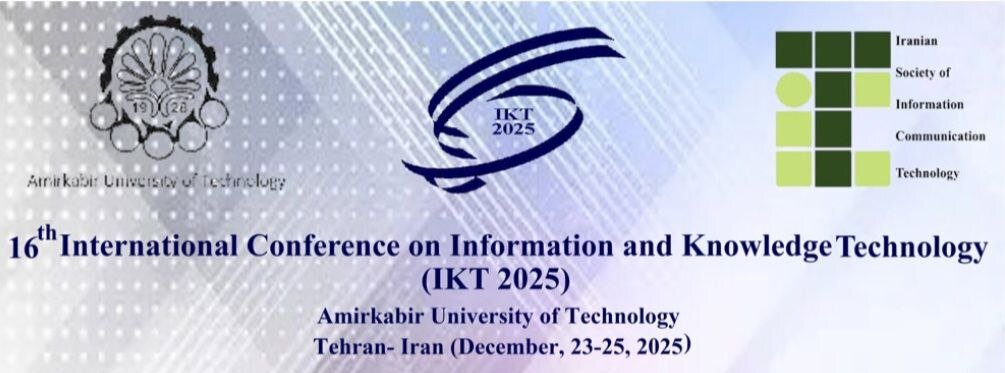
TEHRAN – The 16th International Conference on Information, Knowledge and Technology (IKT 2025) is scheduled to be held in Tehran from December 23 to 25.
The Iranian Information and Communication Technology Association will hold a conference at Amikavir University of Technology, IRNA reported.
The conference aims to develop knowledge and information technology, share expertise and the latest scientific results, and lay the basis for decision-making in the field of information and communication technology.
Theoretical foundations, algorithms, and innovations in artificial intelligence (AI) applications and machine learning will be the focus, covering topics such as natural language models, large-scale language models (LLM), deep learning, big data analytics, generative AI, business intelligence, and decision support systems.
Digital transformation in industry, economy, society and family. smart banking and financial system. Cryptocurrency, education in the age of AI. Ethical and legal issues. Privacy protection; data-driven decision making. Other topics at the conference include digital governance, justice-based sustainable development, and more.
We will also focus on information transmission and processing technologies and cybersecurity, including topics such as network virtualization, 6G networks, edge and fog computing, real-time data analytics, quantum processing and encryption, and self-healing software.
The event will also feature academic conferences, lectures, professional roundtables, educational workshops, competitions, and awards ceremonies.
Innovative knowledge-based products will be on display alongside the conference.
Current status of ICT in Iran
The Ministry of Information and Communication Technology is the country’s highest authority in the ICT sector. All activities related to the information and communication technology industry are directly connected to the Ministry.
The government is paying special attention to plans and policies in this area to maximize the use of ICT to facilitate people’s lives.
The successful design, construction, and launch of a satellite demonstrates the growth of a country’s national technological and scientific capabilities.
Space technology has been considered a tool to expand the prosperity, peace, scientific and cultural development, and economic development of human society.
Different countries of the world are leveraging this technology in one way or another based on their capabilities, capabilities and efforts.
Currently, 13 universities and research institutes under the Ministry of Science, Research and Technology have established aerospace majors in Iran, and the country has a high ability to cultivate experts and experts in the field of aerospace, making it a developed country in the region.
Access to telecommunications services in rural areas of the country improved during the period, with the total number of villages with access to telecommunications services increasing to 52,182, or approximately 93% of all villages, and 47,837 villages now having access to household landline telephone services.
Furthermore, according to the CRA, the number of mobile phone users in Iran has reached nearly 135.89 million, making the country’s mobile phone penetration rate 161.67 percent.
However, the figures show that fixed broadband penetration in Iran remains stagnant at 14%, with nearly 11.921 million customers accessing the internet through these services.
The statistics show that fixed broadband internet is growing by less than 2% compared to last year, while mobile internet is growing by 10%. However, the penetration speed of mobile internet is five times that of fixed internet.
MT/MG