
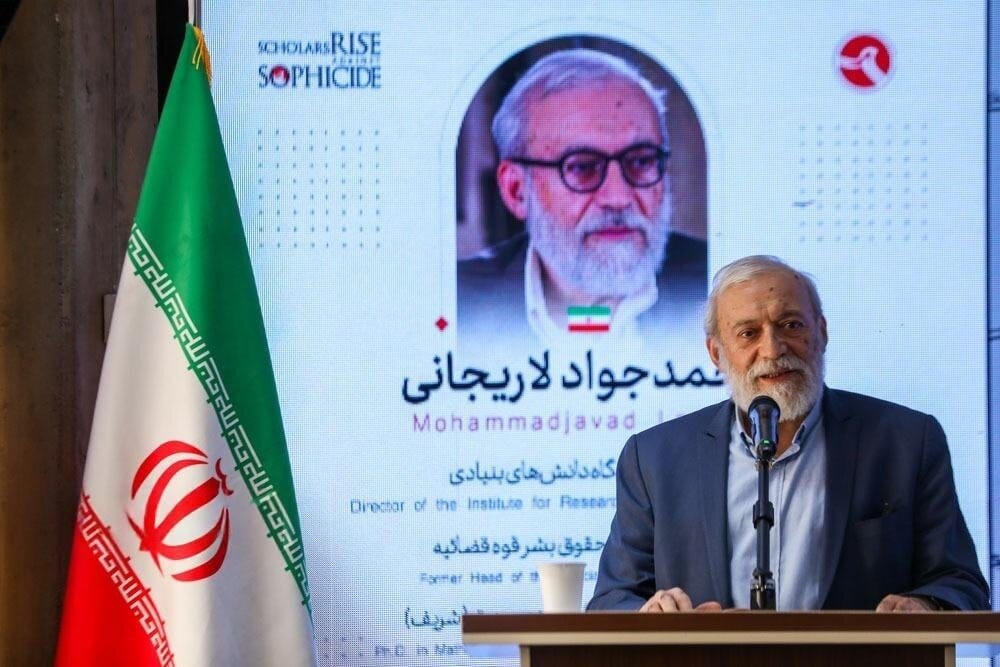
TEHRAN – Iran has launched an international conference entitled “Rise of Scholars Against Sophicide” to condemn the systematic assassination campaign of scientists orchestrated by the United States and Israel.
Mohammad Javad Larijani, director of the Iranian Institute of Basic Sciences and chairman of the event, said Thursday that the conference aims to raise global awareness of the growing threats to scientists in Iran and other developing countries.
“This conference was quickly organized to address emerging threats to science and knowledge,” Larijani said in his opening remarks. “We are facing a new form of terrorism: scientific terrorism.”
Larijani referred to the recent 12-day conflict between Iran, Israel and the United States, and said several Iranian nuclear scientists and military personnel were assassinated during hostilities.
“The administrations in Washington and Tel Aviv have adopted a dangerous new approach, believing that if they don’t like scientists, they can get rid of them by any means necessary,” he said.
Israel launched an unprovoked attack on June 13, killing numerous senior commanders, nuclear experts, and civilians. The United States later joined the conflict, attacking three Iranian nuclear facilities.
Iran responded by targeting Israeli military sites and the US military’s al-Udeid air base in Qatar. A retaliatory operation ended the fighting on June 24.
Larijani pointed out that several prominent scientists were killed along with their families under the false pretext of developing nuclear weapons. Larijani emphasized that Iran’s scientific efforts are completely peaceful, citing a fatwa by Islamic Revolutionary leader Ayatollah Khamenei that explicitly forbids the production of nuclear weapons.
Larijani accused Western countries of trying to monopolize science and technology to maintain global dominance. “They believe that scientific knowledge is not appropriate for certain countries,” he says. “The rise of the Islamic Republic and other emerging powers are challenging this monopoly.”
Iranian academics called for strengthening global mechanisms to protect scientists and promote ethical research. “We must expand our scientific ethics,” he stressed. “Scientists should not be disenfranchised or intimidated. Conferences like this one must continue to raise awareness and strengthen cooperation among academics.”
Larijani described “sophistication murders,” the targeted killings of scientists, as a dangerous new reality that justifies murders in the name of scientific management. He warned that the use of advanced weaponry, surveillance technology and data misuse is turning ordinary equipment into tools of assassination.
“The academic community must lead the effort to build a secure and sovereign technology ecosystem,” he said. “Universities should reclaim their role in shaping political and scientific debates towards justice and peaceful development.”