
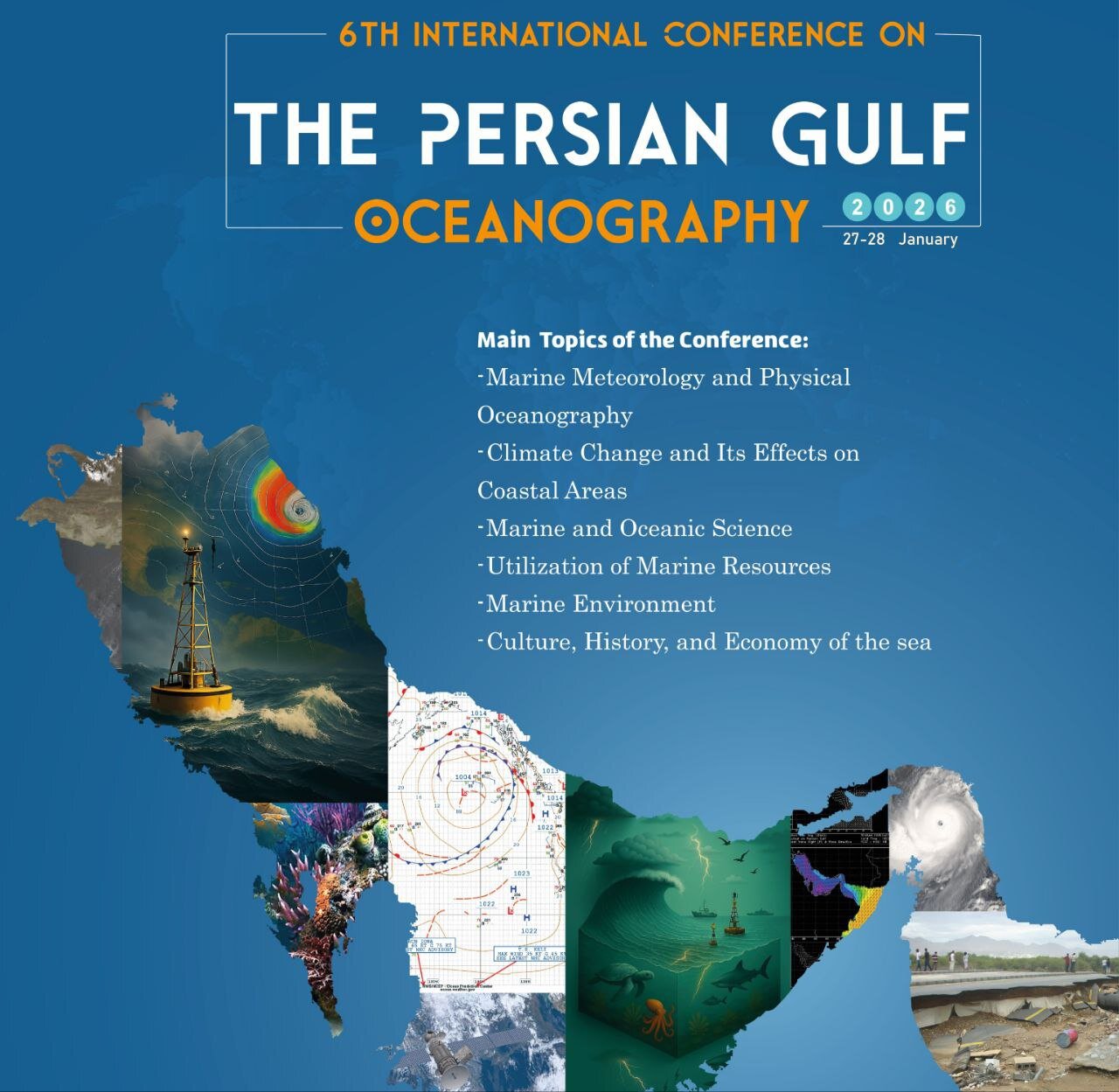
Tehran – The 6th International Conference on Oceanography of the Persian Gulf is scheduled to take place on January 27th and 28th, 2026.
Every four years, Iranian weather agency will hold a meeting this year in Bandar Abbas, a port city surrounded by the Persian Gulf. It brings together local and global experts and researchers in a variety of fields, including meteorology, atmospheric science, oceanography, climatology, physics, geography, remote sensing, and more.
The event serves as an outstanding platform for strengthening knowledge, latest scientific achievements, and national and global cooperation in the oceanography and marine environment sector.
It focuses on marine weather, physical oceanography, climate change, coastal regions, marine and marine science, use of marine resources, use of marine environments, and impacts on marine culture, history and economy.
Development of applied research, sustainable exploitation of marine resources, coastal environmental protection, and sustainable sea-based development are one of the main goals of the conference.
Emphasizing the importance of artificial intelligence, benefiting from modern technologies, including remote sensing to protect the Persian Gulf and increase the resilience of the community, the Sixth Conference’s scientific discoveries will help open up ways to make key decisions and adopt the best strategies for ocean management, and contribute to the development of sustainable oceans. These findings apply not only to maritime geography of the Persian Gulf, but also to a variety of maritime sectors.
The 5th Persian Gulf Ocean Conference began in January 2022 in Tehran. The two-day meeting was attended by representatives from Belarus, Finland, Azerbaijan, Iraq, Ukraine, Pakistan and Russia, as well as civil servants related to marine and port development.
A precious marine environment
The Persian Gulf is a valuable body of water in terms of ecosystems and biodiversity, but is seriously affected by a variety of depletion factors, including oil pollution, extraction and transport.
The Persian Gulf has an area of approximately 241,000 square kilometers. Its length is approximately 990 km and its width varies from a maximum of 340 km to a minimum of 55 km in the Strait of Hormuz.
It is a semi-closed sea with an average depth of 35 meters, a semi-closed sea of 15,000 years, with its unique environmental characteristics due to its severe thermal fluctuations and annual evaporation rate of 140 cm.
In addition to 1,100 species of fish and five turtle species, there are two species of dolphins and whales in the area. The Persian Gulf also has the second largest population of manatees, 232 seaweed species, and 4 million migratory birds a year, but today 240 important species and many habitats are under threat.
Of the 21 largest oil spills in the world, seven cases have occurred in this water, threatening aquatic ecosystems.
Hassan Mohammadi, coordinator of the Regional Agency for Marine Environmental Protection (ROPME), said in December 2019 that, as current environmental issues continue, about 20% of native species in the Persian Gulf will be extinct by the end of the century, and 10% of new species that may be invasive will replace them.
mt/mg