
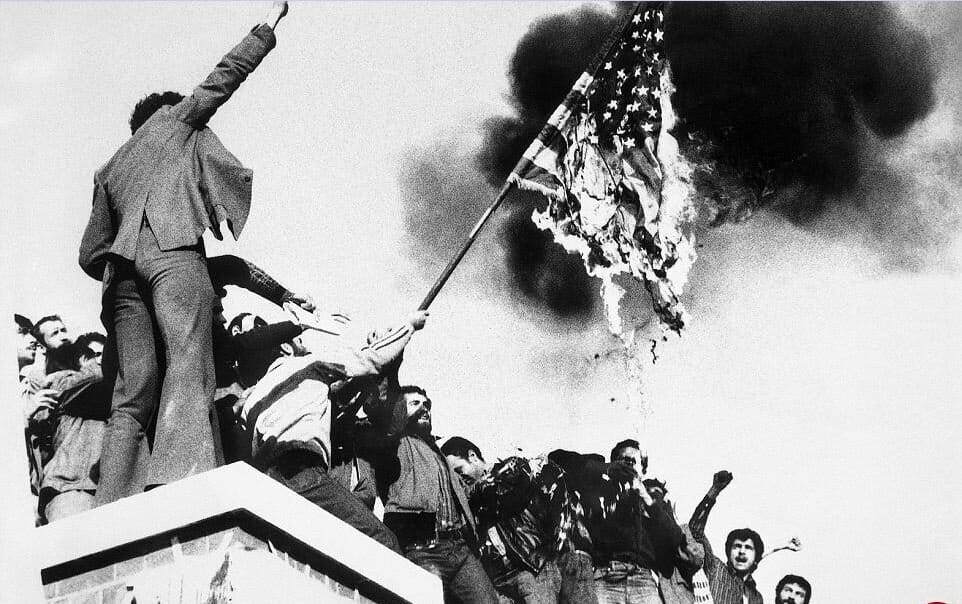
MADRID – Every November 4, Iran commemorates an episode that has transcended the boundaries of historical anecdote to become a founding myth and encapsulates the ontological essence of its revolution: the takeover of the U.S. embassy in Tehran by a group of students.
Far from being an isolated act of extremism, the events of 1979 were the logical—almost teleological—culmination of a revolutionary process that sought to completely redefine Iran’s place in the world order, eradicate decades of foreign influence, and reaffirm long-compromised national sovereignty.
It was the moment when anti-imperialist rhetoric took concrete form and the newly born nation declared to the world that its political will was not for sale. This analysis seeks to unravel the layers of meaning surrounding the event, trace its roots to the Pahlavi era, examine its implementation as an act of geopolitical disobedience, and explore its lasting legacy in shaping Iran’s national identity and position on the international stage.
To understand the depth of this context, we must go back to the decades of Shah Mohammad Reza Pahlavi’s reign. This period is remembered in the revolutionary Iranian imagination not as an era of modernization but as a long interlude of neocolonial rule. During his reign, the United States exercised near-absolute hegemony, and the relationship went beyond diplomacy and became organic. Washington’s political support is a pillar of the monarchy, most evident in the CIA’s decisive and never-forgotten role in overthrowing nationalist Prime Minister Mohammad Mossadegh in 1953. This event, which truncated Iran’s earlier autonomy and restored the Shah to the throne, instilled an indelible belief in the collective psyche: real power, effective sovereignty was not theirs, but in their offices in Washington. This realization was not merely abstract. That is reflected in the day-to-day realities of bilateral relations, where American interests, from oil to anti-communism containment, always seemed to outweigh the aspirations of the Iranian people.
This political patronage led to unparalleled economic and military support, the results of which shaped Iranian society in profound and, for many, traumatic ways. Economically, the Shah’s “accelerated modernization” model, praised in the West, was experienced as alienating and highly unequal by broad sectors of traditional society and popular classes. The so-called “White Revolution,” often accompanied by destructive land reforms and forced secularization, was perceived as a systematic attack on the country’s traditions, Islamic identity, and centuries-old social structures.
The wealth generated by oil was concentrated in a small, Westernized elite, creating huge social rifts and fostering a culture of consumerism that many saw as alien and corrupt. Culturally, Westernization felt like an imposition. The large presence of American advisers and citizens, often acting with impunity and a sense of superiority, exacerbated the nation’s sense of humiliation and loss of cultural autonomy.
Militarily, Iran became a regional military police designated by the Nixon Doctrine, a privileged client state flooded with American weapons, and its presence a constant reminder of its humiliating conquest. The U.S. military mission in Iran enjoyed quasi-extraterritorial status, and its members formed a visible elite that operated with impunity. This symbiotic relationship has turned the U.S. embassy in central Tehran into more than just a diplomatic mission. It became the physical and operational symbol of a foreign power determining the fate of the country from within.
Revolutionary rhetoric firmly believed that it was a “nest of spies”, a headquarters where continued dependence was engineered and plots against true independence were plotted. Given the history of interference, this perception is not without factual basis. The embassy was thus the epitome of a violation of sovereignty.
After the victory of the Islamic Revolution in February 1979, the new order in Tehran faced the enormous task of consolidating itself amidst internal power struggles and external pressures. The revolution offered no single path or unified structure. It was a multiple project contested between nationalist, leftist, and Islamist camps, and it found Imam Khomeini the man who could give meaning and direction to a fluid process. In this atmosphere of fragility and enthusiasm, the spontaneous actions of the students, although not initially ordered by the revolutionary leadership, acquired decisive strategic importance.
By seizing the embassy on November 4, 1979 and denouncing it as a “nest of spies,” young activists – many of them disillusioned contemporary children of the shah – simply gave physical expression to the anti-imperialist rhetoric that fueled the revolution. A deep conviction that they were acting in the spirit of the Imam drove them to challenge the superpowers that had long been pulling the strings of this country in the most direct way possible. They considered themselves not hostage-takers, but liberators of politically occupied territories.
Imam Khomeini’s political genius lay in his immediate recognition of the transformative potential of this act. His swift and public support was not just a reaction to support, but a calculated decision based on deep strategic insight.
The nascent political order needed a foundational event that would signal, beyond any doubt, both to its own people and to a skeptical world, that the era of submission was forever over. Imam Khomeini not only capitalized on the mass movement by supporting the students, but also sent a clear message that the Islamic Republic will not compromise on what it sees as the main vectors of global oppression. It was a declaration of independence in the most powerful terms imaginable, an act of “revolutionary realism.”
Politically, the event served several very effective functions simultaneously. First, it served as a powerful means of national mobilization and unification. By creating a powerful and hostile external “other,” the new republic can channel revolutionary energies into a common purpose and present Islamists as the only true guarantors of national independence. Second, the declaration embodied radical nonalignment and resonated far beyond Iran’s borders. During the Cold War, Tehran proved to both Russia and Washington that there was a third way, an ideological force that refused to be a pawn on a bipolar chessboard. Iran will not negotiate sovereignty or align itself with any hegemon. It stood as a third pole, a model of Islamic resistance that defied both Washington and Moscow and proclaimed autonomy for the Islamic world.
The rhetoric of mustazafin (oppressed) against mutakbilin (arrogant) ceased to be an abstract slogan and became a concrete, globally televised reality. Decades of humiliation accumulated under the Shah and his supporters found collective catharsis in that act of defiance. For a generation that had felt stripped of its cultural and religious traditions, it was an affirmation of restored dignity and a political act of faith that rejected submission to all but God.
As one participant in the embassy attack recalled years later, there was a general feeling that human dignity, which had been trampled upon for decades by an externally dictated regime, was finally being restored. Once occupied, the embassy ceased to represent a center of foreign power and became a symbol, a museum of past humiliation and a stage for present national reaffirmation. Internally seized documents, meticulously released by Iran’s new government, were presented as irrefutable evidence of a network of influence and intrigue, and it was argued that this action was fully justified.
Of course, the consequences were profound and lasting, shaping the country’s destiny to this day. Internationally, Iran became a pariah in the West, sealing hostilities with the United States that continue to this day. Economic sanctions began to creep in, isolating the country but ironically reinforcing the narrative of the empire’s “encirclement” by the Islamic Republic.
This rift was large enough to reshape the geopolitical map of the Middle East, eventually creating an “axis of resistance” that challenged the hegemony of the United States and Israel. Domestically, the event strengthened the power of Islamist forces, sidelined secular and nationalist circles in favor of more pragmatic rapprochement with the West.
Forty years later, the commemoration of that anniversary remains a central and non-negotiable element of the Iranian national story. What is being celebrated is not strictly the hostage-taking, but what it symbolizes: the founding moment when Iran, against all odds, charted its own geopolitical course in indelible ink.
This is the day when a nation, from its youth, declared the end of its history of subordination and accepted the path of sovereignty, despite all the consequences.
The “den of spies”, now a museum, stands as evidence of its demise. The legacy of 1979 thus has two aspects. It is a source of national pride and identity cohesion for many Iranians, who interpret it as a defense of dignity and self-determination, but it is also a source of isolation and conflict that has exacted a considerable socio-economic cost. Understanding this duality is the key to deciphering Iran’s complex and proud reality. The country’s foreign policy, which continues to be guided by the revolutionary principles of resistance to hegemony, was shaped both dramatically and irreversibly during the 444 days that shocked the world.