
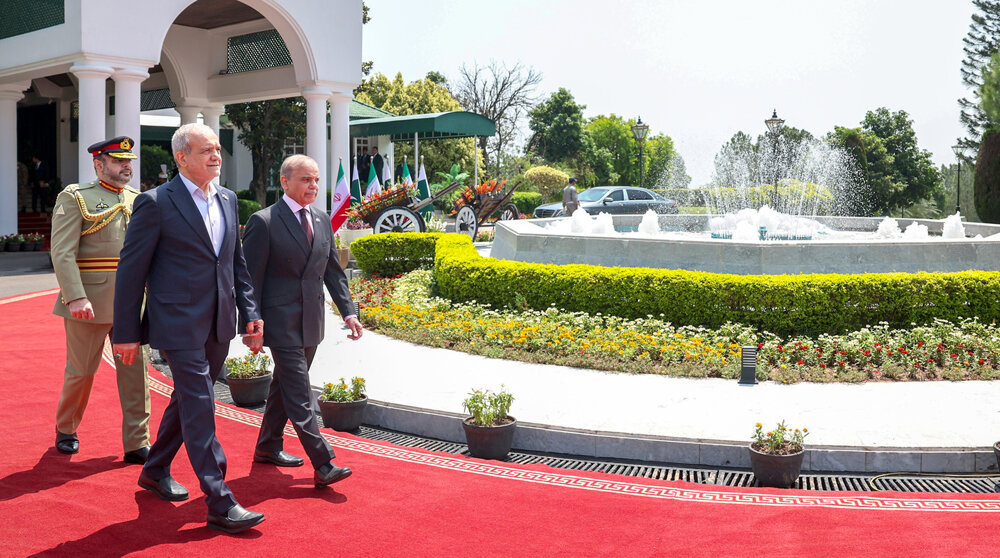
MADRID – In August 2025, Iranian President Masudo Pezeshkian’s visit to Islamabad marks a pivotal moment in the evolution of complex relationships between Iran and Pakistan.
Beyond mere geographic proximity, new chapters are unfolding, with both countries hoping to integrate the strategic axes of integrating security, economic development and regional presence in an increasingly competitive and fragmented geopolitical landscape. The purpose of this article is to not only unleash bilateral relations between the two countries, but also to develop the challenges ahead at both sides and regional levels.
Historical Roots: Relationships Shaped by Cooperation and Complexity
Revisiting their shared history is essential to understand the current dynamics of Iran-Pakistan relations. This is a history that combines moments of cooperation, tension and coexistence within a changing, often volatile geopolitical context. Iran was one of the first countries to recognize Pakistan’s independence in 1947. This is a gesture that laid the foundation for a formal, heart-warming relationship that has been around for a long time, ups and downs.
For example, in the 1960s, Iran supported Pakistan in a conflict with India, supplying weapons and fuel at a priority price. However, the Islamic Revolution in 1979 significantly changed the region and redefine bilateral relations. As Pakistan deepened its ties with Saudi Arabia and strengthened its Sunni identity, Iran integrated its Shia and shaped an ideologically different landscape that influenced political and social dynamics. This difference is rooted in the differences in confession, but served primarily as political and strategic tensions without completely undermining practical cooperation.
The shared border between Balochistan, Pakistan and Iranian Sistan and Balkestan, has long been an unstable region affected by rebel movements and illegal human trafficking. These challenges have forced both countries to tackle similar issues, from internal security to containment of extremism, but their responses vary depending on the national context and priorities.
A particularly complicated episode occurred during the Afghan civil war in the 1990s, when Iran and Pakistan supported the opposition. While Pakistan supported the Taliban, Iran supported the Northern Alliance. This phase highlighted deep strategic differences, but did not cut off diplomatic and commercial connections.
The cultural and identity-based dimensions act as anchors for this relationship. The Islamic communities, historical ties and cultural proximity of both countries provide a framework that allows for gestures of solidarity even in difficult times. This cultural foundation, coupled with economic and strategic realities, points to multifaceted relationships that privilege coexistence around conflict.
Security and border stability: structural challenges
The approximately 900-kilometer border between Iran and Pakistan has traditionally been a space of vulnerability and challenge. Terrorist groups operating in Balochistan, such as Jaish Al-Adl and the Balochistan Liberation Army, represent the lasting threat that transcends borders and shapes the bilateral agenda for decades. During their recent visit, the two governments recognized that the power of these terrorists and the management of their associated violence is central to regional stability and highlighted the urgency to strengthen security and intelligence reporting cooperation.
This intergovernmental commitment is not just about responding to immediate threats. This is part of a long-term strategy aimed at turning historically porous boundaries into a shared space of management and management. Coordination on intercepts, intelligence sharing, and joint operations identifies pathways to reduce structural violence that impact local populations and hinder the vision of sustainable economic development.
By adopting this strategy, both countries demonstrate a political will to overcome historical mistrust despite continuing unresolved tensions over specific insurgent factions and complex ethnic cultural issues. Nevertheless, their common vision of problems and their solutions suggests a level of cooperation that bilateral relations have rarely reached before.
Economic promotion: Aiming for integration and complementarity
Alliances go beyond security. The government’s goal of increasing trade on both sides from $3 billion to $10 billion highlights the scope of shared ambition. Signing 12 contracts and understanding memorandums covering sectors such as energy, technology, tourism and transportation has a clear intention to overcome long-standing barriers.
This commercial expansion corresponds to a double order. On the other hand, it promotes internal economic growth to counter international pressures and sanctions. Meanwhile, it will build a regional economic network that provides new routes for trade and investment. Of particular note, it focuses on improving infrastructure and promoting cross-border trade. It aims to transform borders from restrictions into a dynamic space of exchange and progress.
For Iran, collaboration with Pakistan offers an opportunity to break through the economic siege imposed by Western sanctions and creates alternative access points to the market and energy supply. For Pakistan, it is an opportunity to diversify trade relations and strengthen its position as a strategic hub for the region. The complementarity is clear, and both states seem to understand that their economic futures are closely linked.
Geographical strategic context: Between rivalry and cooperation
It is important to recognize that Iran-Pakistan relations develop within regional chess boards marked by overlapping power struggles. Pakistan’s growing intimacy with the US is driven by a renewed interest in commercial and security cooperation, increasing the layer of complexity. Islamabad is trying to balance connections with global forces, in terms of practical foreign policy, while maintaining traditional relations with neighbors, especially Iran.
For Tehran, this Pakistani ambivalence presents an undeniable challenge and calls for flexible policies that maximize opportunities and minimize risk. Thus, Pezeshkian’s visit can also be read as a diplomatic move to consolidate sharing priorities and prevent unwanted strategic friction from damaging relationships that aim to deepen both sides.
Furthermore, with China’s presence and continuing competition between the US and regional authority, Iran and Pakistan are trying to neutralize external pressure by building a practical bloc based on common interests. Their alliance could serve as meaningful counterweights amid the uncertainty caused by rapid regional changes and fragmentation of traditional power space.
Identity, Culture, and Social Fabric: Links to Maintain Alliances
What sets the relationship between Iran and Pakistan is the factors that transcend national politics and economic accounts, the depth of its cultural and Islamic interconnectedness. The visit was also used to highlight these ties, bringing attention to both Shia and Sunni Islamic traditions and the sociocultural resonance of such links in the legalization of political agreements.
This cultural substrate serves as a narrative of stabilization principles and social cohesion that helps strengthen mutual trust. In regions where identity is often fragmented and politicized under the weight of external interests, recognition and respect for shared traditions adds both ethical and symbolic aspects to the alliance.
Clarification of these elements is an important strategic component. It helps to protect relationships from international volatility and provides a platform for dialogue that can transcend short-term political or strategic friction.
Towards a practical and sovereign alliance
In the face of various complexities, the Iranian-Pakistan alliance represents a serious effort to build a strategic and practical model of cooperation. It is not based on utopia or the greatest rhetoric, but clearly recognizes the need to engage in mutual benefits and shared resilience.
This model appears to embrace sovereignty not as isolation but as autonomy from external influences, expanding the capacity of the state through regional cooperation. Effective management of borders, increased trade, and the use of cultural and historical solidarity refers to roadmap that blends with concrete and symbolic.
As both countries proceed with this project, they are creating alternative narratives in regions that are often defined by hegemony and fragmentation. This story aims to create a space of balance. There, shared interests and projects can coexist without erasing the differences.