
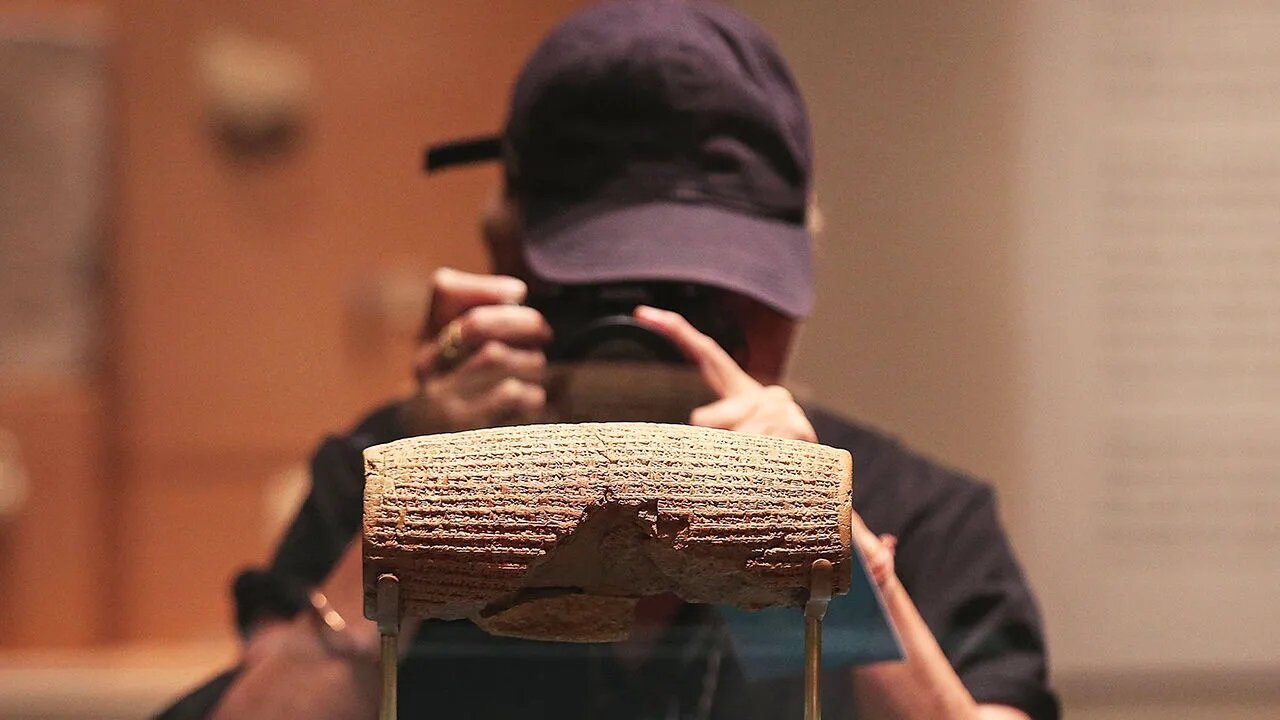
TEHRAN – Iran and Tajikistan jointly submitted a draft resolution to the 43rd UNESCO General Assembly calling for recognition of the Cyrus Cylinder as an early global symbol of human rights and cultural diversity.
Hassan Fartusi, Director-General of the Iranian National Commission for UNESCO, announced the initiative at the 12th Interregional Conference of the National Commission for UNESCO, held in Samarkand ahead of the General Assembly. He asked representatives of member states to support the proposal, Mehr newspaper reported on Thursday.
Fartusi informed that Iran and the Republic of Tajikistan have jointly submitted a resolution proposing to officially recognize the Cyrus Cylinder as an early global symbol of human rights and respect for cultural diversity. “This resolution will be adopted with the support of UNESCO Member States.”
Fartusi said the artifacts represent early messages of freedom, justice and coexistence and could serve as inspiration for dialogue between civilizations. He called on all UNESCO National Commissions to join this initiative and promote the sharing of human values and cultural cooperation.
The Column of Cyrus is an ancient clay artifact inscribed in Akkadian cuneiform and dates from the 6th century BC. This document records the conquest of Babylon by Cyrus the Great in 539 BC and the restoration of religious sanctuaries and refugees. The object was discovered in 1879 at the ruins of Babylon, in present-day Iraq, and is kept in the British Museum.
The cylinder gained attention again in the late 1960s, when Iran’s last shah described it as “the world’s first human rights charter.”
Cyrus the Great (born c. 590-580 B.C. in Media, or Persis (now Iran); died c. 529 in Asia) was a conqueror who founded the Achaemenid Empire, centered on Persia and comprising the region of the Near East from the Aegean Sea east to the Indus River. He is also remembered by the ancient Persians in the legend of Cyrus (first recorded by the Greek military officer and writer Xenophon in his Cyropedia) as a tolerant and ideal ruler who was called the Father of the Nation. In the Bible, he is the liberator of the Jewish captives in Babylonia. In the Bible, Cyrus is famous for freeing Jewish captives in Babylonia and allowing them to return to their homeland. He supported local customs and even placated the local population by offering sacrifices to local gods. With the capture of Babylon, not only did Mesopotamia fall into the hands of Cyrus, but also Syria and Palestine, which had been previously conquered by the Babylonians.
UNESCO’s 43rd General Conference, held every two years, brings together representatives of 194 member states to discuss international cooperation in education, science and culture.
morning