
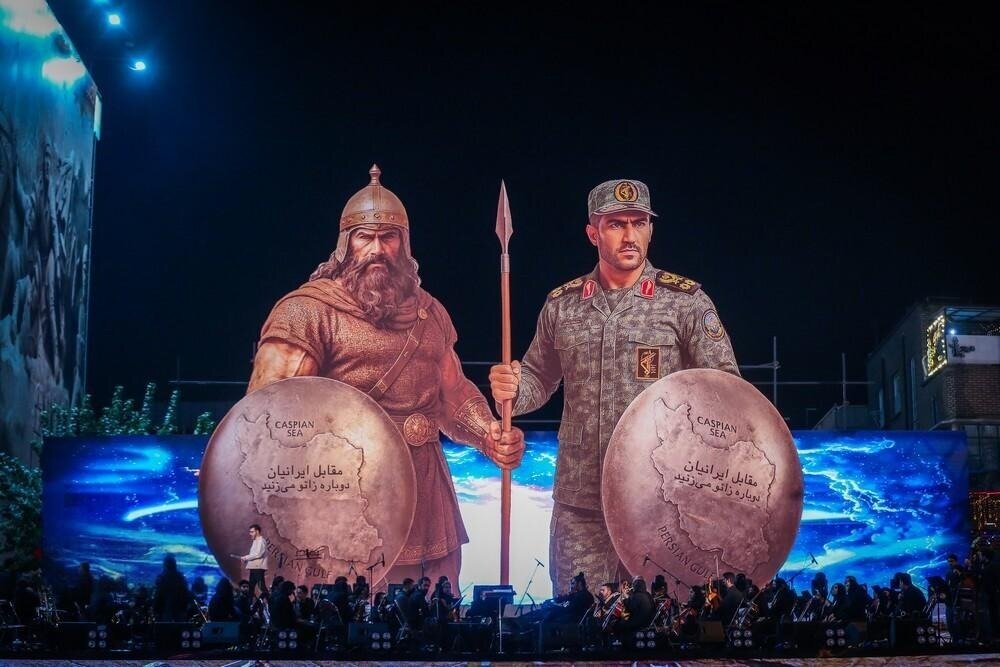
MADRID – In the tumultuous arena of world politics, few countries carry symbols as rich and diverse as Iran. However, although each of these images belongs to a separate story, they all coexist within a single national body.
Behind this apparent contradiction lies a deeper continuity of conflict. It is a struggle to define sovereignty at a time when global powers continue to shape the limits of what is possible.
For more than a century, Iran has been waging a sometimes silent, sometimes bloody battle for political and moral independence. A question that runs through modern history is how to maintain sovereignty in an externally designed world. Throughout the 20th century, this quest took two contrasting forms. One is a secular nationalism with monarchical roots that seeks to recreate Western modernity, and the other is a revolutionary Islamic project that champions political and spiritual independence as a condition for all political freedom. But to understand Iran in this dualistic way is actually to succumb to the simplification that the country has most bitterly contested.
The idea that Iran is divided into a pre-Islamic Aryan soul and an Islamic body is an invention with colonial roots, rather than genuine self-awareness. In the nineteenth century, European Orientalist scholarship projected onto Persia the desire to find a noble civilization of “Aryan” ancestry that served as a tame mirror of their own identity. By separating the bright and rational Zoroastrian Persia from the allegedly decadent and fanatical Muslim Persia, the Orientalists created an instrument of power, a genealogy that justified intervention and protection.
This framework resonated within the Persian elite in the 20th century. With the rise of Reza Shah Pahlavi, pre-Islamic nationalism became the official ideology of the modernizing authoritarian state. Its purpose was twofold. The eradication of Islam as a political force and the fabrication of a national identity based on the glory of the Achaemenid Empire. The grand celebrations of the 2,500th year of the monarchy at Persepolis in 1971 were not just an archaeological uplift. It was a calculated breakthrough in Islamic history, an attempt to link the Shah’s throne with that of Cyrus and erase 13 centuries of popular religious culture.
Through this gesture, the Pahlavi project sought to replace the community of believers with the state and faith with loyalty to the state. What was presented as “modernization” was also a form of forced secularization sustained through political violence and external dependence. Paradoxically, that rupture did not occur in the 7th century with the arrival of Islam, but in the 20th century, when powers claiming sovereignty adopted the category of colonial ruler to define themselves to their own people.
What emerged in the face of this cultural engineering was not simply a revival of religious zeal, but a reconfiguration of old aspirations to unite justice, faith, and sovereignty. The Islamic Revolution of 1979 was the culmination of a process of cultural resistance that matured in clerical networks, bazaars, political poetry, and spaces where Islamic identity served as a refuge from Western homogenization. Seen from this perspective, Islam was the grammar through which Iran regained its voice in the global concert.
What gave power to revolutionary discourse was not nostalgia for a lost past, but the power to transform faith into an ethic of independence. The core Shia concepts of the hidden imam, the justice of the martyrs of Karbala, and the guardianship of Islamic jurists (velayat-e faqih) became political arguments against the injustice of power serving foreign interests. Whereas secular nationalism offered modernity in exchange for subordination, revolutionary Islam proposed a modernity of its own that did not depend on international recognition.
The Islamic Revolution did not destroy the Persian past. I re-read it. In its ideological formulation, Achaemenid grandeur and the message of the Qur’an are no longer antagonistic, but are inscribed with ethical continuity. The Cyrus Cylinder, presented as a precursor to the Declaration of Human Rights during the Pahlavi era, acquired a different interpretation in the post-revolutionary framework. It is justice, not as a gift of empire, but as a command from God.
In this sense, the Islamic Republic is also a hermeneutic of the past. That doesn’t deny it. Although sovereignty ultimately belongs to God, it is interpreted and reconsidered within the theological and political horizons exercised through communities of believers.
The controversy continues today. Western-based media outlets have told Iranians there is a need to call for a return to secular Persian nationalism, and that political Islam is preventing Iran from opening up to the world. People are told that Iran’s current political system is diluting its “Aryan” essence in an imposed “Arabization.” The Islamic Republic considers this discourse to be a reworking of colonial ideology that seeks to separate Iranians from their Islamic soul and reintegrate them into the Western orbit.
The Islamic Republic has paid close attention to these Western efforts in recent years, stepping up its attempts to articulate its historical roots and Islamic identity.
The rehabilitation of figures like Cyrus the Great, the restoration of Persepolis, and the use of Persian symbols in cultural and international spaces testify to this effort to integrate pre-Islamic civilizational elements into a revolutionary narrative that maintains Islam as its central axis.
This process is not without its challenges. On the other hand, political Islam, which has emerged as a revolution against secular nationalism, has at times incorporated symbols and historical references associated with Iran’s rich monarchical tradition, integrating them into its project without losing the Islamic framework that defines it. On the other hand, this Persian reinterpretation seeks to overcome the colonial vision that pitted ‘Aryans’ against Islam, articulating both traditions as complementary and harmonious aspects. In this vision, being Iranian and being Muslim are not contradictory identities, but two interrelated aspects of a common heritage in which Islamic identity gives direction and coherence to Persia’s historical and cultural memory.
At this point, Iranian politics has reached philosophical and political complexity. Resistance is not simply between past and present, but between an abandoned pre-Islamic memory and Shia sovereignty based on divine law. The clarification between these two languages (the language of civilization and the language of the spirit) takes place through continuous dialogue. The Islamic Republic is attempting a synthesis that seeks to transcend its internal contradictions and articulate on the world stage a vision of sovereignty appropriate to its history and present.