
MADRID – Technology has become one of the main sources of power and autonomy in the 21st century world situation. It is no longer enough to have a strong military or access to natural resources. True independence depends on a country’s ability to develop its own technological solutions and maintain its strategy without relying on other countries. In this sense, Iran has made drones a pillar of its sovereignty and a tool that combines innovation, resilience, and political ambition.
Unmanned aerial vehicles (UAVs) are more than just military equipment; they represent a response to decades of sanctions and external pressure. Even in the face of isolation, Tehran bet on its independence and succeeded in turning necessity into strategic advantage. The company’s drone programs, which span surveillance, reconnaissance and precision operations, reflect not only technological advances but also a reaffirmation of independence in a fragmented and reshaped international system.
In a world where great powers strive to maintain their influence, Iran has found its own language of power in technology. Drones are more than just weapons; they represent a country’s determination to maintain decision-making autonomy and protect its interests without bowing to other countries’ rules. These are ultimately declarations of sovereignty in a time of global uncertainty.
According to reference documents such as the U.S. Unmanned Systems Integration Roadmap, unmanned systems are the fastest growing segment of the global aerospace industry. This is not just a technological evolution, but a paradigm shift that redefines the very nature of airpower. The share of drones in advanced air forces has increased from virtually zero in the 1980s to about 23% today, while manned aircraft continue to decline, according to industry estimates.
Contrary to most Western expectations, Iran not only understood this transformation, but accepted it as the basis of its defense strategy. While other countries see it as a means of aid, Tehran sees vectors of technological autonomy and regional projection, incorporating drones into a doctrine that combines deterrence, self-sufficiency, and adaptation to the changing global balance of power.
Sanctions as a driver of innovation
For years, the dominant narrative in Washington and other Western capitals has portrayed Iran as an isolated, technologically backward state doomed to an aging military under the weight of international sanctions. But that interpretation overlooks an important reality. That is, sustained pressure not only punishes it, but also shapes it. In Iran’s case, sanctions did not destroy its technological capabilities. They turned it into a force of invention and autonomy.
Deprived of access to the global defense market, the Islamic Republic’s security establishment has been forced to look inward. It became a matter of strategic survival rather than a political choice. National plans such as the Comprehensive Aerospace Development Plan and the Sixth Five-Year Development Plan formalized that direction, turning technological self-sufficiency into a guiding principle. That pressure has given rise to a domestic drone industry that is adaptable and efficient, capable of producing functional and affordable systems that combine simplicity, low cost, and operational efficiency.
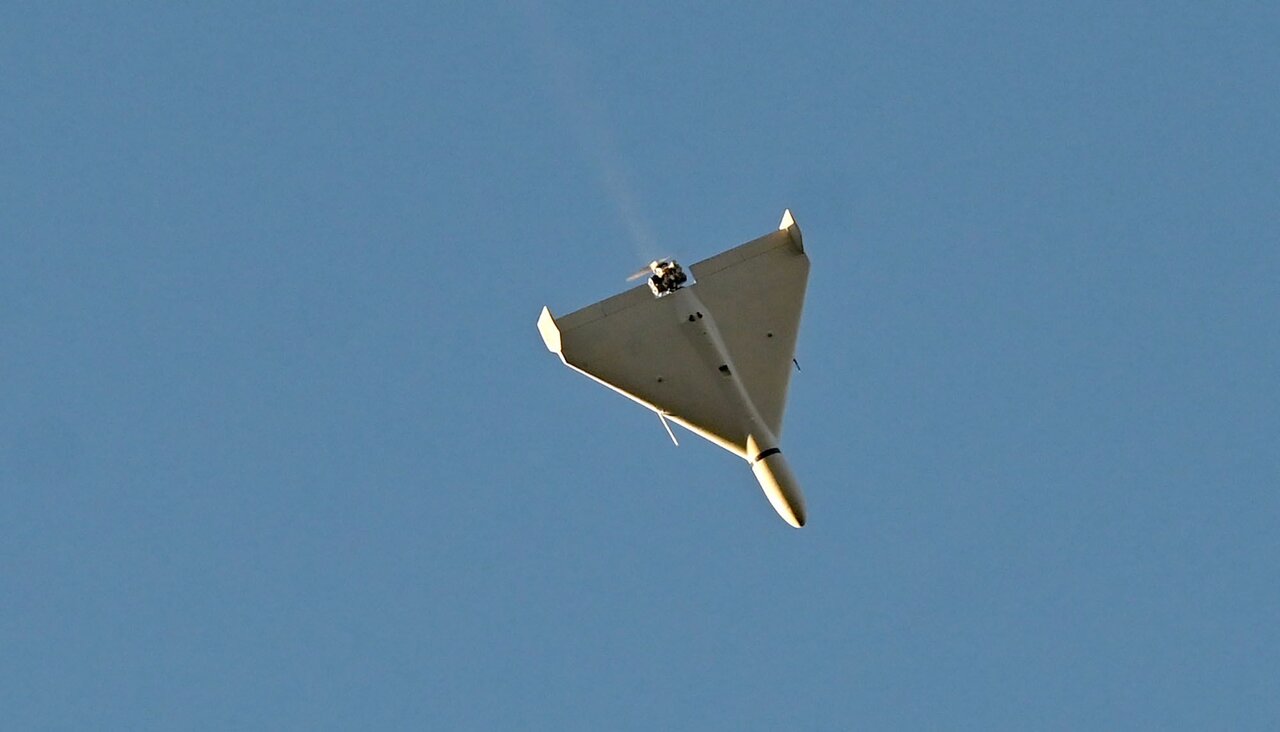
Drones thus became the answer to Iran’s structural defense dilemma. This enables low-cost intelligence, surveillance, and reconnaissance. Projection of force without human casualties. And domestic production is protected from external constraints. The Shahed family, led by the now famous Shahed-136, embodies this philosophy of sufficient technology, mass production, and industrial resilience. In a world of global asymmetry, Iran has managed to turn scarcity into a strategy and sanctions into an incentive to innovate.
The role of Iranian drones cannot be understood without looking at the geopolitical chessboard on which Iranian strategy plays out. Surrounded by U.S. military bases and facing regional rivals such as Saudi Arabia and Israel with privileged access to Western technology, Iran has articulated the principle of deterrence by denial, rooted in asymmetric warfare. Within this framework, UAVs have become the most versatile and effective means of defensive posture.
These systems allow Iran to exercise what some theorists call veto power, the ability to prevent a more powerful adversary from gaining complete control of space or impose prohibitive costs for attempting to do so. Low-cost drones, or those transferred to allied actors such as Lebanon’s Hezbollah or Yemen’s Ansarullah, could threaten critical infrastructure, commercial shipping, and energy facilities, thereby altering the strategic calculus of regional and global powers. Loitering weapons that cost thousands of dollars can damage billions of dollars worth of warships, disrupt oil supplies, and shift the balance of power at minimal cost.
The impact of Iran’s drones, along with the country’s missile program, extends far beyond the military realm. These developments and deployments gave Tehran more leverage in its dealings with the West and strengthened Iran’s diplomatic position. The proliferation of these systems is a constant reminder to Washington and Tel Aviv that direct confrontation with Iran comes at unpredictable costs.
Shahid and Paradigm Shift
The fact that drones continue to exist in modern warfare is now taken for granted. But its importance is not just technical. It has also expanded access to air power, which was once the exclusive domain of countries with large defense budgets.
Shahed 136 shows the logic. Its design deliberately avoids the complexity and cost of radar-evading aircraft like the U.S. RQ-170 Sentinel (which Iran claims to have captured and reverse-engineered), opting instead for a sufficiency philosophy of low-cost engines, GPS-based navigation (with known vulnerabilities), and significant payloads. In reality, it functions as a cheap, reusable cruise missile designed for mass production.
This simplicity is the main operational advantage. This allows mass production, ease of maintenance, and deployment by attackers with limited resources, while providing an overwhelming air defense network built to intercept a small number of high-value targets. Against such a system, a swarm of dozens or hundreds of Shaheds presents a tactical and economic dilemma. Neutralizing each shahed with advanced surface-to-air missiles can cost many times more than the drone itself, leading to a sustained economic and logistical burden on defenders.
The strategic effect is clear. This approach forces a reassessment of principles that are still rooted in qualitative technological superiority. Innovation does not necessarily mean developing cutting-edge systems, but rather designing systems that pragmatically exploit an adversary’s economic and operational vulnerabilities. In that sense, the need to be frugal under sanctions and restrictions has become an operational strength and a modern lesson in applied asymmetry.
The response of the United States and its allies to this challenge has so far been primarily reactionary and military in nature. Efforts are focused on developing more effective anti-drone systems and tightening sanctions to restrict Iran’s supply chain. These measures may make tactical sense, but they fail to address the root of the problem. Iran’s drone program is not the cause, but the result of a long-standing policy of pressure that has deepened its pursuit of strategic autonomy.
The West’s soft power ability to influence through cultural attractions and values has limited influence over the very nations that define their identities against that influence. In Iran’s case, resistance to Western hegemony is part of its founding story. Far from undermining that narrative, sanctions have strengthened it, providing legitimization for state mobilization around technological self-sufficiency and sovereignty. The maximum pressure strategy therefore proved counterproductive, accelerating the very capabilities it sought to thwart.
The real challenge for the West is not just how to shoot down a Shahid drone, but how to manage the rise of actors who have learned how to turn adversity into influence. This requires a strategic reassessment that goes beyond the military dimension and considers political, technological, and diplomatic implications. Through persistence and technological development, Iran has established itself as an inescapable player in the formation of a new regional security order.
Iran’s drone program ultimately embodies its determined pursuit of technological sovereignty. In an international context where technology is both a source of power and a means of exclusion, the ability to independently develop strategic systems has become a key element of national security. For Iran, this is not a luxury, but a condition for political and strategic survival.
Far from being a caricature of an isolated nation relying on quick-fix solutions, Iran’s unmanned aerial vehicle development trajectory reflects a deliberate and coherent policy embedded in long-term planning. Sanctions and isolation did not stop the process. They shaped it. Iran has prioritized resilience, efficiency, and the judicious use of asymmetry as the foundation of its defense doctrine, rather than competing in the realm of cutting-edge sophistication.
The rise of the drone industry is not only a military achievement, but also a political story of adaptation and autonomy in an increasingly fragmented world. This marks the end of the West’s monopoly on advanced defense technology and suggests a more pluralistic and complex landscape in which middle powers armed with destructive, low-cost systems can challenge great powers and reshape regional power relations.
It would be a strategic mistake to ignore this phenomenon or dismiss it as a mere provocation. Future wars will be fought in part from the air and from a distance, but the implications are deeply political. It’s about who controls technology and the ability to determine one’s own destiny with it. In this respect, Iran is demonstrating an adaptive capacity that forces the world to rethink the very foundations of power in the 21st century.