
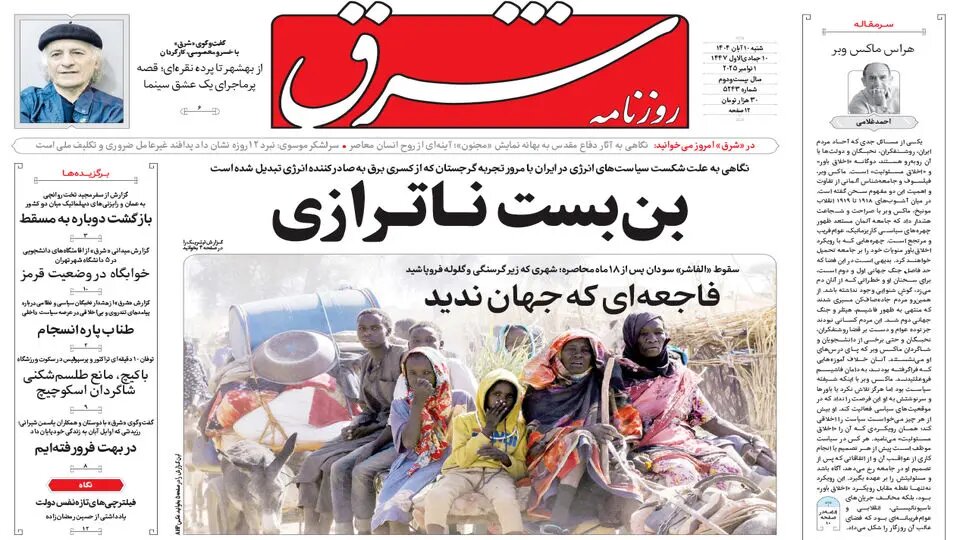
TEHRAN – Foreign Minister Shagh analyzed Iran’s dual position in foreign policy, quoting Dr. Anahita Motazed Rad.
The report said Iran is in a double predicament. On the one hand, there is political isolation and economic pressure, and on the other hand, continued active involvement in regional dynamics. The Iranian government faces two scenarios: it can either stick to its current course and maintain a policy of resistance, or it can accept a settlement and enter into direct negotiations with the US government. However, the second option carries ideological costs and could call into question the Islamic Republic’s strategic identity. Ultimately, whether Iran chooses rapprochement or insists on confrontation, the future of Iran-US relations will not be shaped in the White House or Tehran, but through a mutual understanding of “real limits.” President Trump has imposed a new challenge on the region’s fragile order. If this cycle repeats, the Middle East will once again witness policies driven less by commitment and more by impulsive excitement and personal calculations. This policy may be “great” for the president, but it is dangerous and endless for the region.
Mr. Armaan Emroos: The reality of diplomacy revealed
Recent developments surrounding the reinstatement of sanctions against Iran and the formal expiration of Resolution 2231 have revealed new rifts in the international system. The United States and its European allies are once again opting for pressure and sanctions, while China and Russia consider reimpositions illegal and contrary to international commitments. A review of China and Russia’s actions from 2006 to 2010 shows that during this period, both countries supported sanctions resolutions against Iran. However, after the signing of the JCPOA, China and Russia began to see Iran as a victim of US law violations and European inaction. This realization led the two world powers to redefine their positions and support Iran against unilateral pressure. Nevertheless, the bitter truth of the international system is that decisions are ultimately shaped by power and the ability to enforce it. In such a structure, Iran is forced to think pragmatically, relying not only on legal arguments but also on strengthening its economic and political capacity to reduce the impact of sanctions.
Donya e Ektesad: The relationship continued
In a recent article, Donya Ektesad examined Japan’s continued engagement with Iran. It wrote: Before the massive U.S. sanctions, Japan was one of Iran’s largest buyers of crude oil. However, following the return of US pressure and sanctions, Japan gradually withdrew from Iranian oil projects in order to maintain relations with the US. After the JCPOA agreement, Japanese companies expressed renewed interest in returning to the Iranian market, but that momentum stalled when the US withdrew from the agreement. Despite these setbacks, Japan has maintained a balanced approach and refrained from completely severing economic ties with Iran. If sanctions are eased or a new nuclear deal is reached, Japan is likely to be one of the first countries to invest in Iran’s clean energy, petrochemical and infrastructure sectors. Tokyo’s commitment to sustainable energy could also lead to participation in Iranian renewable energy projects. Moreover, Japan generally supports a policy of engagement with Iran in international forums and has distanced itself from harsh measures.
Hamshahari: Reza Pahlavi’s new delusion
In his commentary, Hamshafli referred to Reza Pahlavi’s latest delusion after the 12-day war between Israel and Iran in June. The newspaper wrote: Tel Aviv’s pursuit of regime change goals during the 12-day conflict has taken Reza Pahlavi’s fantasies to a new level. Recently, he chose to take a personal initiative, launching the so-called “Iranian Immortal Guard” with the aim of completing the unfinished projects of the United States and the Zionist regime. However, the initiative was widely ridiculed by Farsi-speaking social media users and dismissed by fellow opposition figures. The core idea behind Immortal Guard is a decentralized organization of small groups for a nationwide uprising. However, this project appears to be a poor imitation of terrorist tactics used by the MEK (Mojahideen-e-Khalq). The fate of Reza Pahlavi’s recent campaign suggests that he is not taken seriously even within the opposition movement.
Jam-e-Jam: If officials follow the law, people will respect the law.
Jam-e-Jam newspaper quoted senior religious scholar Ayatollah Javadi Amoli as saying that the people will abide by the law whenever they realize that the authorities are upholding the law. “Our people respect the law, and if they see that this country is ruled by law, they will respect the rules,” he said while speaking in his office with commanders of Tehran’s Mohammad Rasulullah (PBUH) Brigades. Javadi Amoli also prayed for the success of the regime’s servants, saying, “May God protect this regime, its officials, and its leaders.” Elsewhere in his remarks, Oayato paid homage to the memory of revered martyrs such as Shahriari Martyr (a nuclear scientist) and Martyr Hassan Tehrani Moghaddam (known as the father of Iran’s missile industry), saying, “Their pure blood.” The martyrs are alive and influential. He also referred to Iraq’s war against Iran in the 1980s, saying, “In eight years of war, we fought with our bare hands. It was a unique experience. Our martyrs are our purest treasure, and we must cherish these sacred treasures of our nation. We must also recognize that our people expect purity and integrity from their leaders and officials.”