
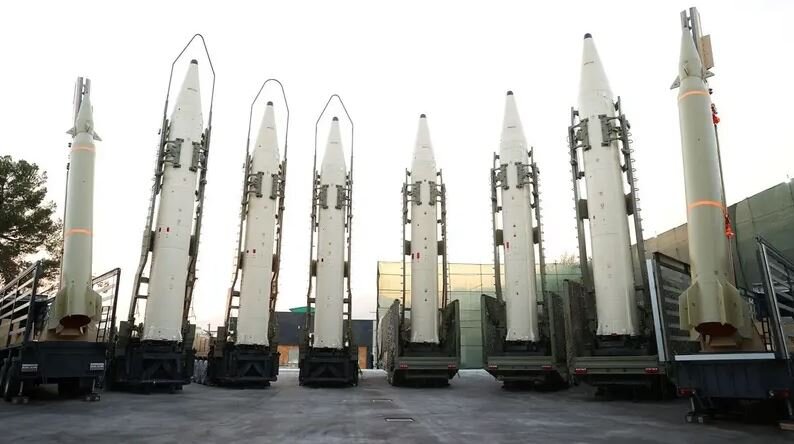
TEHRAN – A senior Iranian military commander said the country has reached self-sufficiency and developed the ability to export products in militarily sensitive areas, adding that Iran can now export missiles to other countries.
“Today, we are proud to be one of the countries that can export missiles, drones and ships,” said Brigadier General Alireza Tansiri, commander of Iran’s Islamic Revolutionary Guard Corps (IRGC) Navy.
The commander-in-chief stressed that Iran was the target of military aggression during the eight-year war imposed by Iraq in the 1890s, and military equipment at the time was very limited.
“They attacked us. We were bare-handed. We had nothing and they gave us nothing. They even denied us barbed wire, as the Supreme Leader of the (Islamic) Revolution (Ayatollah Seyed Ali Khamenei) aptly stated,” he pointed out.
The Israeli regime has claimed that Iran’s recent military invasion has robbed it of its ability to develop missiles and drones.
However, Iran has made significant military advances in recent years, allowing it to develop a wide range of military products domestically, including missiles and unmanned aerial vehicles (UAVs).
Iran’s large and rapid advances in drone technology and its ability to carry out long-range strikes with high levels of precision in drone warfare have cemented the country’s growing military power in West Asia.
The cutting-edge drone program marks one of the Iranian military’s breakthroughs in producing a wide range of indigenous defense equipment, making the military self-sufficient in the face of years of U.S. threats and sanctions.
Iranian officials have repeatedly warned that the country will not hesitate to build up its military for purely defensive purposes.
Iran deployed domestically produced unmanned aircraft, including Shahid drones, in retaliatory strikes against Israel during the regime’s military invasion of Iran in June.
It also launched dozens of missiles into occupied territory. Immediately after the missiles arrived, air raid sirens sounded, forcing the colonists to return to the bunkers where they spent most of their time at the time.
Israeli media reported a large explosion in central Tel Aviv, indicating that the missile had once again evaded the three-tier air defense system and hit its intended target.
Some stages of Operation Truth Promise III were conducted in the heart of the occupied Palestinian territories and Ben Gurion Airport, targeting military installations and operational support centers of Zionist regime forces.
Meanwhile, several countries have started manufacturing copies of Iran’s Shahid drone that are not expensive but efficient and accurate, a leading US daily reported.
The Wall Street Journal said in a report that various companies from the United States, China, France and the United Kingdom are developing armed unmanned aerial vehicles (UAVs) modeled on Iran’s Shahed.
He added that the United States and its allies are “competing to develop low-cost, long-range replica weapons.”
The report also noted that models similar to Shahed stood out among the 18 prototype U.S. drones on display at an event held by the U.S. Department of the Army this summer.
It added that these models included LUCAS and Arrowhead, manufactured by SpectreWorks and Griffon Aerospace, respectively.
“Shahed and its counterfeit products have become so widespread that companies such as Griffon and Sweden’s Saab are selling target practice drones that resemble Iranian munitions,” the report said.