
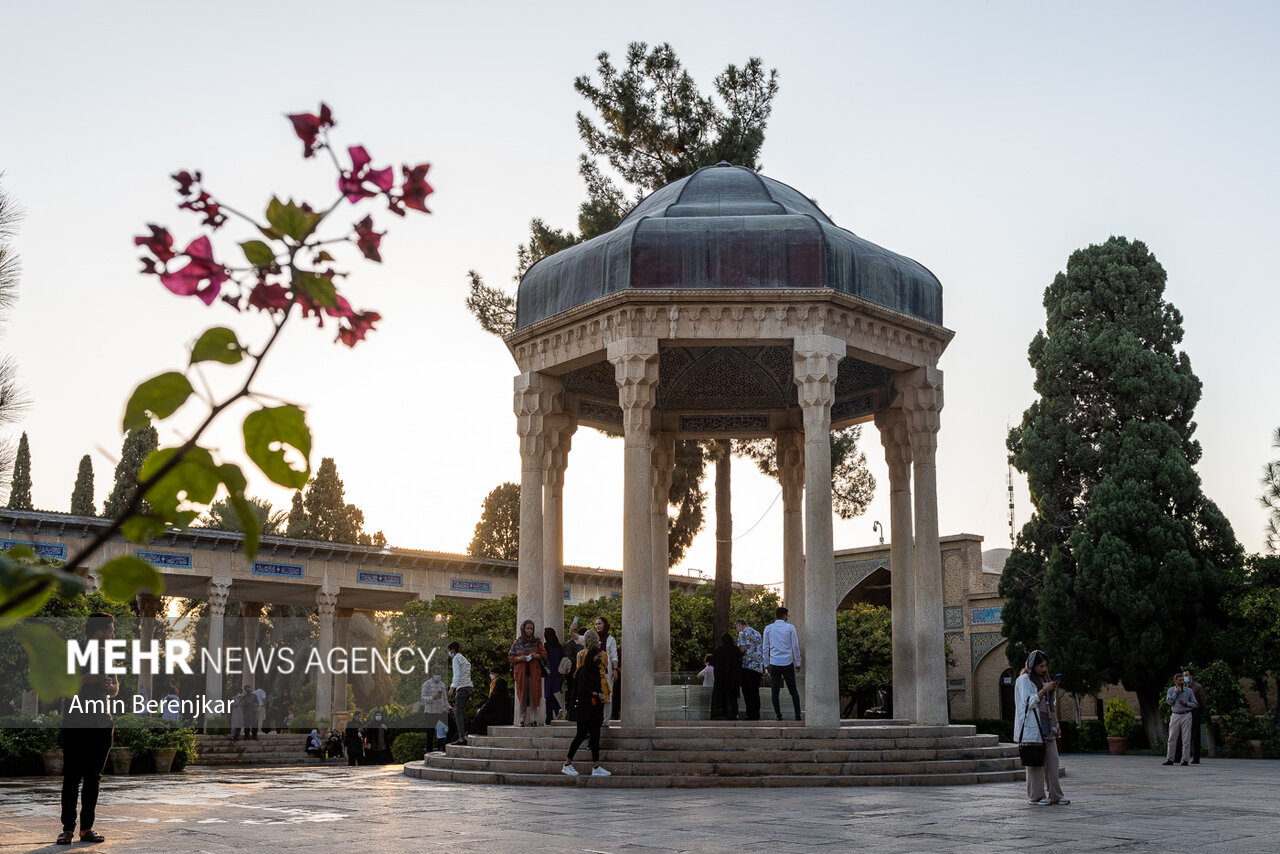
Hafez was born in Shiraz in the 14th century and is widely regarded as one of the most influential Persian poets of all time. His works, collected in Hafez Divan, explore themes such as love, spirituality, nature, and the pursuit of truth. Known as a master of the lyrical poetic form of ghazal, Hafez’s poetry is acclaimed for its profound beauty, intricate metaphors, and philosophical depth.
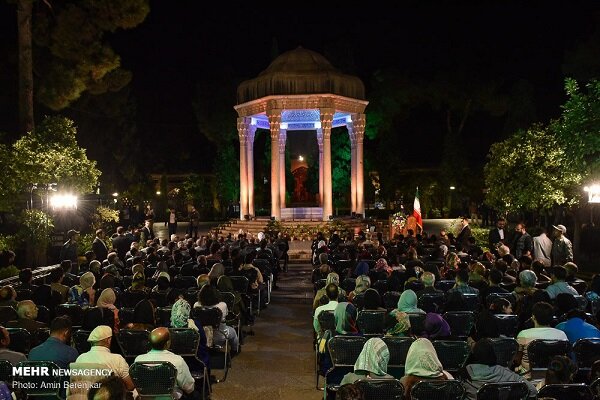
October 12th is celebrated as Hafez Day in Iran. On this day, many writers, scholars and enthusiasts from all over the world visit Iran to celebrate this event at Hafez’s tomb in Shiraz.
People gather at Hafez’s tomb to read his poems and perform special rituals.
Built in 1935, Hafez Tomb was designed by famous French architect and archaeologist Andre Godard. The tomb and its surrounding gardens are one of Shiraz’s biggest tourist attractions.
Life of Hafez Shirazi
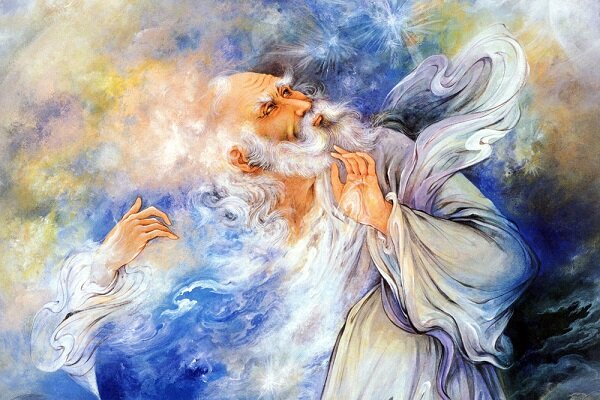
Born during one of the most turbulent times in history, Khajeh Shamseddin Mohammad Hafez-e-Shirazi is considered one of Iran’s greatest poets and mystics. The reason he is called Hafez is due to the fact that he memorized the entire Quran. He also holds the title “Risan-ul-Ghayb” which means invisible language.
Hafez is considered one of the most famous poets not only in Iran but around the world, but his life is shrouded in mystery. There are various thoughts and comments about his life, but there is no single reliable source in this regard.
Hafez is thought to have been influenced by many earlier writers, such as Omar Khayyam (also one of the most important Iranian figures in the fields of mathematics, astronomy, and poetry). However, many critics symbolize Hafez as a bee flying over different flowers to produce the most delicious honey.
Hafez’s poem
Generally, Hafez wrote mystical poems known as ‘ghazals’. It is considered a form of Arabic poetry that originated in the 7th century. Hafez’s poetry combines rich imagery and symbolism. He is also a master of using ambiguity in his work. His poems are mostly emotional and show his inquisitive mind.
The following poem is one of Hafez’s famous ghazals.
That beautiful Siraj Tak took charge and stole my heart,
For the mole of her Hindu beauty, I will give Samarkand and Bukhara.
O you who have wine, bring me wine, such as is not to be found in heaven.
Flowing through a stream, spending time in a flower garden, or taking a walk.
Oh, you gentle gypsy clowns, agitators of our town
It took the same patience of my heart as the sacrifices of the marauding Turks.
Unfinished love like ours, our beloved doesn’t need it,
For perfect beauty, frills and ornaments are of no use.
I learned more and more about Joseph’s goodness each day.
Even the chaste mistress succumbed to the love she admired.
Whether blasphemous or cursed, I will only reply with praise
The sweetness and even bitterness of your tongue and lips will captivate you.
Listen to the advice of the wise and set the goals that are most important to you.
Lucky young man, listen to your old, wise souls.
Let’s tell the story of song and wine, don’t look for the secrets of the world,
No one has found it and no one will ever find it, but knowledge will completely solve this mystery.
You wrote and sang, Hafiz, you lived your days well.
Venus married your song in the upturned bowl of the firmament.
Diban-e-Hafez
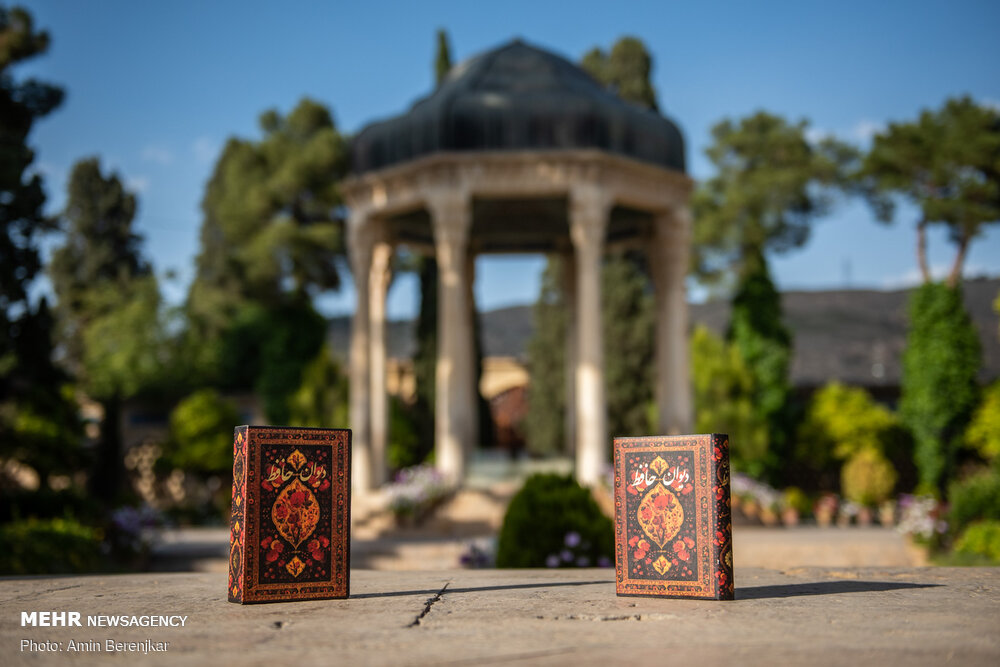
Hafez’s famous book is Divan (a collection of poems). His books are so valuable to Iranians that every Iranian home has one. Iranians gather to read Divan-e-Hafez on various occasions, including Nowruz and Yalda nights.
Hafez did not compile poetry. Some say that Mohammad Gholandam, who also wrote the preface to his compilation, completed the book in 813 AD or 1410 AD, 21 to 22 years after Hafez’s death.
Hafez and Goethe
Johann Wolfgang von Goethe (1749-1832), the most famous poet in German literature, had a deep interest in Oriental literature, and above all in the poetry of Hafez, which awakened an increasing interest in Persian literature. Goethe’s first impulse to imitate Hafez was as a framework for composing romantic poetry, but he later became fascinated by the mystical aspects of Hafez’s poetry.
The influence of Hafez Ghazariat (his collection of poems/ghazal) on Goethe was so deep that Goethe created a collection of poems to imitate Hafez and named it “West-East Divan.”
A professor at Austria’s Klagenfurt University told Shiraz University that it is undeniable that Johann Wolfgang von Goethe did not write his famous West-East Divan without the influence of Hafez.
When Goethe was about 65 years old, he encountered Hafez’s translation, which changed his life. Hafez was Iran’s greatest poet and had a great influence on Goethe’s life, she said.
Goethe was able to establish the image of Hafez’s mystical terminology and language. His understanding of Hafez allowed him to compose 15 new works in one week. Goethe composed Western poetry with Eastern content, she added.
She said the book had an Easter theme, but weaved together Eastern literature and the Old Testament to make it understandable to Western audiences.
Later, he became interested in other elements of Persian literature. According to Professor Bosse, he even tried to copy Perso-Arabic script from Eastern books.
In the Western and Eastern Divans, Goethe seeks to bring the two men closer together and to show that man should develop his own nature.
Edited by Mohadese Pakhravan