
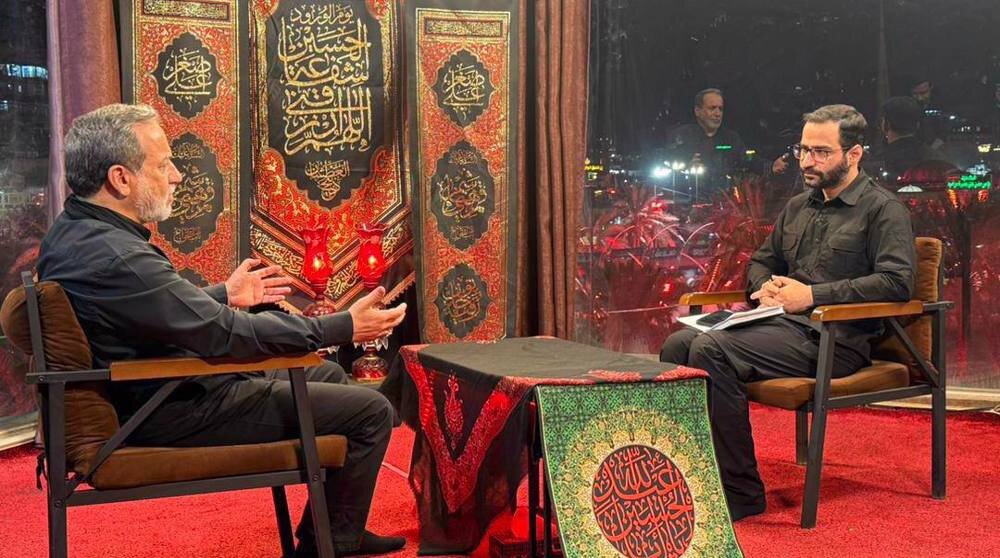
TEHRAN – Iranian Foreign Minister Abbas Aragut says Tehran has worked closely with China and Russia to prevent the reinvigoration of UN sanctions through a so-called “snapback” mechanism, and has recently threatened to be summoned by European powers.
“We are working with China and Russia to stop it,” Araguchi told National Television late Thursday. “If this doesn’t work and they apply it, we have the tools to respond. We’ll announce them in time.”
The snapback provisions, organized in UN Security Council resolution 2231, which approved the 2015 nuclear trade (JCPOA), relate to the automatic recovery of sanctions lifted under the agreement.
“When the US unilaterally left the JCPOA and reordered sanctions in 2018, we began to gradually reduce our nuclear commitments. He pointed out that Iran’s nuclear infrastructure has been preserved during the JCPOA year, allowing enrichment “within 24 hours” to 60%, below 20%, after the decision was made.
Araguchi stresses that the legal authority of the UK, France and Germany to trigger snapbacks is “very suspicious” under international law, claiming that the recent call for “zero enrichment” violates the terms of the JCPOA, allowing for an enhancement of up to 3.67%. “By rejecting the framework of a transaction, they lose their right to use that provision,” he said.
Tehran has set its position in a detailed letter to the UN Security Council, claiming that the three European states are no longer legitimate JCPOA participants. The position is supported by China and Russia, both have vetoes at the Security Council and have repeatedly opposed Western use of snapback clauses.
“We have held repeated technical and legal discussions between China and Russia over the years,” Araguchi said. “Their support is essential to this legal and political battle.”
The snapback clause of Resolution 2231 will automatically expire on October 18th, 2025. “Europeans have it until the end of October,” Araguchi said. “The mechanism then disappears.”
Economically, Aragut said Iran has little or no fear of the potential impact of sanctions, noting that existing, unilateral US measures are “a lot broader” than what snapbacks impose. “United Nations sanctions do not include oil or bank embargoes, primarily targeting specific individuals and businesses,” he said. “The real damage is political, removing the arms embargo and classifying Iran as a “threat to international peace and security” under Chapter VII. ”
“IAEA cooperation must be redefine after attacks on nuclear facilities.”
The Foreign Minister said the cooperation between Iran and the International Atomic Energy Agency (IAEA) must be based on a new framework after the recent attack on nuclear facilities. “The IAEA must explain what the testing protocols for the nuclear sites that were first bombed, and there is no precedent,” he said.
Under Congressional Act, future inspections must be approved by the highest national security council. Araghchi confirmed that preliminary consultations have been taking place with the IAEA delegation, and that the Ministry of Foreign Affairs and Iran’s atomic energy organizations have spent the day on discussions. “The initial idea was exchanged and handed over to the IAEA for review. It’s not a bad start, but it takes time to reach an agreement,” he said.
Arbaeen Reflections: Unity and Resistance after a 12-Day War
Araguchi’s comments also touched on the resilience of its people following the US-Israel attack on Iran on June 13th. In response, Iran launched a precision missile strike at Israeli military and industrial infrastructure and at US bases in Qatar. Twelve days later, the Israeli government accepted the one-sided ceasefire proposed by Washington.
Speaking from Kalbala at the annual Arbaeen Pilgrimage (one of the world’s largest peaceful gatherings), Araghchi said the immorality of the Iranian people “furiated our enemies.” He pointed to Gaza’s serious water crisis and dismissed claims by turning sewage into drinking water by turning Iran’s water issue into “laughter.”
He said that Aaaainian Iraqis expressed pride in Iran’s missile response, describing the procession as a “indication of Shia strength,” and noting that Ashura’s spirit had influenced Iran’s resistance during the war. “The commander martialism will not stop the movement. It will strengthen it,” he said.
Addressing speculation about another war, Araguchi said that although he currently sees no signs of an imminent conflict, preparation is essential. “Our enemy tries to impose the psychological consequences of war without fighting. We must be vigilant about such tactics,” he said.
“Nearly 40 years of international affairs, I don’t think war is near. But the military must always be prepared. Preparation is the best deterrent.”