
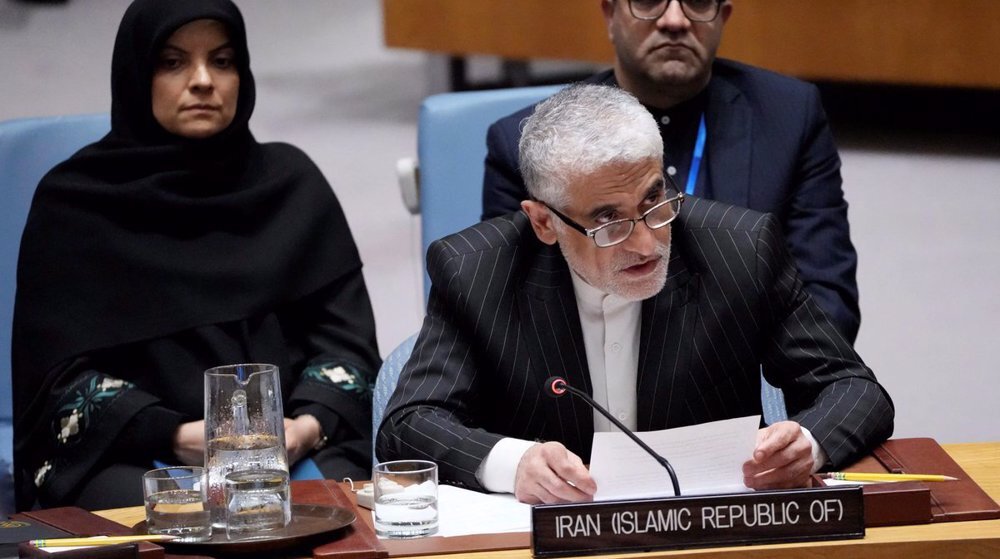
Amir Seid Irabani, ambassador to Iran and permanent representative of the United Nations, explained the “illegal” actions by three European countries, which add that the snapback process is “unacceptable,” adding that it would circumvent the Dispute Resolution Mechanism (DRM) in the Joint Comprehensive Plan of Action (JCPO).
He spoke in New York on Friday after the UN Security Council was convened to discuss the proposal.
Earlier on Thursday, the European troika – France, Germany and the UK are collectively referred to as E3. It aims to formally submit a notice to the UNSC to invoke the DRM, also known as the Snapback mechanism, and to restore UN sanctions in Iran that were lifted under resolution 2231.
Irabani stressed that Iran is committed to diplomacy, but will not negotiate under threat or coercion.
Speaking to reporters at the UN headquarters on local Friday, Irabani said foreigners from three European countries on Thursday sent letters to the UNSC, relying on what they called the snapback mechanism, simply putting political pressure on Iran alone.
He added that France and the UK justified this illegal and politically motivated action and called for a closed door meeting to equipment the UNSC and serve their own agenda. The meeting was just over.
He said representatives of three European countries appeared here and once again repeated unfounded accusations, ignoring their own failures and fundamental violations of JCPOA and Resolution 2231.
Irabani emphasized that Iran’s Islamic Republic will firmly reject and condemn illegal activities by France, Germany and the UK and will begin a snapback process. This move avoids the DRM of JCPOA. It is an illegal attempt to revive the cancelled solution and a clear violation of Resolution 2231.
He said that the three European countries lacked legal or moral status to evoke mechanisms. Their declaration to start the snapback process is essentially invalid.
He emphasized that the JCPOA’s conflict resolution mechanism is a step-by-step process and is specifically designed to prevent abuse in three European countries, among others.
He also said that some UNSC members, including China and Russia, have confirmed that three European countries have not followed the correct procedures. This is a flawed, politically motivated action against Iran. The European Troika and the US were the first to violate the JCPOA. They can’t claim honesty now.
Irabani added that the Islamic Republic of Iran has consistently notified the UNSC, the UN Secretary-General and the European Union (as JCPOA Coordinator) of many cases of severe non-compliance between the United States and three European countries over the years. These violations of JCPOA and resolution 2231 are fully documented.
He emphasized that Iran’s corrective actions were gradually, proportional and perfectly legal. Actions by the three European countries distort reality. It rewards offenders and punishes victims.
The Iranian ambassador said the situation was clear. The US has withdrawn from the JCPOA. The European Union and the three European countries did not fulfill their duties. They even imposed new illegal sanctions. Iran showed greatest restraint, took part in negotiations and continued to commit to diplomacy. The failure of the talks was not due to Iran, but the actions of three countries, the US and Europe.
Irabani recalled that while Iran’s pursuit of diplomacy, Iran’s protected nuclear facilities were attacked. The attack was supported by the US and justified by three European countries. Nevertheless, Iran did not abandon its diplomacy. Tehran continued its involvement with E3 and the International Atomic Energy Agency (IAEA) and remained in fair negotiations.
He emphasized that this action is filled with a solid, proportional response. Iran is ready to work constructively with members who are dedicated to diplomacy, justice and peace.
The Iranian ambassador has reiterated that Iran is committed to diplomacy, but will not negotiate under threat or coercion. The pressure tactics are designed to add that Iran will not surrender to them, rather than solving the problem.
Irabani concluded that Iran believes that resolution 2231 must be implemented in accordance with the original provisions without political manipulation. Iran continues to be committed to peaceful nuclear energy and international involvement, but he will firmly defend that right. UNSC must not permit it to be misused by violators of Resolution 2231 and JCPOA.
In 2015, Iran signed a contract with five permanent members of UNSC Plus Germany. This is also known as the Joint Comprehensive Action Plan or the Iran nuclear deal. However, in 2018, US President Donald Trump unilaterally withdrew from the contract, and European signatories were unable to fulfill their commitment. As a result, after a year of patience, Tehran began to reduce its commitment, following the deal.
Following the announcement of European troikas that sparked a “snapback” mechanism, the Foreign Ministry condemned the move on Thursday, warning that decisions from France, Germany and the UK would seriously undermine continued cooperation between Iran and the IAEA.
MNA/