
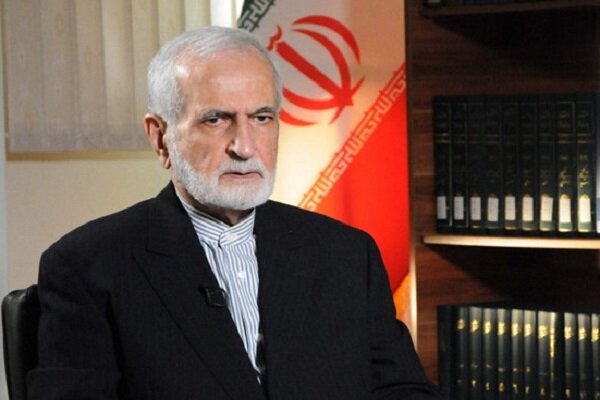
Kamal Khalazi, chairman of Iran’s Foreign and Strategic Council and a senior advisor to Islamic Revolution leader Ayatollah Ali Khamenei, made this remark in an interview on Ayatollah Ali Khamenei’s official website published on Wednesday.
The official recalled the three guiding principles outlined by leaders as the basis for a decent negotiation process worthy of the Islamic Republic’s participation: dignity, wisdom and expediency.
“As long as the negotiations are based on logical grounds and the dignity of the Islamic Republic is respected, we are ready for dialogue as long as nothing is imposed on us. If there is any attempt at imposition, we will counter it,” he said.
Referring to Khamenei’s comments last month when he rejected U.S. demands for nuclear negotiations, Haraj said agreeing to negotiations under duress “is something that no honorable nation would ever do and no sensible politician would ever support.”
He noted that the leaders emphasized that talks with the United States are not in the interests of the Iranian people, since the American side has already predetermined the outcome, namely the cessation of the Islamic Republic’s nuclear activities and nuclear enrichment. “It’s not negotiation. It’s an order, it’s imposition,” Haraj said, quoting Ayatollah Khamenei.
The official went on to elaborate on the three principles leaders outlined as hallmarks of good negotiations.
“Dignity means defending the national honor and avoiding any sense of humiliation. Wisdom means relying on logic and rational argument in dialogue. Expediency means having a realistic understanding of the situation and showing reasonable flexibility to achieve a win-win outcome.”
He added that Iran’s acceptance of indirect dialogue with the United States before the illegal and unprovoked Israeli-American war against Iran erupted in June reflected the Islamic Republic’s wisdom in demonstrating its readiness for dialogue while neutralizing American propaganda accusing Iran of avoiding negotiations.
“Although there were doubts about the sincerity of the other side, the leaders approved the framework for indirect dialogue in order to demonstrate Iran’s logic and goodwill to the world,” Haraj said.
He stressed that through five rounds of indirect talks, no agreement was reached that was contrary to national interests, Iran’s right to enrichment was reaffirmed, and reasonable flexibility was shown when necessary, so Iran’s dignity was fully preserved.
“The 12-day war proved that the West is not committed to logical dialogue.”
But Haraj said the outbreak of a 12-day war in the middle of talks proved that the West was not committed to logical dialogue and was seeking to impose restrictions beyond the nuclear issue.
“Of course, Iran will never negotiate on missile capabilities or (support for) the (regional) Axis of Resistance. We will express our position rationally, but we will never accept forced negotiations.”
Nevertheless, the official said two decades of nuclear diplomacy on the part of the Islamic Republic shows that it has never shied away from diplomacy.
“For us, diplomacy is not a symbol of weakness, but of rationality and strength.”
He cited the country’s legal nuclear countermeasures under former presidents Mohammad Khatami and Hassan Rouhani in response to the other country’s violations.
“This experience has proven that Iran must always be ready to negotiate, but should never accept imposition,” he said.
Recent interactions with Europe aimed at encouraging a withdrawal of efforts to impose nuclear-related sanctions against Iran followed the same pattern, as European countries continued counterproductive pressure despite Iran’s flexibility.
“Western countries’ nuclear condemnation is rooted in a lack of understanding of Iran’s religious culture.”
Elsewhere in his remarks, Mr. Khalaj referred to persistent Western accusations that Iran had “diverted” its nuclear program.
He said these claims were rooted in Western countries’ lack of understanding of the Islamic republic’s religious culture, which led to the issuance of fatwas (religious decrees) prohibiting its leaders from acquiring, producing or possessing nuclear weapons.
“Western countries do not take this fatwa seriously because they do not understand our religious culture and think that Iran may change course in the future,” he said.
“The nuclear issue is just an excuse”
As a good example of Iran’s commitment to non-conventional weapons, he recalled that the Islamic Republic voluntarily implemented the Additional Protocol of the International Atomic Energy Agency (IAEA), allowing the agency to visit nuclear facilities without prior notice.
“The IAEA’s current data confirming that Iran is not pursuing nuclear weapons is precisely the result of these inspections,” he said.
The official stressed that the nuclear issue is just a pretext for the West’s long-standing hostility to Iran’s Islamic revolution and is being used as a means of political pressure.
“Self-reliance is a core principle of the Islamic Republic,” Karaj said in response to a question about whether uranium enrichment was worth enduring sanctions.
“Just as we achieved independence in missiles and defense, we must become self-sufficient in energy. Oil will eventually run out, so the country must develop alternative sources, including nuclear power.”
He added that countries wishing to build nuclear power plants must have the technical capacity to produce the fuel. Otherwise, dependence on foreign suppliers will become a lever of pressure.
“Iran’s long-term goal is to generate 20,000 megawatts of nuclear power,” Haraj said. “The fueling of these reactors must be planned now, because uranium enrichment is Iran’s inalienable right and the basis of its energy independence.”
“Iran’s strong and swift response forced the enemy to surrender.”
“The (Israeli regime) made a grave mistake by acting first,” the official said, noting the development of the 12-day war, which was marked by decisive and successful defense and retaliatory operations by the Iranian armed forces.
“Iran’s strong and swift response forced our adversary to seek a ceasefire.”
“In politics and defence, we must always be prepared for any development. The Islamic Republic relies on the strength of its domestic forces and the determination of its military to ensure its preparedness.”
Khalaj pointed out that in recent wars, Israel has relied on Western weapons and systems, including the American THAAD radar, while Iran has relied on complete independence.
He analyzed the leadership’s performance during the invasion and recalled how Khamenei immediately appointed a replacement after the martyrdom of a senior Iranian commander.
The prime minister also personally addressed the nation in three televised messages, adding that he calmed society and demonstrated that he was in full control of the situation.
According to Haraj, the enemy’s goal was to collapse Iran’s defense apparatus, but due to the leadership’s prudence and timely efforts, the plan was thwarted and the morale of the people stabilized.
MNA