
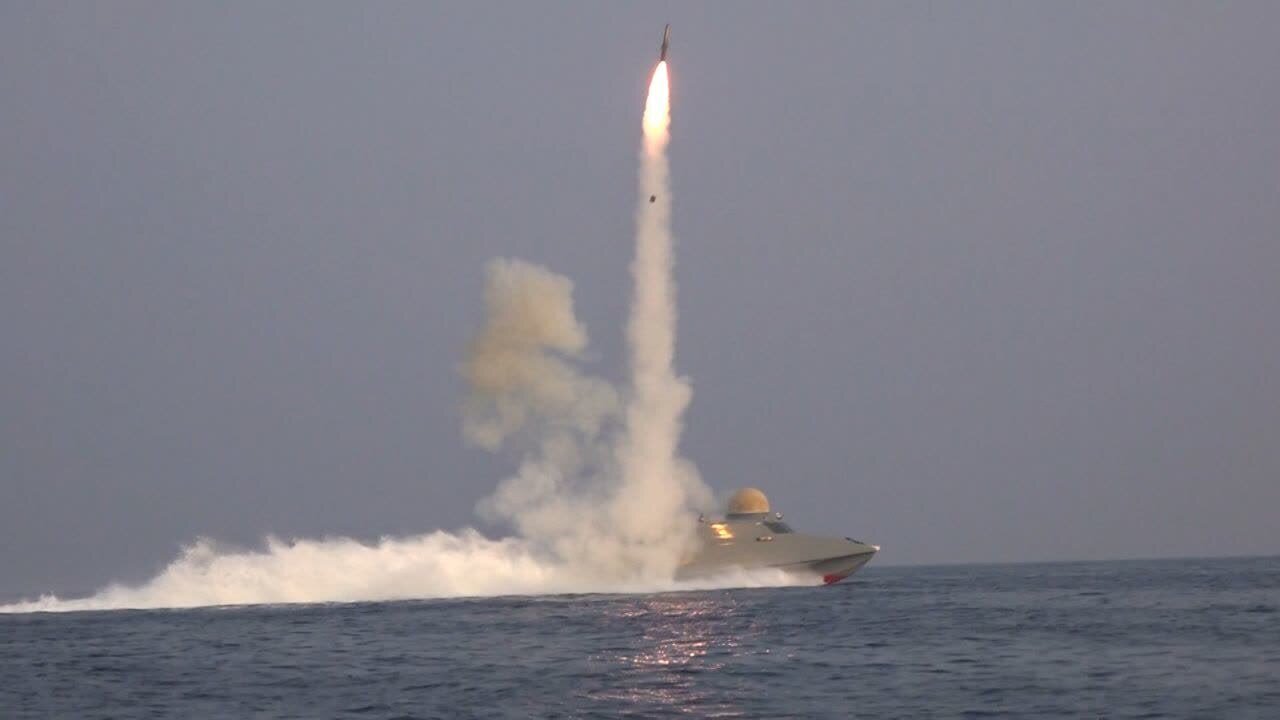
TEHRAN – The commander of the Islamic Revolutionary Guards Corps Navy (IRGC Navy) said that an indigenous missile with a range that exceeds the length of the Persian Gulf was test-fired during a recent naval exercise.
Rear Admiral Alireza Tansiri, commander of the Revolutionary Guards Navy, said in a television interview that the “Eghtedar” (Power) exercise, which was carried out in recent days in the Persian Gulf, Bu Musa, Greater Tunbu, Lesser Tunbu, Siri, the Strait of Hormuz and the Sea of Oman, had achieved all its planned objectives.
“This exercise demonstrated some of the capabilities of the Revolutionary Guards Navy, including missile systems such as air defense missiles and surface-to-surface missiles,” he said.
“For this exercise, we used a missile manufactured by the Revolutionary Guards Navy that has a range longer than the length of the Persian Gulf. This missile has unique features, such as the ability to receive commands after launch,” Tansiri added, referring to the 1,375-kilometre-long Persian Gulf.
He stressed that all the systems used in the training were indigenous. “The other missile used in the exercise was a new type of ballistic missile with very high accuracy. I won’t reveal its name, but the enemy saw through its accuracy.”
Asked if these missiles could engage warships of certain countries with large numbers of fighter jets and protective shields, Tansiri said: “We use weapons on the ground, under water and on the ground, and that’s exactly what they’re for.”
Disputing claims that it was impossible to get close to such warships, he said: “Absolutely not. There were times when we approached them and marked their ships, but they did not see us.”
“We maintain complete surveillance and control throughout the Persian Gulf, and our capabilities allow us to completely monitor Americans,” he said, referring to recently released aerial footage of U.S. warships being monitored by Revolutionary Guard naval drones.
In response to a question about whether foreign warships entering Iranian waters would be escorted, Tansiri said: “They will not enter our waters, they will not enter waters under our control. If they do, we will see a repeat of incidents like the one where 10 American sailors and four more Americans were captured, or the other two cases where British troops were detained.”
In response to a question about the possibility of the conflict escalating into the sea, Iran said it was ready. “I’m not a politician and I have nothing to do with politics. I’m a military man. I study the enemy’s mindset, hostility, and presence in the area and prepare accordingly. And the commander-in-chief of the military always instructs the military to maintain complete readiness.”
Tansiri concluded by warning, “The Iranian people should know that we have no hesitation in dealing with our enemies. Frankly speaking, if our enemies try to violate the assets of this country, what our martyrs entrusted us with, and our national interests, they will definitely receive a severe blow.”
Iranian officials claim the country’s military response to the June War has established a balance of deterrence, but analysts warn that a new confrontation could spread into the maritime domain, particularly the Strait of Hormuz.
The narrow waterway at the entrance to the Persian Gulf is the world’s most important energy chokepoint. Approximately 20 percent of the world’s oil supplies (approximately 17-18 million barrels per day) pass through the strait, as well as large exports of liquefied natural gas, particularly from Qatar.