
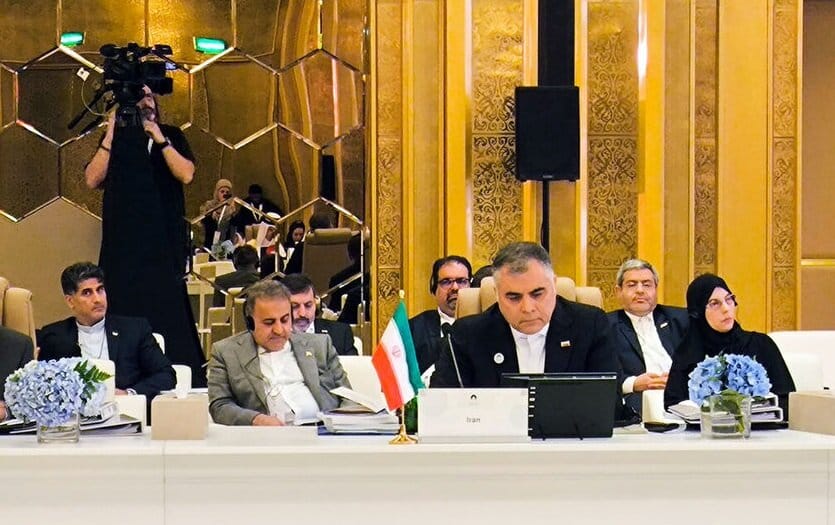
Speaking at the GECF’s 27th Ministerial Meeting in Doha on Thursday, Pakhnejad urged the forum to transform into a more structured and influential organization and proposed evolving it into the Organization of Gas Exporting Countries (OGEC) to better address new energy and policy challenges.
Mr. Paknejad began his speech by expressing his gratitude to Qatar for hosting the conference and for its hospitality, which he held at what he called a “sensitive period for peace and energy security.”
He condemned recent acts of aggression by the “Zionist Israeli regime”, citing attacks on Iranian territory and similar attacks on Qatar, and called on GECF member states to jointly condemn acts such as threats to regional stability and disruptions to global energy markets.
“The Islamic Republic of Iran expects all GECF member states, as members of one family, to condemn the Zionist regime’s aggression against two of its member states,” Paknejad said. “These actions have short- and long-term implications for global order and market stability.”
Turning to the global energy outlook, the Minister highlighted the growing importance of natural gas in ensuring energy security and sustainable development. Citing projections from the GECF Secretariat, he said global gas demand is expected to increase by 32% by 2050, and its share in the global energy mix will rise from 23% to 26%.
He said Iran supports the joint goal of achieving a global natural gas share of 30% by 2050, reflecting the common responsibility of the forum, which holds 70% of the world’s proven reserves, SHANA reported.
Mr. Paknejad also warned of increasing policy pressure to phase out fossil fuels, noting that such moves could undermine global investment in clean gas technologies and jeopardize energy access for developing countries. He reaffirmed that natural gas must be part of the solution to the twin challenges of energy supply and climate change.
He reiterated the themes of the 7th GECF Summit Declaration in Algiers (March 2024), underscoring the Forum’s continued focus on fighting energy poverty, supporting sustainable development and investing in cleaner technologies for gas production.
The Iranian minister strongly criticized the unilateral sanctions imposed on resource-rich countries, calling them “disruption that undermines market stability and increases supply costs.” Pakhnejad said that despite facing increased sanctions, Iran continues to expand its gas production and efficiency programs through domestic innovation and international cooperation.
He called on GECF members to invest in and cooperate with Iran’s natural gas projects, promising that the Iranian government is open to “all forms of joint cooperation.”
Looking ahead, Mr. Paknejad proposed that the GECF establish a high-level dialogue platform between gas producers and consumers to stabilize supply and demand in the global market. To support this, he proposed a restructuring of the Forum to better meet member states’ policy and technical needs, possibly evolving into the Organization of Gas Exporting Countries (OGEC).
He concluded by thanking GECF Secretary-General Mohamed Hamel for his leadership and achievements and reaffirming Iran’s commitment to strengthening cooperation within the Forum as a founding member.
“Through solidarity, dialogue and cooperation, the GECF can play an important role in shaping the development of global energy markets,” Paknejad said. “The Islamic Republic of Iran stands ready to strengthen its active and constructive participation in achieving the common goals of the GECF.”
MNA/