
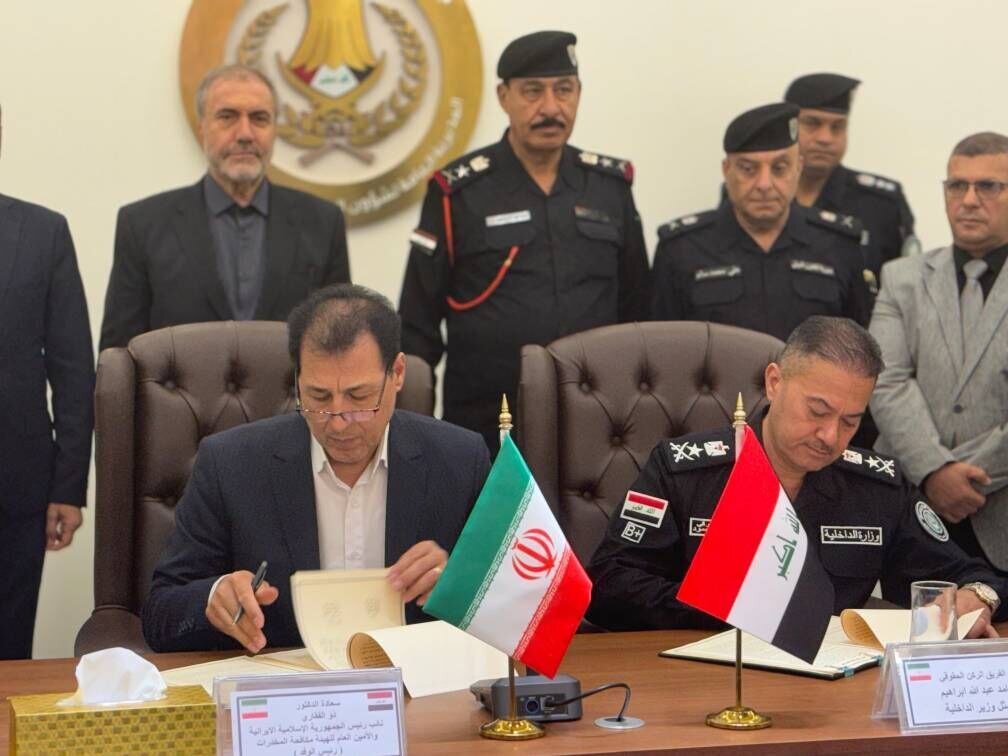
TEHRAN – Iranian and Iraqi officials have signed a memorandum of understanding to promote joint efforts in the fight against illegal drugs.
The MOU was signed on Thursday at the second joint meeting of the Committee on the Commission on the Fighting of Drugs and Psychotropic Drugs in Baghdad.
Brigadier General Hossein Zolfakari, executive director of the Drug Management Headquarters (DCHQ), attended the second meeting at the invitation of Iraqi Health Minister Sale al-Hasnawi, who is also head of the Supreme Committee for the Fighting of Iraq’s Drugs.
The MOU focuses on measures to enhance training, empowerment, security, and technical skills.
It is one of the main goals of the agreement through strengthening border security, holding mutual training workshops, developing the scientific capabilities of experts in demand reduction, prevention, treatment and empowerment, exchanging joint activities, increasing the increase in psychotropic substances and chemicals under international supervision to prevent its use in illegal manufacturing of medicines.
On Wednesday, Zorfakari and Iraqi Home Minister Abdul Amir al-Shamari highlighted the two countries’ commitment to combat drugs as one of the biggest social and security challenges of the present day.
This ominous phenomenon targets national security and social health, particularly the economic stability of young people and both countries. Our shared geography must be a source of prosperity and progress,” the IRNA quoted Zolfaqari as saying.
He detailed his initial achievements in the fight against drugs, saying, “By sharing information and expertise on drugs, we can take effective measures. However, our common enemy is refined, armed and equipped with the latest technology tools.
Officials proposed establishing a joint border security and operational centre with liaison officials from both countries, allowing information exchange in real time and allowing for more accurate coordination of joint missions.
He also expressed preparations for Iran to hold a specialized training course on the latest strategies to detect and fight organized smuggling and money laundering for both Iran and Iraqi anti-drug police.
The development of the Legal Subcommittee was another proposal by Iran. It aims to identify and freeze assets in smuggling networks operating in both countries, and to encourage and promote coordination in the areas of judicial law and protocols.
Joint efforts in the war on drugs should not be limited to land borders. Coordination in monitoring drug trafficking in the Air Force, cyberspace and social networks has a major impact on smugglers.
During his official visit to Iraq, Zolfakari also held a meeting with Iraqi Health Minister Al Hasnawi.
After the meeting, Al Hasnawi said:
This cooperation has progressed to reduce drug smuggling crime in both countries,” Rudaw.net reported.
The meetings are the result of a memorandum signed two years ago between Iraq’s drugs and drugs and psychotropic substances in the Islamic Republic of Iraq, officials added.
An Iraqi government official delved into the details that “the conference’s recommendations are effective, realistic and applicable,” expressing his hopes for “further integration of relations between the two countries, Iraq and its neighbouring countries in order to curb the phenomenon that has invaded society.”
On the last day of the trip, Zolfakari attended a press conference. “The second joint meeting emphasizes adopting a unified approach in the fight against illegal drugs, and the main purpose of this initiative is to enhance security of joint perimeters, exchange information, implement joint missions, reduce drug-related crime and share successful experiences in reducing demand.
Officials stressed that Iran and Iraq are committed to creating safer spaces for their citizens by addressing the challenges posed by drug trafficking. It also improves regional stability.
mt/mg