
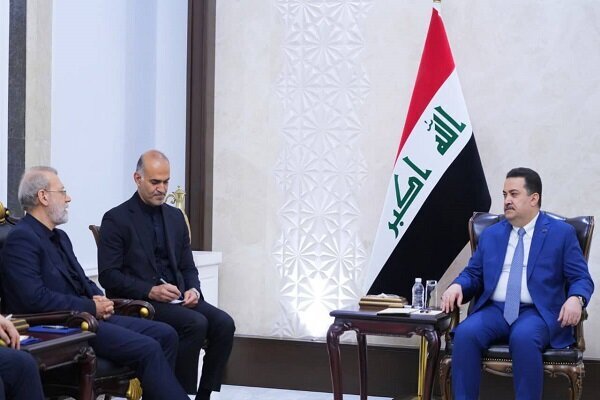
Iran’s Islamic Republic still has a strong presence in the region, and after a 12-day Israeli war, the country’s regional power sphere is not only unlimited, but also expanding. The choice of Iraq as the first destination for Ali Larijani, the new secretary of Iran’s Supreme National Security Council (SNSC), is a clear indication of the importance of relations between the two countries, especially in the context of Baghdad, which was also the first foreign trip of Iran’s President Masuud Pezeshkian. This is a clear indication that Iraq remains Tehran’s strategic priorities.
Iraq was able to overcome internal disruption, occupation, terrorist attacks and infrastructure problems thanks to Iran’s extensive cooperation in the post-Saddam era. In explaining this situation, it should be said that the Islamic Republic of Iran is the most important supporter of saving Iraq from terrorist attacks and ensuring the internal stability and security of the country, and has now placed its neighbors in a position promoted by a country that needs an effective and important security economic partner. As a result, under the shadow of ensuring security and mutual cooperation, epic rituals such as the Irvine Procession of 1 million people make progress without obstacles and challenges.
Iran and Iraq are key pillars of regional security not only because of their 1,458km of common borders, but also because the history of cooperation over the past 20 years has created an accumulation of efforts to protect mutual understanding and interests. Both countries play a very important security role in critical geographical areas, so their stability directly affects the security of energy routes, trade corridors, supply lines and supply chains. They jointly control huge oil and gas reserves. Basra and Kirkuk Iraq, Iran, Huzestan and Offshore Field. Coordinated energy policies could change OPEC dynamics and regional pricing strategies.
Contracts to maintain mutual security
Over the past few years, the development of Iran-Iraqi relations has encompassed all political, economic, social and cultural fields. Undoubtedly, there is another factor for the development of bilateral relations that maintain security, in addition to the historical and cultural background and brotherhood between Muslim peoples in both countries. The pinnacle of security cooperation between Iran and Iraq over the past few years dates back to the signing of the agreement on March 19, 2023.
The main priority and focus of the agreement was to “prevent Iraq from being used as the foundation for hostile and Islamic revolutionary groups, particularly Iraq-Kurdistan.” In addition to political and security officials and agencies, the military took serious action to implement the agreement, and bilateral cooperation has led to counter-revolutionary groups being displaced from the border areas of the Islamic Republic of Iran, and their camps and headquarters have been evacuated.
The achievement of this long-term cooperation has reached a point called common security understanding. This is why Iraqi’s selection authorities Al Arij “openly states that Iran and Iraq’s security are intertwined, and for this reason, Baghdad is willing to implement previous security contracts, but is also preparing for a new one.” Major General Tasin Al-Kafazi, spokesman commander for Iraq’s joint operations, also said Iraq is fully committed to implementing the security contract. Therefore, necessary measures have been taken to prevent the use of Iraqi soil to attack our neighbors. “The Iran-Iraq security agreements reflect strategic alignment in maintaining regional stability, ensuring borders and facing terrorism.
A review of evidence on the ground shows that the Iraqi central government demonstrates a high level of commitment to agreements with Iran and security cooperation, but in reality, challenges have been observed in implementing the agreements related to internal inadequacies and contradictions in the Kurdistan region of Iraq. One of Iran’s most important criticisms in this regard is its inability to provide a basis for disarmament of all hostile groups.
US did not create a cleft between Tehran and Baghdad
Over the past 20 years, the Islamic Republic of Iran has always been in continuous contact with all political groups and currents in Iraq. This is during many times the US has used various tricks to distance all Iraq’s political currents and enforcement agencies from Iraq. However, such a situation has not yet occurred. At the time of the internal political conflict, Iraqi leaders, taking into account the goodwill and fraternity views of all groups, asked Iranian officials to act as mediators and advisors.
Iraq is currently discovering important capabilities for political mediation in the region, and using this important capabilities has resulted in valuable achievements in the relationship of Tehran-Baghdad, and now from the Persian Gulf to the Arab League and other regions, Iraqi diplomatic devices are references to present diplomatic consultations and accurate and fair photographs of the foreign policy goals of Islamic communities. As a result, the US and Zionist regimes naturally look for opportunities to deprive these two influential and effective actors of the region of diplomatic and security cooperation, but it shows that Tehran and Baghdad are too cautious to give such opportunities to their enemies.
MA/6559748