
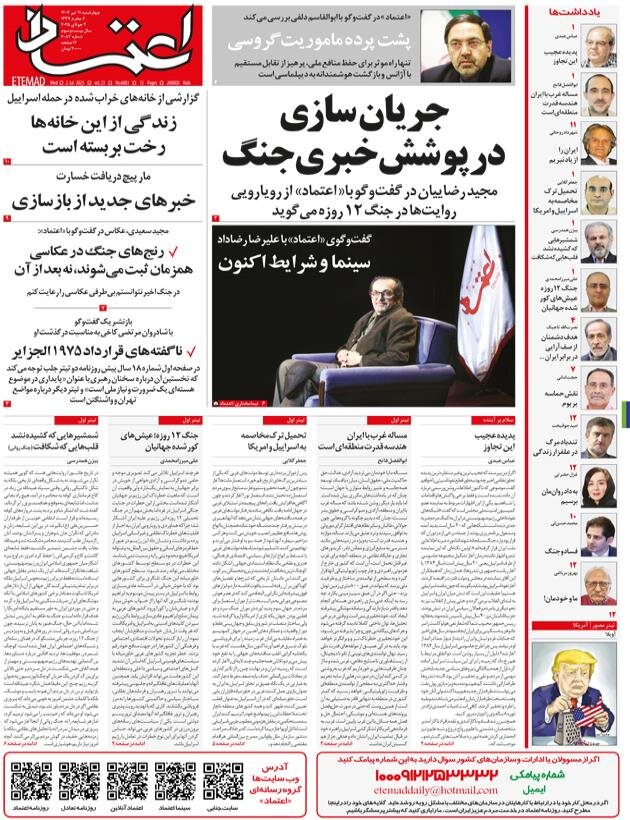
Tehran – Writing an article in the Etemad newspaper, former diplomat Noslatra Tajik said, “In regards to the alleged purpose of aggressive attacks on the territorial integrity of our country in Israel, I must say that the main goal of Israel and the United States is to destroy the balance of the region.
In this context, both countries define specific objectives regarding Iran, including the alleged attempts to halt Iran’s nuclear program and eliminate nuclear capabilities. However, the evidence and indicators, in particular the chosen goals and the nature of operations, clearly demonstrate that these countries, and in particular Israel, are pursuing goals that go beyond the nuclear debate. For example, during these operations a wide range of civilians were targeted, with over 900 people martyred. This indicates that the objectives of recent attacks are far deeper and more dangerous than those officially claimed.
The choice of such a method was particularly first day operations, with complex, complex and multi-layered nature, and apparently designed for the purposes of overthrowing governments or destroying the country. In fact, enemy targets are directed not only at the national level, but also at the regional level that weakens Iran’s position and dismantles the levers of power in the Islamic Republic. Therefore, in this conflict, it can be said that Iran faces more than NATO. The aid of the US Israel and several European countries have all played a role in this alignment. Nevertheless, it is noteworthy that Iran decided to enter negotiations despite no hope of reaching an agreement with the Trump administration. This is an action that shows diplomatic preferences for direct conflict. But what Trump did was essentially a blow to diplomacy, even before the dialogue took shape. This decision not only lacked international legitimacy, but also lacked a legal basis within world order or international law. The US lawsuit effectively trampled and trusted the legal structures and institutions established after World War II.
Iran: Moves towards strategic ambiguity
In the commentary, the Iranian newspaper spoke about the ambiguity of Iran’s negotiations after the war, writing: This war may ultimately strengthen Iran’s position in the region and in diplomacy. Trump and his envoy, Steve Witkov, continue to insist that Iran must abandon uranium enrichment completely, but Tehran firmly states that enrichment is unnegotiable. At the same time, Trump has offered to ease sanctions and allow China to even buy Iranian oil. These contradictory signals reflect deeper reality. Both Washington and Tehran seem to be increasingly focused on stabilizing the situation rather than resolving basic nuclear differences. In reality, both sides may be willing to embrace strategic ambiguity. Rather than seeking to destroy Iran’s nuclear infrastructure, which Trump claims to have destroyed, the US appears to be ready to escalate through diplomacy and economic incentives. Meanwhile, Iran looks like content to maintain existing functionality in a non-transparent way and avoid further escalation.
Kayhan: Missiles, not negotiations
Keehan said it was missiles that protected Iran in Israel’s 12-day war with Iran, not negotiations. It wrote: It was the country’s missile forces that allowed Iran to withstand the current important situation of this war. A missile that not only targeted enemy defense systems, but also transformed the secret base of the region into hell. This was just a small part of Iran’s defensive capabilities. The enemy, who thought Iran could be damaged by some bombs and media wars, has now roamed to Tel Aviv and Haifa, sleeping in nightmares of Iranian missiles. It was these missiles that paralyzed the enemy, not negotiations. Iran’s Islamic Republic pushed the enemy back with military force, aggressive resistance and missile deterrent. Now, the enemy itself reveals in its official confession that Iran’s bombing has been fully adjusted. This is just the beginning, not the end. Because Iran has yet to reveal its main focus. Israel prepares for dark and scary days.
Khorasan: Multipolar Order and Crisis of Trust
In the article, Khorasan tackled the International Atomic Energy Agency’s biased actions on Iran’s nuclear program. It writes: In the current tensions around the world where trust is the most important asset of nuclear diplomacy, regulatory bodies must be fair and reliable. The International Atomic Energy Agency, once known as a technical and impartial authority, is now receiving criticism and accused of prejudice and political activity. Today’s world is no longer unipolar. In such a world, multilateral institutions can only survive by remaining equitable. However, government agencies have lost some of their trust capital in recent years. It shows that supervisor justice has become a victim of politics if countries like Iran have the highest level of cooperation and testing, but regimes like Israel continue to escape from oversight. If an institution wants to regain its status in the international community, it has no choice but to become a technical, transparent and fair institution. Otherwise, it becomes an ineffective organization and symbolizes the failure of global trust building in the not too distant future.