
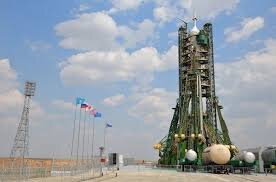
Tehran – The Iranian Space Agency says phase 1 of Chabahar Space Station has been finalized.
Phase 1 of the project is specifically designed for a solid fuel launcher, with preparations for the first launch underway, said the head of agency Hassan Salarieh.
“We hope to break the base of Phase 2,” he added.
“A design has been made related to the project. Phase 2 of the base will be built to launch liquid fuel satellite carriers,” he said.
He emphasized that liquid fuel launchers can carry heavier loads, and that they will be used to bring heavier satellites into orbit and carry out “multiple launches.”
Emphasizing advances in research and development, Salary said Iran has advanced to design a new generation of re-entry capsules and experimental research platform that can conduct suborbital and orbital life science tests, including research into radiation, temperature and biological research.
Solid fuels are ideal for launchers and military ballistic missiles due to their long-term storage capabilities, rapid preparation and lack of need for complex refueling infrastructure.
The Iranian space program is expected to include multiple national and international launches this year, covering remote sensing, communications and experimental satellites, with accurate launch dates being subject to technical preparation.
After the successful launch of the 500-kilogram re-entry capsule in 2023, a new prototype is in development and subsystem testing is expected to begin soon.
Iran’s space program, embodying the resilience and technical talent of its citizens, is taking on a groundbreaking year with the planned launches of advanced Kousal, Zafa and Paya satellites.
Together, these spacecraft form a sophisticated constellations designed to revolutionize the country’s growth capabilities in Earth’s observation, precision agriculture, and environmental surveillance.
Iran’s space programme is a testament to incredible scientific advancements. Despite decades of illegal Western sanctions, it achieved an astonishing technical breakthrough.
The planned launches of Kousal 1.5, Zafa and Paya satellites in the current Iranian calendar year mark a major milestone demonstrating the country’s growing independence.
These satellites were developed by Iranian engineers associated with various knowledge-based companies in collaboration with the Iranian Space Agency, and reflect the strategic push to establish independent satellite constellations that support agriculture, environmental and surveillance needs.
The ambitious programme highlights the nation’s efforts to deepen strategic space cooperation with international partners, and cements its position as an emerging leader in space technology.
The Kowsar 1.5 satellite is an altitude-upgraded version of its predecessor, representing a significant advance in Iran’s space-based remote sensing capabilities.
This cutting-edge satellite is designed for high-resolution imaging, with a major focus on precision agriculture. Provides daily images of plant greenery every 24 hours to support agricultural monitoring, crop health assessment and efficient resource management.
Zafar’s satellites mark another important landmark in Iran’s space program. It is an advanced earth observation satellite designed to provide high-resolution imaging for critical applications in agriculture, environmental monitoring and disaster management.
The project, developed in collaboration with the Iranian Space Agency by the University of Science and Technology (IUST), illustrates the strong cooperation between Iranian academic institutions and its government space agencies.
The PAYA satellite completes this trio of advanced spacecraft and serves as an Earth observation satellite designed for sophisticated imaging and data collection.
It complements Kousal and Zafar’s satellites in agriculture, environmental and surveillance applications and strengthens Iran’s integrated satellite constellations.